Required section · Section 4 of 6
Guided case: a paired draw and a stimulation test
An adult is worked up for suspected adrenal insufficiency. At 07:55 the laboratory draws a paired ACTH and cortisol: the ACTH tube is handled according to the cited assay manufacturer, reference laboratory, or local controlled procedure; its handling requirements cannot be copied between systems; the cortisol tube follows routine serum handling. The paired result comes back as ACTH markedly elevated and cortisol low. Because the two were drawn together and both carry documented handling, the paired pattern is readable: an elevated ACTH alongside a low cortisol points toward a primary adrenal problem, since the pituitary signal is present but the adrenal gland is not responding to it.
That paired result is a screening finding, not a reserve measurement. The clinician orders a cosyntropin (ACTH1-24) stimulation test the same morning to ask the reserve question directly: can the adrenal cortex respond at all if given a maximal exogenous signal? Baseline cortisol is 3.5 ug/dL, drawn immediately before the cosyntropin dose. Cortisol is redrawn at 30 minutes (6.0 ug/dL) and at 60 minutes (8.5 ug/dL) after the dose, per the local controlled protocol.
Both the 30-minute and 60-minute values rise from baseline, showing some adrenal response, but the 60-minute value stays below this assay's stimulated-cortisol cutoff. A response that rises but does not clear the assay's cutoff supports limited adrenal reserve rather than a normal response; it does not, by itself, hand the laboratory a diagnosis. The dose, the exact sampling times, and the exact cutoff number are all set by the local controlled protocol and the assay's package insert, not by a value memorized from any single guideline.
Oral-estrogen-associated CBG elevation can raise total cortisol and affect interpretation of a stimulated total-cortisol result. Dexamethasone and CYP3A4 interactions instead matter in suppression testing; they are not part of this stimulation case.
When reporting a stimulation-test series, state the collection times relative to the dose, not just clock times, so the reader can see the response shape rather than three isolated numbers.
Illustrative drawing — this picture was drawn rather than captured.
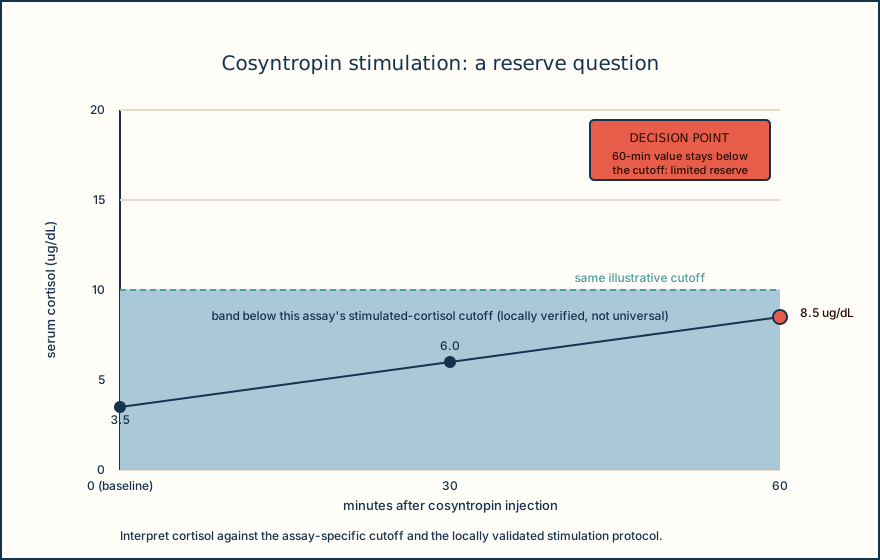
| Time relative to dose | Cortisol (ug/dL) | Relative to this assay's cutoff |
|---|---|---|
| 0 min, baseline | 3.5 | Below |
| 30 min post-cosyntropin | 6.0 | Below |
| 60 min post-cosyntropin | 8.5 | Below |
Knowledge checks
Reading and checks are open. Sign in only to save.
Knowledge check 1
Knowledge check 2
Section status
Finish this section
Reading and checks are open. Sign in only to save.
The module finishes after every required section is marked done and every check in those sections is correct.