Required section · Section 3 of 6
Standardization, equations, and the situations that distort a single result
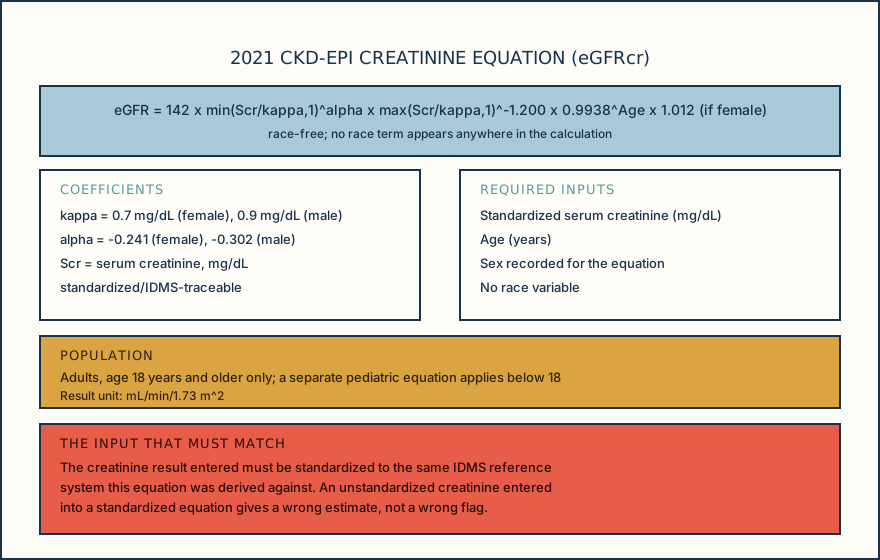
Standardization comes first. The National Kidney Disease Education Program's (NKDEP) Laboratory Working Group recommended that routine creatinine assays, whether Jaffe (alkaline picrate) or enzymatic chemistry, be calibrated so results are traceable to an isotope-dilution mass spectrometry (IDMS) reference measurement procedure. That traceability reduces interlaboratory calibration bias, but it does not remove sample-specific analytical interference. Jaffe methods are more prone to positive interference from non-creatinine chromogens such as protein, glucose, and ketones than enzymatic methods, which are largely unaffected by total protein. An eGFR equation must be paired with a creatinine standardized to the same reference system the equation was derived against; an unstandardized creatinine entered into a standardized equation produces a wrong estimate, not a flagged one.
KDIGO's 2024 guideline recommends race-free GFR estimation: race is not used as a variable in the calculation. For initial adult assessment, KDIGO 2024 supports creatinine-based eGFR (eGFRcr) using the 2021 CKD-EPI creatinine equation, derived and validated for adults 18 years and older. When cystatin C is available, KDIGO 2024 recommends the combined creatinine-cystatin C equation (eGFRcr-cys) for CKD staging, particularly when eGFRcr may be inaccurate or when a threshold-dependent decision, such as staging or drug dosing depends on the result; any transplant or donor evaluation must use the applicable clinical setting and criteria.
A cystatin-C-only equation (eGFRcys) exists and is also race-free, but the combined equation is generally preferred when both markers are available, because combining them improves accuracy over either marker alone. These 2021 equations are adult equations; a separate pediatric estimating approach (the bedside 2009 CKiD, IDMS-traceable Schwartz equation, roughly ages 1 to 16) is required and must not be substituted with the adult equation. NIDDK also lists a separate CKiD U25 equation for ages 18 to 25; its coefficients are a distinct topic and are not reproduced here.
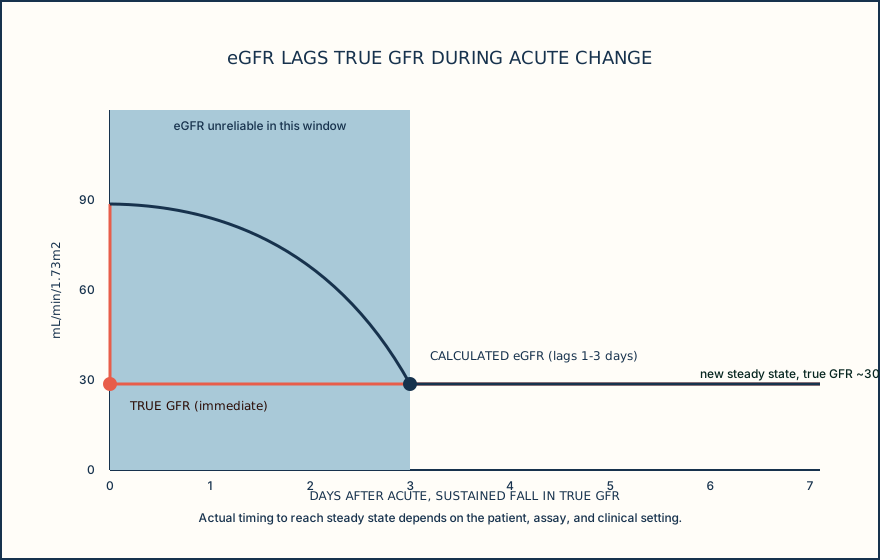
Standard creatinine-based equations assume steady state: a marker concentration that has stopped changing because generation and elimination are in balance. During an acute, sustained fall in GFR, creatinine may take days to approach a new steady state; the exact timing depends on the patient, assay, and clinical setting for moderate reductions in filtration, and can take a week or longer when the reduction is severe. While creatinine is rising toward that new steady state, the calculated eGFR overestimates current true GFR; while creatinine is falling during recovery, the calculated eGFR can lag and underestimate recovering GFR.
KDIGO's 2012 acute kidney injury (AKI) criteria define AKI by a creatinine rise of at least 0.3 mg/dL within 48 hours, at least 1.5 times baseline within the prior 7 days, or urine output below 0.5 mL/kg/h for 6 hours, with staging following whichever criterion gives the higher stage. A single eGFR calculated during that window describes yesterday's kidney more than today's.
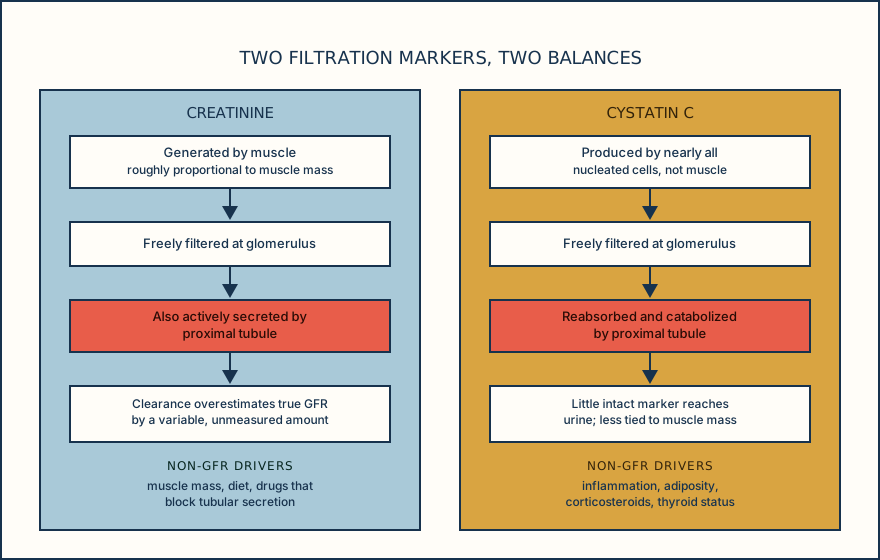
Several non-kidney situations distort a creatinine-based estimate without changing true GFR. Extremes of muscle mass (amputation, malnutrition or muscle wasting, or very high muscle mass), high dietary protein or creatine-supplement intake, and a recent cooked-meat meal are recognized factors; in a controlled study a cooked-meat meal transiently raised serum creatinine and lowered calculated eGFR, with the effect resolving after roughly 12 hours of fasting.
Medications that competitively block tubular creatinine secretion (for example trimethoprim or cimetidine) can raise creatinine and lower calculated eGFR through that same mechanical pathway, not through a true change in filtration; the magnitude of that effect varies by drug and is not quantified further here. Standard CKD-EPI/MDRD-type creatinine equations are also not validated for pregnancy, where renal plasma flow and GFR normally rise while creatinine normally falls, and cystatin C is separately affected by pregnancy-related, non-GFR factors. KDIGO's living-donor guideline lists these situations explicitly as reasons to confirm with cystatin C or a measured GFR before a high-stakes decision.
Cystatin C carries its own caveats at the bench. Hyperthyroidism is associated with higher serum cystatin C and hypothyroidism with lower serum cystatin C in pooled analyses, a direction opposite to what a pure filtration marker would show, though the underlying studies are heterogeneous. The representative Roche Tina-quant Cystatin C Gen.2 assay used in the guided case here is a particle-enhanced immunoturbidimetric method, reported in mg/L, standardized against ERM-DA471/IFCC reference material, with a manufacturer-stated measuring range of 0.40 to 6.80 mg/L; its package insert names thyroid dysfunction and corticosteroid therapy as factors that can affect result interpretation.
Each laboratory follows its own validated assay, reagent, calculation, and local quality-system procedures. Calibration verification, report rounding, and any trigger for recalculation after a lot, software, or method change are governed by the applicable method instructions and local policy, rather than by one universal eGFR schedule.
Before trusting a single eGFR for a threshold-dependent decision, confirm the creatinine is standardized to the equation, that the clinical picture is at steady state, and that no recognized non-GFR factor (muscle mass extreme, recent diet, pregnancy, drug effect, or cystatin C confounder) is in play; if any of those is uncertain, the estimate is a starting point, not the answer.
Illustrative drawing — this picture was drawn rather than captured.
Illustrative drawing — this picture was drawn rather than captured.
Illustrative drawing — this picture was drawn rather than captured.
| Equation | Inputs | Population | Result unit | Race term |
|---|---|---|---|---|
| eGFRcr (creatinine-only) | Standardized Scr, age, sex | Adults 18 years and older | mL/min/1.73 m^2 | None |
| eGFRcr-cys (combined) | Standardized Scr, Scys, age, sex | Adults 18 years and older | mL/min/1.73 m^2 | None |
| Bedside Schwartz (pediatric) | Height (cm), Scr | Roughly ages 1 to 16 years | mL/min/1.73 m^2 | None |
Knowledge checks
Reading and checks are open. Sign in only to save.
Knowledge check 1
Knowledge check 2
Knowledge check 3
Section status
Finish this section
Reading and checks are open. Sign in only to save.
The module finishes after every required section is marked done and every check in those sections is correct.