Required section · Section 4 of 6
Working the paired estimate for today's patient
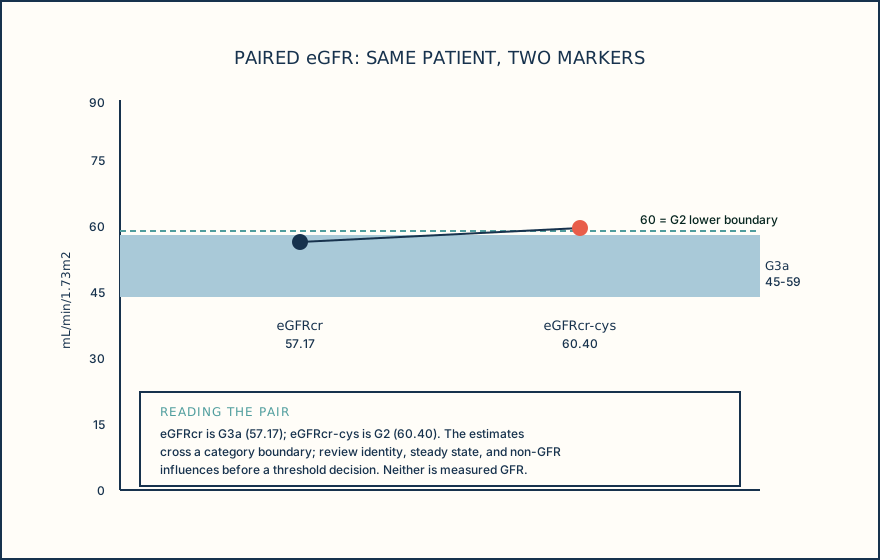
Return to the 61-year-old outpatient from the opening problem. Specimen: serum, collected by venipuncture, no hemolysis noted, received and analyzed within the laboratory's validated stability window. Serum creatinine: 1.10 mg/dL, enzymatic and IDMS-traceable. Age: 61 years; sex recorded for the equation: female. For 2021 CKD-EPI creatinine eGFR, κ = 0.7 mg/dL and α = −0.241: Scr/κ = 1.10/0.7 = 1.571429; min(1.571429, 1)^−0.241 = 1 and max(1.571429, 1)^−1.200 = 0.581362. Age factor: 0.9938^61 = 0.684287. Therefore eGFRcr = 142 × 1 × 0.581362 × 0.684287 × 1.012 = 57.168, rounded to 57.17 mL/min/1.73 m^2.
The creatinine estimate is KDIGO G3a (45–59 mL/min/1.73 m^2) and sits near the 60 mL/min/1.73 m^2 G2 boundary. Because the result will inform a medication decision, cystatin C is added to the same collection. Serum cystatin C is 1.15 mg/L by Roche CYSC2, within that method's stated measuring range of 0.40–6.80 mg/L. For the 2021 CKD-EPI combined equation, κ = 0.7 and α = −0.219: max(Scr/κ, 1)^−0.544 = 0.782016; Scys/0.8 = 1.15/0.8 = 1.4375, so min(1.4375, 1)^−0.323 = 1 and max(1.4375, 1)^−0.778 = 0.754017; 0.9961^61 = 0.787915.
eGFRcr-cys = 135 × 1 × 0.782016 × 1 × 0.754017 × 0.787915 × 0.963 = 60.400, rounded to 60.40 mL/min/1.73 m^2. This crosses the category boundary: eGFRcr is G3a and eGFRcr-cys is G2. Neither is measured GFR. The different estimates require the laboratory and clinician to confirm analytical identity and steady state, then consider non-GFR influences and which estimate—or, for a high-stakes decision, measured GFR—best answers the stated question. A single same-day pair, even after that review, does not establish CKD; diagnosis requires kidney-damage evidence or persistently reduced eGFR for at least 3 months.
A discordant pair is informative, not a serial reflex. Start by confirming the correct patient, specimen, method inputs, standardization, and steady state because a threshold decision cannot be defended from an analytically mismatched or changing result. Then review non-GFR influences such as atypical muscle mass or inflammation and select the estimate or measured GFR that answers the clinical question. The category crossing in this case makes that bounded review appropriate; it is not proof of either a disease diagnosis or a measured filtration rate.
Illustrative drawing — this picture was drawn rather than captured.
| Item | Value | Note |
|---|---|---|
| Age / sex for equation | 61 years / female | No race term used |
| Serum creatinine | 1.10 mg/dL | Enzymatic, IDMS-traceable |
| Serum cystatin C | 1.15 mg/L | Roche CYSC2, in measuring range |
| eGFRcr | 57.17 mL/min/1.73 m^2 | Category G3a |
| eGFRcr-cys | 60.40 mL/min/1.73 m^2 | Category G2; crosses category boundary |
Knowledge checks
Reading and checks are open. Sign in only to save.
Knowledge check 1
Knowledge check 2
Section status
Finish this section
Reading and checks are open. Sign in only to save.
The module finishes after every required section is marked done and every check in those sections is correct.