Required section · Section 5 of 6
Your call: disposition and corrective action
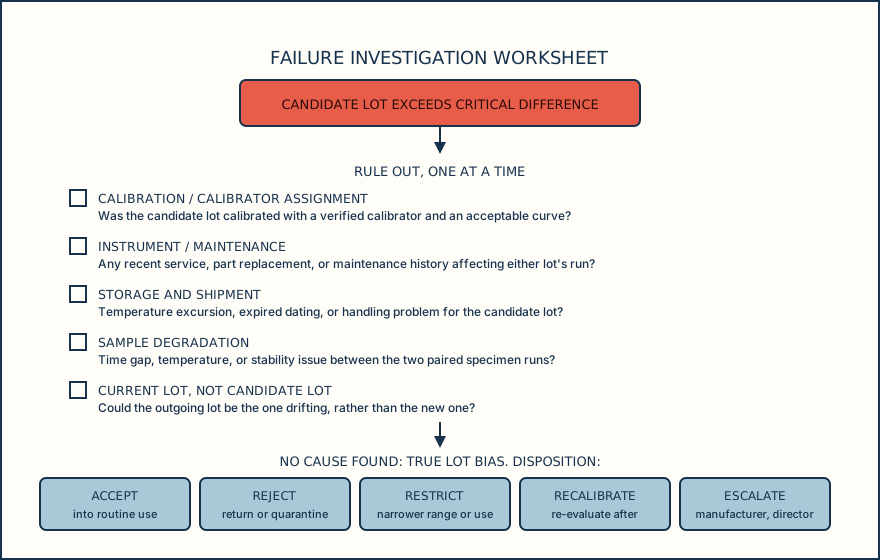
The Stage 2 data are in front of you: six paired specimens, a consistent 2.4 to 5.1 percent positive bias on the candidate lot, QC acceptable on both lots, and one specimen, number 4, whose candidate-lot result of 128 mg/dL crosses the 126 mg/dL decision point while its current-lot result of 122 mg/dL does not. Before this lot can be released for routine patient use, or before it can be pulled entirely, the investigation from the guided example has to run: calibration and calibrator assignment, instrument and maintenance history, reagent storage and shipment, sample degradation, and the possibility that the outgoing lot, not the new one, is the one that has drifted.
The laboratory's bounded dispositions after a lot evaluation are: accept the lot into routine use, reject it and return or quarantine it, restrict its use, for example to a narrower concentration range or a specific patient population, pending further data, recalibrate and re-evaluate, or escalate to the manufacturer and the laboratory director for further action. Each of those is a defensible answer for a different set of investigation findings; there is no single correct disposition independent of what the investigation turns up.
If the investigation finds no calibration, instrument, storage, or degradation explanation, and recalibration with a verified calibrator does not remove the bias, the laboratory is looking at a true lot composition difference at the top end of the tested range, where specimens 5 and 6 sit, and near the 126 mg/dL decision point, where specimen 4 sits. A restrict-and-gather-more-data disposition, or an escalation to the manufacturer with the paired data attached, are both reasonable in that situation; an unqualified accept is not, because the decision-point crossing on specimen 4 has not been explained away.
If the new lot was already placed into routine use before this evaluation finished, or if a verification failure is confirmed after implementation, the laboratory has one more job: define the exact time window and patient population the premature lot use could have affected, and review results from that window with priority given to specimens near medical decision points and critical values, not only to frankly abnormal results. That lookback is a patient-impact review, separate from the accept-or-reject decision about the lot itself.
Write the disposition down with the specific finding that supports it, calibration confirmed clean, storage records clean, bias persists after recalibration, because the next person who reads the record needs to see what was ruled out, not just what was decided.
Illustrative drawing — this picture was drawn rather than captured.
Ordering exercise
A candidate lot's Stage 2 data show a bias that exceeds the laboratory's predefined critical difference near a decision point. Put the failure investigation in the order that rules out explanations before concluding the lot itself is the problem.
1. Conclude true lot bias and choose a disposition
With calibration, instrument, storage, degradation, and current-lot drift all ruled out, treat the difference as a real lot effect and select accept, reject, restrict, recalibrate, or escalate.
2. Check reagent storage and shipment records
Look for a temperature excursion, handling problem, or dating issue specific to the candidate lot.
3. Consider that the current lot, not the candidate, has drifted
Rule out the possibility that the outgoing lot is the one out of specification, not the new one.
4. Check calibration and calibrator assignment
Confirm the candidate lot was calibrated with a verified calibrator lot and the calibration curve was acceptable.
5. Check for sample degradation
Confirm the time gap and storage between the paired current-lot and candidate-lot runs did not let a specimen change in the interim.
6. Check instrument and maintenance history
Review recent service, part replacement, or maintenance events on the analyzer for either lot's run.
Knowledge checks
Reading and checks are open. Sign in only to save.
Knowledge check 1
Knowledge check 2
Section status
Finish this section
Reading and checks are open. Sign in only to save.
The module finishes after every required section is marked done and every check in those sections is correct.