Required section · Section 2 of 6
What a nonconforming event is, and how the response runs
A nonconforming event is broader than an error. It is any occurrence that misses the laboratory's own procedure, misses a regulatory or accreditation requirement, or has affected or could affect the safety of a patient, donor, or staff member. An overridden QC failure fits directly: the procedure required an investigation before release, and that step did not happen.
Related terms describe different slices of the same territory, and the boundaries are not standardized across organizations, so every laboratory defines its own categories for internal consistency. An error is an act of commission or omission that creates the potential for an undesirable outcome; it may or may not cause harm. A near miss (close call) is a hazardous event or unsafe condition that did not reach or harm the patient, only because of chance, timely detection, or intervention. An adverse event is patient harm caused by care rather than by the underlying condition, and harm can occur without any error at all. A preventable adverse event is one caused by an error or by failure to use an accepted prevention strategy. A sentinel event is an adverse event involving death or serious harm that signals the need to examine underlying system problems; it is the threshold that typically triggers a full root cause analysis rather than a scaled investigation.
CLSI QMS11 crosswalks nonconforming-event management to complaint handling, control of nonconforming work, corrective action, and records of nonconformity as connected parts of one quality system, not a standalone form you fill out once and file away. The response itself follows a consistent sequence regardless of what triggered it or how it was found.
The map below names each stage in order. Steps 1 through 4 establish what happened and stop the bleeding. Steps 5 through 7 find out why and confirm the fix worked. A learner working any nonconforming event, from a QC override to a mislabeled specimen to a recalled reagent lot, walks the same seven stages.
Name the event by what happened and what it touches, not by who you think caused it; the category decides who gets notified and how fast, the cause comes later.
Illustrative drawing — this picture was drawn rather than captured.
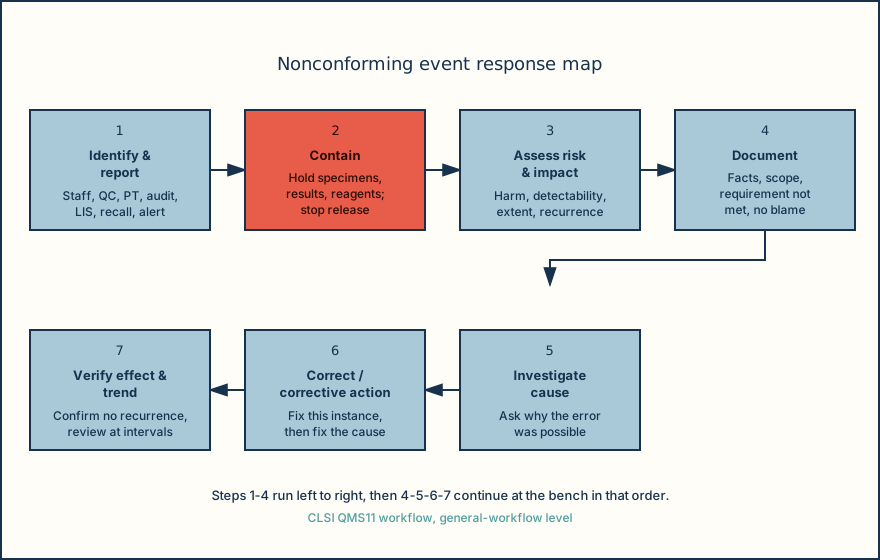
The seven-step nonconforming event response, applied to any detection source.
Identify and report
Recognize the event from staff observation, QC, proficiency testing (PT), audit, complaint, instrument alarm, laboratory information system (LIS) flag, recall, or external alert, and report it to the person your local policy names.
Contain
Hold or quarantine affected specimens, reagents, or results and stop further release or use pending assessment. This is immediate correction, not yet corrective action.
Assess risk and impact
Triage by potential harm, detectability, extent, and recurrence to decide how deep the investigation needs to go.
Document
Record the event number, date and time discovered, reporter, description of what happened, the requirement not met, immediate action taken, and affected items, as facts separate from interpretation or blame.
Investigate cause
Ask why the error was possible, not only whether one occurred. Check whether training, staffing, equipment, procedure clarity, or information systems were adequate.
Correct and take corrective action
Fix the immediate problem (issue a corrected report, discard an affected reagent) and separately address the underlying cause (procedure revision, retraining with competency reassessment) to reduce recurrence.
Verify effectiveness and trend
Confirm no recurrence over a defined monitoring period, review the quality-indicator trend, and close the record with that objective evidence attached.
Knowledge checks
Reading and checks are open. Sign in only to save.
Knowledge check 1
Knowledge check 2
Section status
Finish this section
Reading and checks are open. Sign in only to save.
The module finishes after every required section is marked done and every check in those sections is correct.