Required section · Section 2 of 6
Mental model: five layers of authority
U.S. laboratory regulation is layered, and each layer does a different job. At the base is federal statute and regulation: CLIA itself and its implementing regulation, 42 CFR Part 493, administered by CMS (Centers for Medicare & Medicaid Services). This layer sets the national floor. Every CLIA-certified laboratory in the country must meet it, regardless of which state it sits in or which accreditor it uses.
Above the regulation text sits CMS interpretive guidance, which explains how CMS surveyors apply the regulation in practice. Guidance is not itself a separate law; it interprets the existing one. Next is the deemed accreditor layer: CMS approves certain accreditation organizations, currently including CAP, The Joint Commission, AABB, A2LA, ACHC, ASHI, and COLA, to inspect on CMS's behalf. This is called deemed status. An accreditor's checklist may equal or exceed the CLIA condition-level regulation, and CAP explicitly states its checklists commonly meet or exceed CLIA requirements, but the accreditor's standard is not itself the statute, and the laboratory remains subject to CLIA, proficiency testing, and other applicable federal and state requirements regardless of which accreditor it uses.
Above or beside the federal layer, state law can impose independent, sometimes stricter, requirements, and two states have CMS-approved exemption arrangements: Washington operates its own Medical Test Site licensing program as a full CLIA exemption, and New York's Clinical Laboratory Evaluation Program is a partial exemption covering only the activity within its approved licensure. An exemption is not the same as no oversight; it substitutes state licensure oversight for the federal certification process, and the laboratory still has to meet its state program's requirements. At the top, closest to daily work, is the laboratory's own written policy, which fills in procedural detail the higher layers leave open, such as exact competency-assessment intervals or new-hire training checklist length, but cannot lower the floor set below it.
The process map below names these five layers in order. Knowing the order matters because the most common overclaim in this area is skipping a layer: reading an accreditor checklist requirement and calling it federal law, or reading a state licensure rule and assuming it applies nationally. Before citing a requirement, name which of the five layers it actually comes from.
Illustrative drawing — this picture was drawn rather than captured.
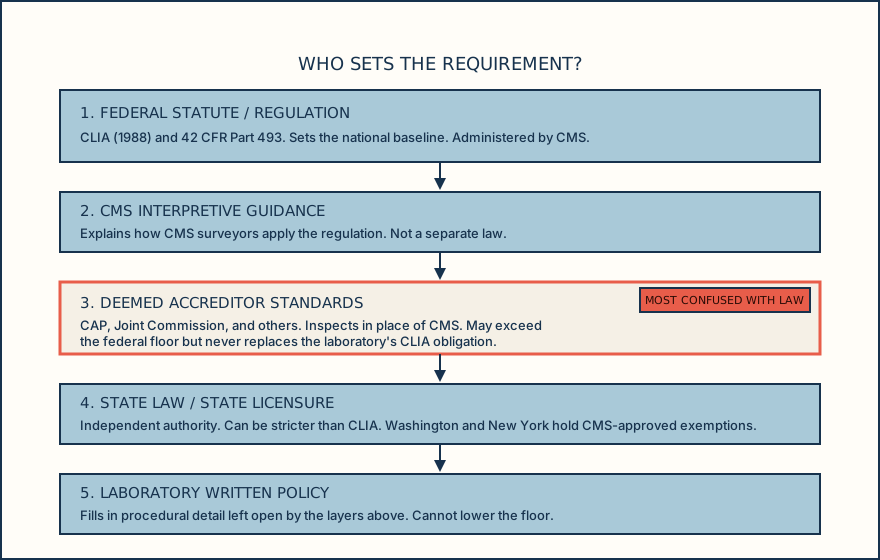
The five layers a requirement can come from, checked in order before treating a rule as fixed.
Federal statute and regulation
CLIA (1988) and 42 CFR Part 493, administered by CMS. Sets the national baseline every CLIA-certified laboratory must meet.
CMS interpretive guidance
Explains how CMS surveyors apply the regulation. Interprets the statute; it is not a separate law.
Deemed accreditor standards
CMS-approved organizations such as CAP inspect in place of CMS. Checklists may meet or exceed the federal floor but never replace the laboratory's underlying CLIA obligation.
State law and licensure
Independent authority that can be stricter than CLIA. Washington and New York hold CMS-approved exemption arrangements that substitute state licensure for separate federal certification.
Laboratory written policy
Fills in procedural detail left open above, such as exact competency-assessment timing. Cannot lower any requirement set by the layers above it.
Knowledge checks
Reading and checks are open. Sign in only to save.
Knowledge check 1
Knowledge check 2
Section status
Finish this section
Reading and checks are open. Sign in only to save.
The module finishes after every required section is marked done and every check in those sections is correct.