Required section · Section 3 of 6
Complexity, certificates, and personnel roles
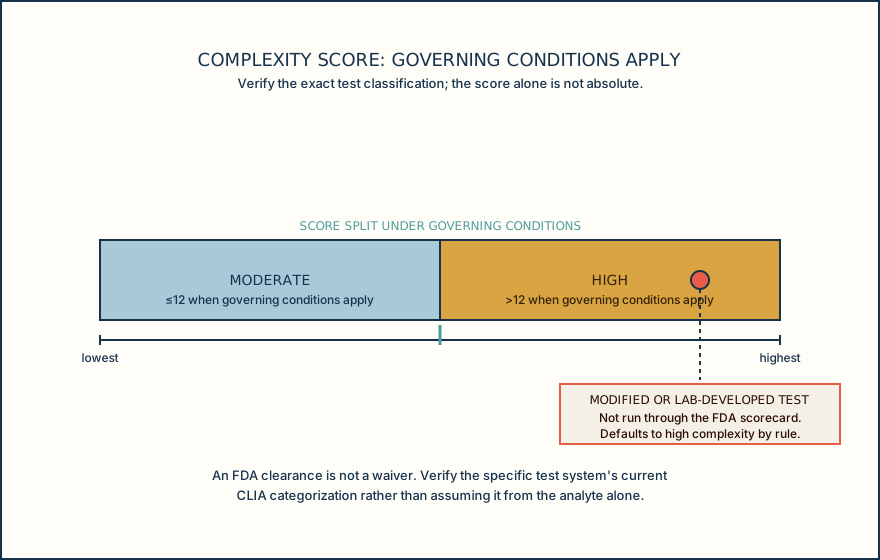
Use the governing complexity criteria for the exact test system. Where the applicable regulatory conditions assign a score of 12 or less, the test is moderate complexity; where they assign a score above 12, it is high complexity. The score alone is not an absolute classification outside those governing conditions.
An FDA clearance or approval does not by itself make a test waived; waived status requires a specific waiver determination, by regulation, by over-the-counter or home-use clearance, or through a CLIA Waiver by Application, so the laboratory has to verify the current categorization of the exact test system rather than assume it from the analyte. A laboratory-developed test, or any test run modified from the manufacturer's instructions, is categorized by default as high complexity, because it was never run through the FDA scorecard as cleared.
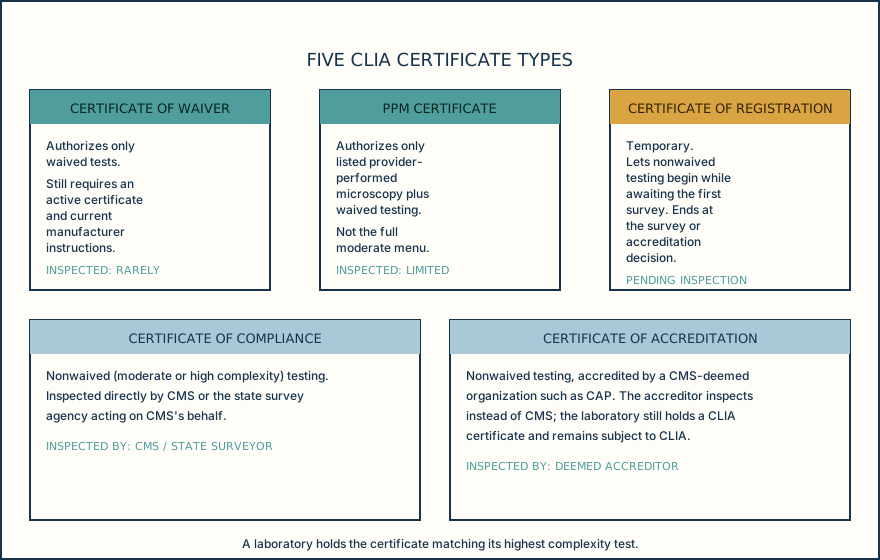
The certificate a laboratory holds has to match its highest complexity testing. There are five CLIA certificate types. A Certificate of Waiver authorizes only waived tests; it does not exempt the facility from CLIA, and the laboratory still needs an active certificate and current manufacturer instructions. A Certificate for Provider-Performed Microscopy authorizes only the specific listed PPM procedures, generally bright-field or phase-contrast microscopy, plus waived testing; it is not a general moderate-complexity certificate.
A Certificate of Registration is temporary, letting a laboratory begin nonwaived testing while it awaits its initial inspection, and it ends when a Certificate of Compliance or Certificate of Accreditation is issued. A Certificate of Compliance follows direct inspection by CMS or a state survey agency acting for CMS. A Certificate of Accreditation follows accreditation by a CMS-deemed organization, which inspects in place of CMS, though the laboratory still holds a CLIA certificate and stays subject to CLIA regardless.
For a personnel decision, work from the candidate record: determine the test complexity and role; open the current primary pathway; verify credentials, transcripts, and experience; apply state and accreditor overlays; then assess the appointment date. Do not treat a job title or a memorized pathway as verification.
For a potential grandfathering pathway, resolve the appointment date and continuous service from the current primary text. Do not rely on memorized 2024 wording.
If state law bars an otherwise matching federal pathway, do not appoint under that pathway. Use an allowed route or escalate the record under the current process.
Because of that recent change, do not memorize a personnel pathway as fixed; verify the current eCFR (Electronic Code of Federal Regulations) text and the applicable date at the time of appointment. Match the test's complexity to the correct numbered section first, then match the candidate's exact credential to a numbered pathway inside it, rather than to a general impression that the degree "sounds right."
Illustrative drawing — this picture was drawn rather than captured.
Illustrative drawing — this picture was drawn rather than captured.
| Certificate | Authorizes | Inspected by | Notes |
|---|---|---|---|
| Certificate of Waiver | Waived tests only | Rarely inspected | Still requires an active certificate and current manufacturer instructions |
| PPM Certificate | Listed provider-performed microscopy plus waived tests | Limited inspection | Not the full moderate-complexity menu |
| Certificate of Registration | Nonwaived testing, temporary | Pending initial survey | Ends when Compliance or Accreditation is issued |
| Certificate of Compliance | Nonwaived testing (moderate or high) | CMS or state survey agency | Direct federal or state inspection |
| Certificate of Accreditation | Nonwaived testing (moderate or high) | CMS-deemed accreditor | Laboratory still holds a CLIA certificate and stays subject to CLIA |
| Role | CFR section | Core function |
|---|---|---|
| Laboratory director | 493.1443 | Overall responsibility; qualified by pathology board certification, physician experience, or qualifying doctoral degree with experience |
| Technical supervisor | 493.1449 | Specialty/subspecialty technical oversight; may be filled by the director if qualified |
| General supervisor | 493.1461 | Day-to-day supervision of testing personnel; assumes responsibility when director and technical supervisor are absent |
| Testing personnel | 493.1489 | Performs the testing; qualified by degree pathway matched to the specific role, including an alternate pathway for blood gas analysis |
Knowledge checks
Reading and checks are open. Sign in only to save.
Knowledge check 1
Knowledge check 2
Knowledge check 3
Section status
Finish this section
Reading and checks are open. Sign in only to save.
The module finishes after every required section is marked done and every check in those sections is correct.