Required section · Section 5 of 6
Repair the change record
A different laboratory drafted its own change-control record for a similar revision. Read it as a reviewer would, before it goes to the director for approval. Document ID: HEMA-SOP-009, "Manual Differential Slide Review." Draft version: 4. Draft text of the revised step: "Review the slide and note anything unusual." Approver listed on the change form: laboratory technical supervisor. Effective date: left blank, to be set "whenever convenient." Prior version 3 status: "still in binder, will remove eventually." Training action: "none needed."
This draft has more than one defect, and the exercise below asks you to place its lifecycle steps in the order the record should actually follow, and the checks that follow ask you to identify the defects and the fixes a reviewer should require before this document is fit to approve.
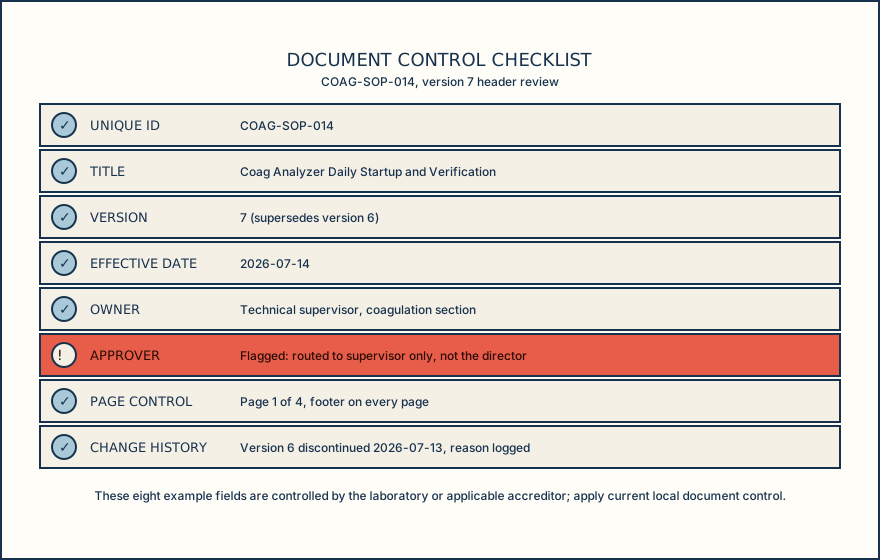
Notice what is missing compared to the COAG-SOP-014 example: the revised step gives no measurable criterion and no defined action if a slide review turns up something unusual, the listed approver is not the laboratory director, the effective date is not set, the superseded version has no discontinuance plan, and the training action was set without asking whether the change affects an acceptance criterion staff must apply.
A change-control record is itself a controlled document; if the record does not show a measurable step, the director's approval, a set effective date, and a plan to remove the old version, treat the revision as not yet ready to use.
Illustrative drawing — this picture was drawn rather than captured.
Ordering exercise
Put these steps for revising HEMA-SOP-009 in the correct controlled-document order, from the trigger for change through protecting the superseded version.
1. Director approval
The current laboratory director signs and dates approval of the revised version; this cannot be delegated to the supervisor.
2. Trigger identified
A reviewer or supervisor notices the differential slide-review step lacks a measurable criterion and flags a need to revise.
3. Staff notified, effective date set
Staff are notified of the change before the stated effective date, giving them time to read the new version.
4. Draft written
The document owner rewrites the step with a measurable criterion and a stated action, and sets a proposed effective date.
5. Prior version retired
The superseded version is dated as discontinued and pulled from the active bench location so no one can act on it by mistake.
6. Technical review
A qualified reviewer checks the draft step for accuracy before it goes to the director.
Knowledge checks
This section has no knowledge checks.
Section status
Finish this section
Reading and checks are open. Sign in only to save.
The module finishes after every required section is marked done and every check in those sections is correct.