Required section · Section 4 of 6
Worked example: reorder point, unit cost, and capital versus rental
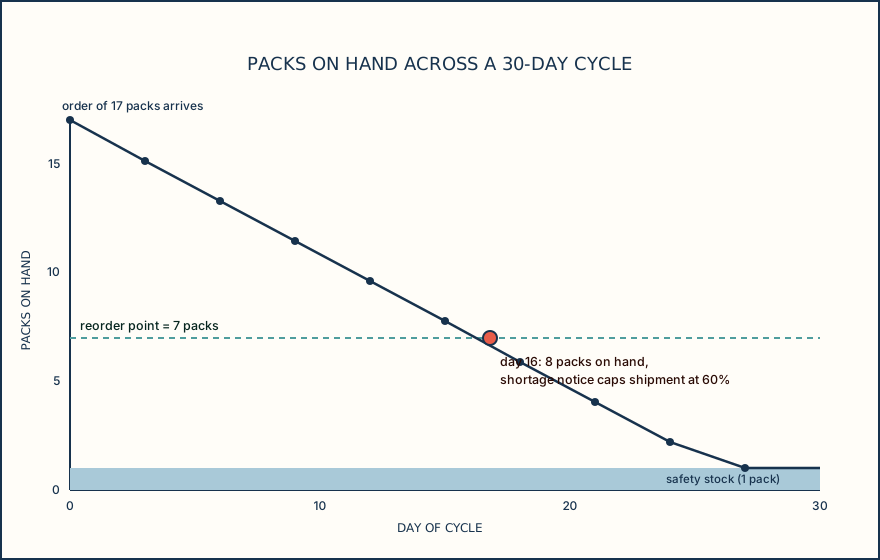
Chemistry runs a high-sensitivity troponin I immunoassay on a fixed analyzer platform. Average daily consumption is 1,528 tests per month divided by 30 days, about 50.9 tests per day, or 0.55 packs per day at 92 reportable tests per pack. Vendor lead time is 10 calendar days, so lead-time demand is about 0.55 times 10, roughly 5.5 packs. From 90 days of consumption history, daily demand standard deviation is 8 tests per day, or 0.087 packs per day.
The standard operations-management formula is reorder point equals average demand during lead time plus safety stock, and safety stock equals z times the standard deviation of demand times the square root of lead time, where z is the factor for a chosen service level. At a 95 percent service level, z is about 1.645. A 95% service target still leaves a nonzero chance of stockout; when shortage risk appears, follow the current shortage and escalation procedure rather than treating the reorder point as a guarantee.
Safety stock equals 1.645 times 0.087 packs per day times the square root of 10, about 0.45 pack, rounded up to 1 whole pack because inventory is only ordered and held in whole packs. Reorder point equals 5.5 plus 1, about 6.5, so this laboratory reorders when on-hand inventory reaches 7 packs. This is standard supply-chain mathematics applied to a laboratory setting; it is not a CLSI-mandated number, and the chosen service level is a local policy decision tied to how critical the item is.
Unit cost: a pack costs $850 and yields 92 reportable tests, so the reagent variable cost is $850 divided by 92, about $9.24 per test. The analyzer is owned outright: $180,000 purchase price plus $10,000 installation, over a 5-year useful life with straight-line depreciation, is $190,000 divided by 5, or $38,000 per year. A service contract adds $24,000 per year. At an annualized volume of 1,528 tests per month times 12, or 18,336 tests per year, depreciation adds about $2.07 per test and the service contract adds about $1.31 per test. Adding a $1.50 per test labor and QC allowance gives a fully loaded ownership cost of about $9.24 plus $2.07 plus $1.31 plus $1.50, roughly $14.12 per test.
A competing reagent-rental proposal quotes $17.50 per test, all-inclusive of reagent, instrument access, and service, with no capital outlay. At this laboratory's volume, ownership is cheaper per test, but ownership required the up-front $190,000 and carries the utilization risk if volume drops, since depreciation and service cost do not shrink when test volume falls. Reagent rental removes the capital requirement and shifts utilization risk to the vendor, at a higher steady-state per-test price. Comparing the two options correctly requires the fully loaded cost per actual reportable test, not the list reagent price alone, because reagent price is only one component of either model.
The reorder point protects against running out during the lead-time window, and the ownership-versus-rental decision depends on volume, capital availability, and who should carry the risk if volume changes, not on reagent price alone.
Illustrative drawing — this picture was drawn rather than captured.
| Cost component | Ownership ($/test) | Reagent rental ($/test) |
|---|---|---|
| Reagent | 9.24 | included |
| Depreciation ($190,000 over 5 years, 18,336 tests/year) | 2.07 | not applicable |
| Service contract ($24,000/year) | 1.31 | included |
| Labor/QC allowance | 1.50 | included |
| Total fully loaded cost | 14.12 | 17.50 |
Knowledge checks
Reading and checks are open. Sign in only to save.
Knowledge check 1
Knowledge check 2
Knowledge check 3
Knowledge check 4
Section status
Finish this section
Reading and checks are open. Sign in only to save.
The module finishes after every required section is marked done and every check in those sections is correct.