Required section · Section 2 of 6
What a monthly reagent cycle actually consumes
A laboratory performing nonwaived testing is required to have adequate space, equipment, instruments, reagents, and supplies for the testing it performs (42 CFR 493.1101). Meeting that requirement in practice means running a forecast-to-order cycle every month for every critical reagent, not just reacting when the shelf looks thin.
The cycle has four steps, shown in the diagram below. First, forecast patient test volume from historical order counts, seasonality, and any known growth trend or menu change. Second, add every non-patient consumption source: QC run on schedule, calibration events tied to new reagent lots, and a repeat-testing rate for dilutions, instrument flags, and delta-check follow-up. Third, convert total test consumption into pack quantity using the laboratory's own, locally verified effective yield per pack, not the manufacturer's label claim, because dead volume and onboard stability loss reduce the number of reportable results a pack actually delivers. Fourth, round up to whole packs, because a laboratory cannot order a fraction of a reagent pack.
The laboratory director carries responsibility under 42 CFR 493.1407 for ensuring the laboratory has sufficient, appropriately qualified staff and that quality control and proficiency testing remain effective. Reagent adequacy and staffing adequacy are two halves of the same operational-readiness requirement: a fully stocked shelf with nobody trained to run the assay is not a functioning laboratory, and neither is a fully staffed bench with no reagent on hand.
Every monthly forecast starts from patient order volume, but total consumption—patient tests plus QC, calibration, and repeats, divided by the laboratory's real pack yield—drives the order.
Illustrative drawing — this picture was drawn rather than captured.
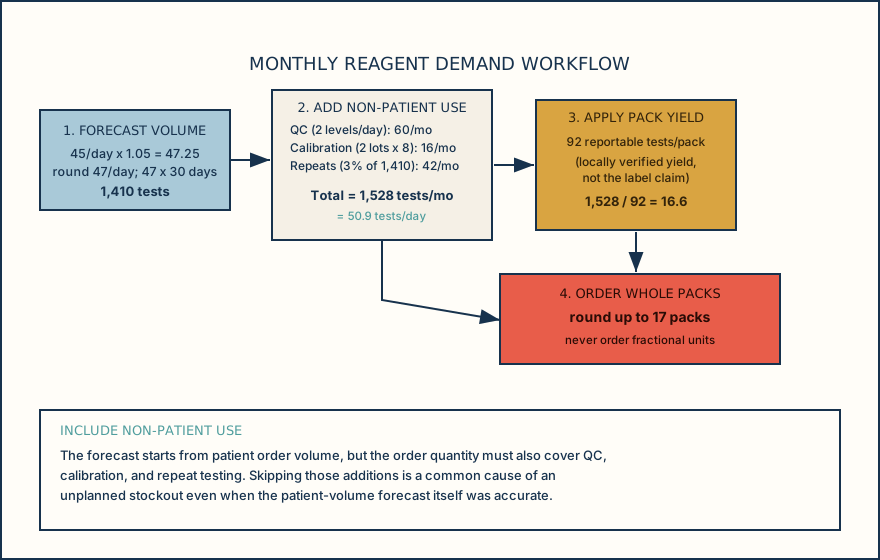
Four-step monthly reagent demand workflow, from forecast volume to a whole-pack order quantity
Forecast patient volume
Start with 45 orders/day and 5% growth: 45 × 1.05 = 47.25; round to 47 orders/day, then calculate 47 × 30 = 1,410 forecast patient tests.
Add non-patient consumption
Add QC run on schedule, calibration events for new lots, and a repeat-testing rate. Example: 60 QC tests plus 16 calibration tests plus 42 repeat tests brings total monthly consumption to 1,528 tests.
Apply the laboratory's verified pack yield
Divide total consumption by the locally verified reportable-tests-per-pack figure, not the manufacturer's label claim. Example: 1,528 tests divided by 92 reportable tests per pack equals 16.6 packs.
Round up to a whole-pack order
Reagent ships in whole packs, so round the calculated quantity up. Example: 16.6 packs becomes an order of 17 packs for the month.
Knowledge checks
This section has no knowledge checks.
Section status
Finish this section
Reading and checks are open. Sign in only to save.
The module finishes after every required section is marked done and every check in those sections is correct.