Required section · Section 3 of 6
Make the count representative before making it precise
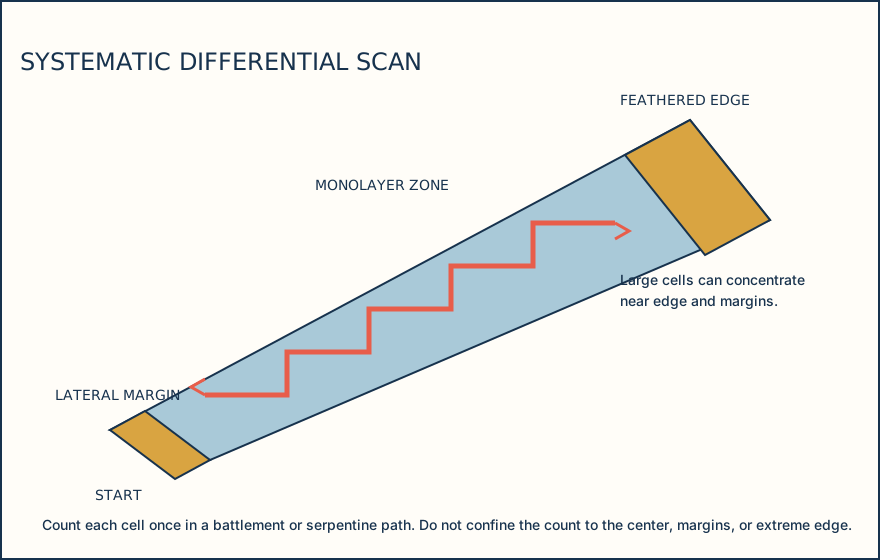
Perform the differential in the monolayer, the smear zone where red cells are mostly touching in one layer without excessive overlap. A battlement path is a systematic stepwise field-to-field route, and a serpentine path is a systematic alternating left-to-right and right-to-left route; either prevents recounting when each leukocyte is counted once. Larger, less deformable cells concentrate near smear edges because spreading flow displaces them laterally and they do not deform through the thinning film as readily as RBCs.
A 100-cell differential is a common baseline, not a universal rule. Sampling imprecision is intrinsic: if the true lymphocyte proportion is 20%, repeated 100-cell counts can fall roughly from 12% to 28% by chance. Rare populations are even less stable, and a true 1% population can be counted as zero in about 37% of 100-cell differentials. A 200-cell count narrows the spread and improves rare-cell detection, while taking more bench time.
Band reporting and routine count size belong to the local procedure. Clearly earlier immature granulocytes remain distinct categories even where bands are combined with segmented neutrophils, and any left-shift wording follows local policy. CLIA proficiency testing requirements describe event acceptability, not a universal patient-reporting interval or a substitute for competent smear review. A systematic path through a representative zone prevents a biased count before statistics can help.
Illustrative drawing — this picture was drawn rather than captured.
Ordering exercise
Put these actions in the order that supports a representative manual differential.
1. Review totals
Check category totals, morphology notes, and the reason for any extension.
2. Classify one cell
Use multiple morphologic features and increment one category.
3. Choose monolayer
Locate the zone with mostly touching, nonoverlapping red cells.
4. Advance to next field
Move along the path without returning to a counted field.
5. Start systematic path
Begin a battlement or serpentine pattern.
Knowledge checks
Reading and checks are open. Sign in only to save.
Knowledge check 1
Knowledge check 2
Section status
Finish this section
Reading and checks are open. Sign in only to save.
The module finishes after every required section is marked done and every check in those sections is correct.