Required section · Section 3 of 6
Reading matrix, edges, focus, and cargo
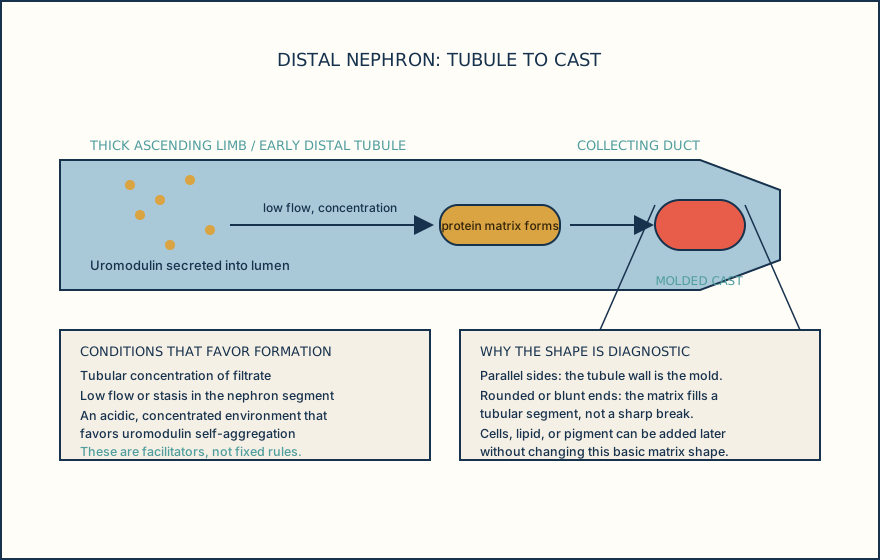
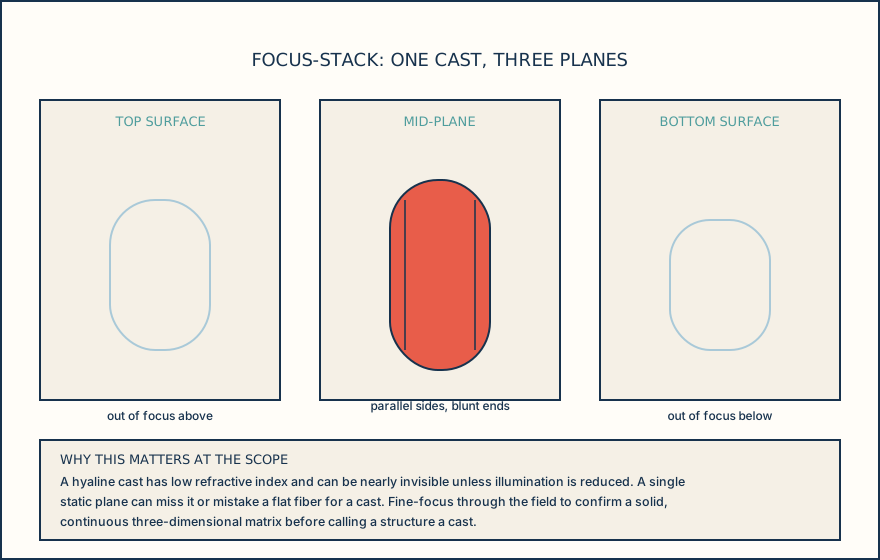
Hyaline casts are colorless with a low refractive index and can be difficult to see by routine brightfield microscopy. Reducing illumination, or using phase-contrast microscopy where available, improves visibility of a transparent matrix that would otherwise blend into the background; which approach is used is a local method decision. Because a cast has a genuine three-dimensional matrix, focusing up and down through the structure should keep the parallel sides and blunt ends in view at multiple planes, which is part of the morphology assessment and not an optional step.
Granular casts contain fine or coarse granules embedded in the matrix. The distinction between fine and coarse is a continuum in granule size and prominence, not two biologically discrete entities, so do not force a borderline structure into one bin or the other when the local procedure allows a combined or intermediate call. Granular casts commonly arise from degeneration of cellular material trapped in a matrix and are interpreted together with the rest of the sediment rather than read as a diagnosis on their own.
Cellular casts are defined by intact cells embedded in the matrix: red blood cell, white blood cell, or renal tubular epithelial cell casts, named for the incorporated cell type. A clump of cells sitting next to each other in the field does not establish a cellular cast unless those cells are enclosed within a recognizable cast matrix. Cells inside a forming cast can degenerate over time, so an evolving cellular cast can appear mixed with granular features rather than showing clean, intact cells throughout.
Fatty casts contain lipid droplets, oval fat bodies, or cholesterol crystals within the matrix. Cholesterol and cholesterol esters can produce a Maltese-cross pattern under polarized light, which is a useful confirming feature but does not identify every lipid droplet, so its absence does not rule out fat. Waxy casts are relatively homogeneous and highly refractile, with sharp or notched margins and indented or cracked edges; this appearance can occur across segments of an otherwise cellular or granular cast, which is why a mixed-cast description is sometimes the accurate call rather than forcing one category label.
Broad describes width, not composition. A broad cast may be waxy, granular, or mixed, and broad casts are commonly associated with formation or retention in a dilated distal nephron segment or collecting duct, though the microscopic finding alone does not establish a diagnosis by itself. Delayed examination matters here too: alkaline, low-osmolality urine can dissolve or disintegrate a cast's protein matrix over time, so a specimen held too long before the sediment is read can show reduced cast recovery and altered morphology compared with a promptly examined specimen.
Name the matrix and edge behavior first, then read the cargo, because cargo without a confirmed matrix is not a cast category, it is an unclassifiable structure that needs review.
Illustrative drawing — this picture was drawn rather than captured.
Illustrative drawing — this picture was drawn rather than captured.
| Category | Defining cargo or texture | Typical clinical note |
|---|---|---|
| Hyaline | Uromodulin matrix only, no added cargo | Low refractive index, easy to miss without reduced light |
| Granular | Fine to coarse granules, a size continuum | Often reflects degenerating cellular material |
| Cellular (RBC, WBC, or RTE) | Intact cells enclosed in the matrix | Named for the incorporated cell type |
| Fatty | Lipid droplets, oval fat bodies, or cholesterol crystals | Cholesterol esters may show a Maltese-cross under polarized light |
| Waxy | Homogeneous, highly refractile, cracked or notched edges | Can occur as a segment within a cellular or granular cast |
| Broad | Any composition, defined by width alone | Associated with dilated distal or collecting-duct segments |
Knowledge checks
Reading and checks are open. Sign in only to save.
Knowledge check 1
Knowledge check 2
Knowledge check 3
Knowledge check 4
Section status
Finish this section
Reading and checks are open. Sign in only to save.
The module finishes after every required section is marked done and every check in those sections is correct.