Required section · Section 5 of 6
Classify the field, flag what is uncertain
Working sediment images always mixes clear calls with borderline ones. The decision here is not only naming a category; it is deciding, for each structure, whether the evidence is enough to call it confident, probable, or in need of a second review, and being able to say which two visible features drove that call.
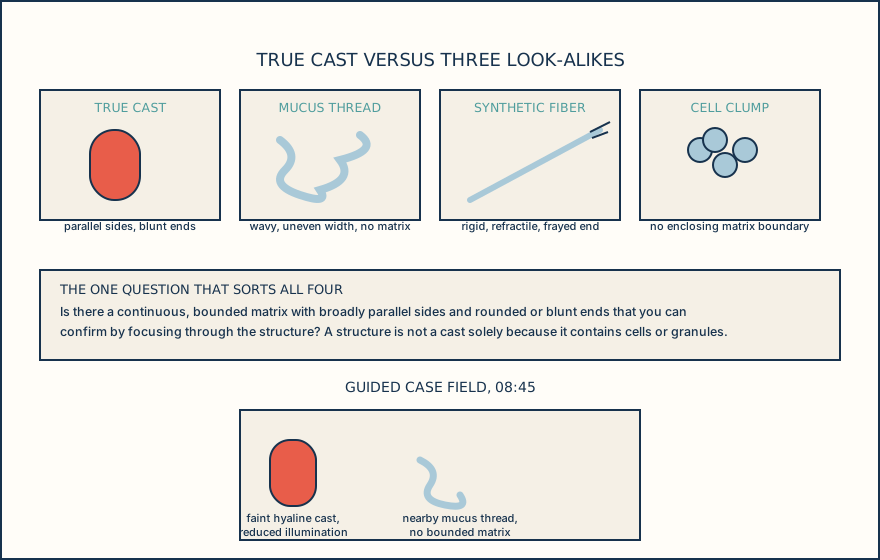
Use the same test on every structure: is there a continuous, bounded matrix with broadly parallel sides and rounded or blunt ends, confirmed by focusing through the structure, before any cargo is read? A structure that fails this test is not a cast regardless of what it appears to contain, and it should be described as what it is (mucus, a fiber, a cell clump) rather than forced into a cast category. A synthetic fiber is the closer look-alike of the two non-cellular mimics: it can show straight, roughly parallel sides like a cast, but focusing through it shows a flat, uniformly thin strand with sharp, high-contrast edges at every plane rather than a solid, rounded three-dimensional matrix, and its ends are typically cut square, frayed, or tapered to a point instead of the smooth, blunt ends a molded matrix produces. That through-focus profile and end shape, not parallel sides alone, is the repeatable feature that separates a fiber from a true cast.
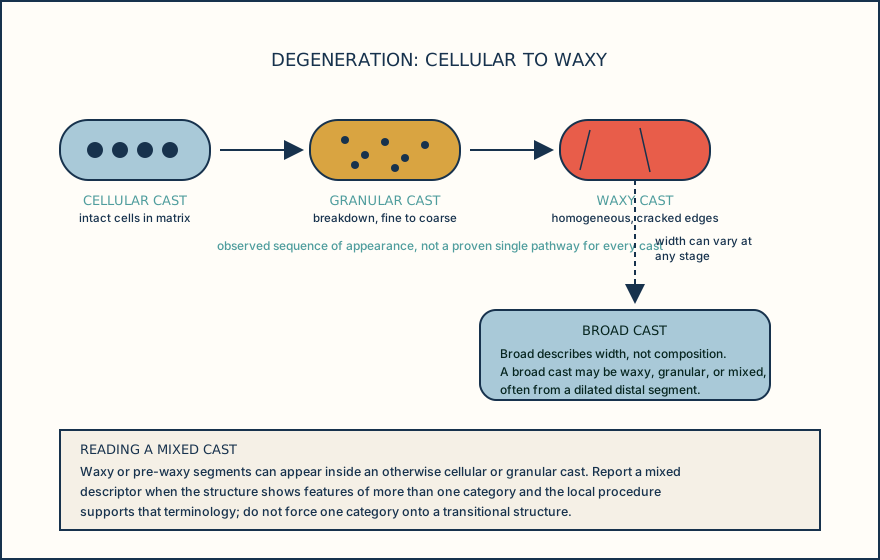
For structures that pass the matrix test, read the cargo next. Intact cells enclosed in the matrix make a cellular cast; granules of any size make a granular cast; lipid droplets or oval fat bodies make a fatty cast; a homogeneous, cracked-edge texture makes a waxy cast; and any of these in an unusually wide matrix is additionally described as broad. A structure that shows features of more than one category, such as a granular cast with a waxy segment, is reported with a mixed descriptor where the local procedure supports it, rather than assigned to a single category that does not fit the whole structure.
When a structure sits genuinely between two readings, for example a very faint hyaline candidate at the edge of visibility, or a granular cast where the granule size will not settle into fine or coarse, flag it for second review rather than guessing. Flagging is a legitimate outcome, not a failure to identify.
A confident call, a probable call, and a flagged-for-review call are all acceptable outcomes as long as the two features behind the call can be named.
Illustrative drawing — this picture was drawn rather than captured.
Illustrative drawing — this picture was drawn rather than captured.
Ordering exercise
A single cellular cast is followed as it ages in a delayed specimen. Place these described appearances in the order most consistent with a degeneration sequence, then explain why the order matters for interpretation.
1. Waxy cast
Homogeneous, highly refractile matrix with sharp or notched margins and cracked edges, no residual granularity.
2. Finely granular cast
Matrix with small, fine granules, further broken down from coarse granularity.
3. Intact cellular cast
Matrix with clearly intact, individually recognizable red blood cells, white blood cells, or renal tubular epithelial cells.
4. Coarsely granular cast
Matrix with prominent, coarse granules and no recognizable intact cell outlines remaining.
Knowledge checks
Reading and checks are open. Sign in only to save.
Knowledge check 1
Knowledge check 2
Section status
Finish this section
Reading and checks are open. Sign in only to save.
The module finishes after every required section is marked done and every check in those sections is correct.