Required section · Section 4 of 6
Working the Case
A fresh clean-catch urine specimen is collected at 08:10 and examined at 08:50, a 40-minute turnaround for this specific case that leaves little time for preanalytical change and is not a general rule for how long any cast stays recognizable. The specimen is not visibly hemolyzed or short filled. Chemistry runs on the laboratory's validated reflectance-photometric strip, and sediment is prepared and examined by the local manual method. The full result set is in the table below.
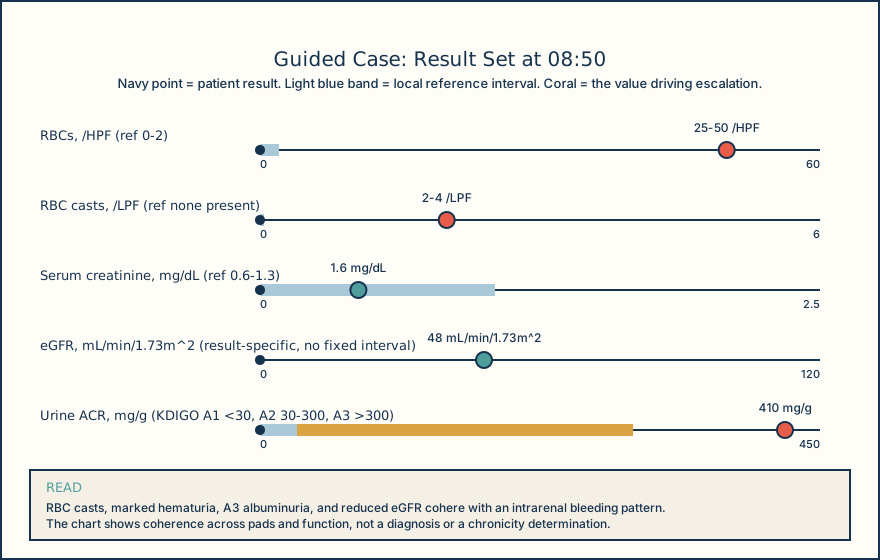
Start with what is corroborating. The blood pad is 3+ and the RBC count is 25 to 50 per high-power field (HPF) against a local interval of 0 to 2, so the strip and the microscopy agree that there is real, marked hematuria; this is not a case of pad-positive, cells-negative discordance that would raise a specimen-quality question. The RBC casts, 2 to 4 per low-power field (LPF) where none are expected, are the pivotal finding: because casts only form inside a renal tubule, their presence localizes at least part of this bleeding to the nephron rather than to the bladder or urethra.
Now bring in renal function and chemistry. Serum creatinine is 1.6 mg/dL against this case's laboratory's adult creatinine interval of 0.6 to 1.3 mg/dL, and the paired eGFR is 48 mL/min/1.73 m^2, flagged low with no single universal reference interval attached to that number. The urine albumin-to-creatinine ratio (ACR) is 410 mg/g, which falls in the KDIGO A3 category, above 300 mg/g. Leukocyte esterase and nitrite are both negative, which argues against a WBC-cast or infectious pattern being the dominant process here, though a single negative screen does not exclude every inflammatory process.
Put together, the RBC casts, marked hematuria, A3-range albuminuria, and reduced eGFR cohere with an intrarenal, usually glomerular, bleeding pattern. The result does not establish a specific diagnosis and does not establish chronicity; chronic kidney disease (CKD) requires an eGFR under 60 mL/min/1.73 m^2 or a marker of kidney damage persisting for at least three months, and this is a single time point. The specimen was examined promptly, so delayed lysis is an unlikely explanation for the RBC casts seen here, which strengthens confidence that the finding is real rather than a preanalytical artifact.
The technologist verifies cast morphology under the local review process, releases the factual result along with any comment the laboratory's policy permits, and follows the approved escalation pathway. KDIGO lists urinary RBC casts as a circumstance for specialist kidney-care referral; that is a clinical referral consideration, not a laboratory diagnosis, and the laboratory's job stops at correlating and communicating the result. When a cast finding and the chemistry, cells, and renal function all point the same direction, say so in bounded language, and let the pattern's own limits, not your certainty, set the tone of the comment.
Illustrative drawing — this picture was drawn rather than captured.
| Result | Value | Local reference or decision context | Flag |
|---|---|---|---|
| Specific gravity | 1.018 | Local method interval 1.005-1.030 | None |
| pH | 6.0 | Local method interval 5.0-8.0 | None |
| Blood pad | 3+ | Negative expected | High |
| Protein pad | 2+ | Negative expected | High |
| Leukocyte esterase | Negative | Negative expected | None |
| Nitrite | Negative | Negative expected | None |
| RBCs | 25-50 /HPF | Local interval 0-2 /HPF | High |
| WBCs | 0-2 /HPF | Local interval 0-5 /HPF | None |
| RBC casts | 2-4 /LPF | Not present, per local reporting policy | Abnormal morphology |
| Hyaline casts | 0-1 /LPF | Local reporting policy | None |
| Serum creatinine, collected 07:55 | 1.6 mg/dL | This case's laboratory's adult creatinine interval 0.6-1.3 mg/dL | High |
| eGFR, reported with creatinine | 48 mL/min/1.73 m^2 | Result-specific calculation, no universal reference interval | Low |
| Urine ACR | 410 mg/g | KDIGO A3, above 300 mg/g | High |
Knowledge checks
Reading and checks are open. Sign in only to save.
Knowledge check 1
Knowledge check 2
Section status
Finish this section
Reading and checks are open. Sign in only to save.
The module finishes after every required section is marked done and every check in those sections is correct.