Required section · Section 5 of 6
Allocate, calculate, and flag
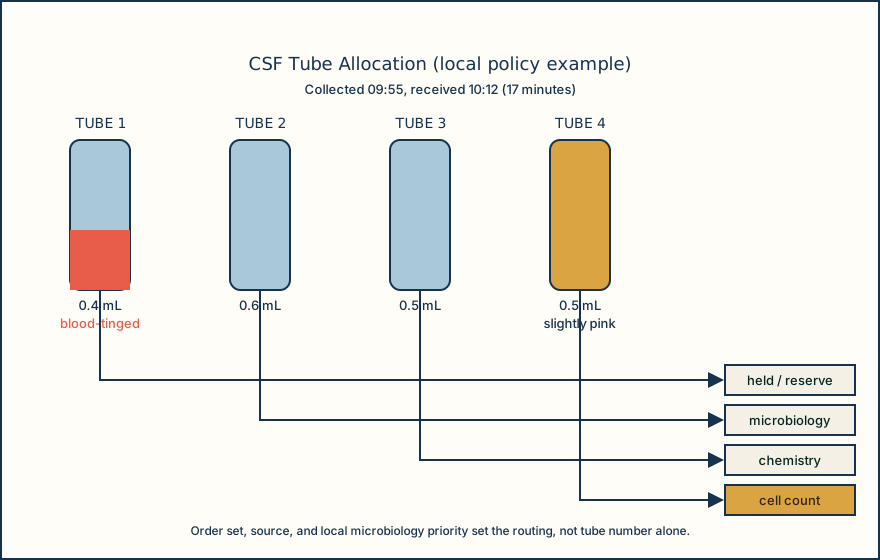
Now the learner works the case end to end. Given the four tubes, their volumes, and the requisition, first choose the allocation that follows the stated local policy; do not discard a tube merely because it is short filled. The allocation feedback then identifies the tubes assigned to microbiology, chemistry, and the cell-count bench.
The second task is calculation. Using the side A and side B readings from the designated cell-count tube, the learner confirms side agreement and states the reportable total nucleated cell count and RBC count, in cells/uL, with the correct tube identity referenced in the final report.
The third task is recognizing a counting-quality failure. The learner is shown a second, contrasting scenario in which chamber sides disagree well beyond the local limit, with uneven cell distribution visible in the chamber. The learner identifies that this result should not be released until the cause, such as an air bubble, drying, overfilling, or uneven mixing, is investigated and corrected.
The fourth task asks the learner to write a one-sentence specimen limitation for a clotted CSF tube, stating that a clot can trap cells unevenly and make the count nonrepresentative, without inventing a numeric correction the dossier does not support.
A defensible CSF cell count result is inseparable from the documentation of how it was obtained, so allocation, agreement check, and limitation statement are as much a part of the reportable result as the number itself.
Illustrative drawing — this picture was drawn rather than captured.
Ordering exercise
Put the steps of processing the designated cell-count tube for a manual CSF cell count in the correct working order.
1. Report with context
Release the result with tube identity, timing, and any specimen limitation.
2. Charge the chamber
Load the Fuchs-Rosenthal chamber promptly after mixing.
3. Apply the chamber formula
Calculate the reportable concentration using the validated chamber-specific formula.
4. Gently invert the tube
Resuspend settled cells before any aliquot is taken, per local procedure.
5. Check side-to-side agreement
Compare the two side counts against the local limit of agreement before proceeding.
6. Count both sides
Read side A and side B under the local boundary rule.
Knowledge checks
Reading and checks are open. Sign in only to save.
Knowledge check 1
Section status
Finish this section
Reading and checks are open. Sign in only to save.
The module finishes after every required section is marked done and every check in those sections is correct.