Required section · Section 2 of 6
Two different questions, four combinations
Precision asks whether repeated measurements of the same material cluster together. Accuracy asks whether a result is close to an accepted reference or an assigned value. These are independent properties. A method can be precise and accurate, precise and biased, imprecise and accurate, or imprecise and biased, and a laboratory needs a different response for each combination.
The target board makes this concrete. Picture a QC target with the assigned value at the center. Tightly grouped results that land on center are accurate and precise, the goal state. Tightly grouped results that land off-center are precise but biased: something is consistently pushing every result the same direction, which points toward calibration, reagent lot, or a comparison-method problem. Widely scattered results centered near the target are accurate but imprecise: the average is fine, but any single result is unreliable, which points toward handling, mixing, or a random instrument issue. Widely scattered results centered off-target combine both problems.
This distinction matters because the two problems have different causes and different fixes. Random error moves each result independently in either direction and is summarized by SD and %CV. Systematic error, the cause of bias, pushes results the same direction every time and is summarized by comparing the observed mean against an accepted or assigned value. Total observed difference is the combination of both when a single result is compared against a target: it can come from random scatter, systematic offset, or both at once, and a single result cannot tell you which.
A result that misses its target could be scattered, offset, or both. The target board tells you which question to ask next before you touch the calibration.
Illustrative drawing — this picture was drawn rather than captured.
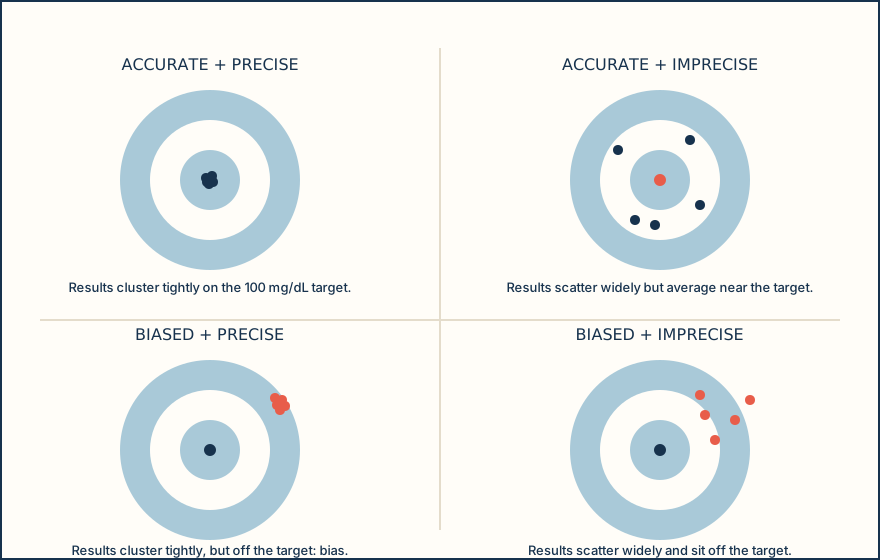
Reading a QC target board: from the pattern of points to the likely error type.
Observe the pattern
Look at where repeated results fall relative to the assigned target: tightly grouped or scattered, on-center or offset.
Check the spread
Wide scatter around the target signals random error. Calculate SD and %CV to quantify it.
Check the center
A cluster that sits off the target signals systematic error. Calculate bias as the observed mean minus the assigned value.
Name the error type
Combine both checks: random error alone, systematic error alone, both together, or neither, before choosing an investigation.
Knowledge checks
Reading and checks are open. Sign in only to save.
Knowledge check 1
Section status
Finish this section
Reading and checks are open. Sign in only to save.
The module finishes after every required section is marked done and every check in those sections is correct.