Required section · Section 3 of 6
Precision tiers, bias estimation, and allowable difference
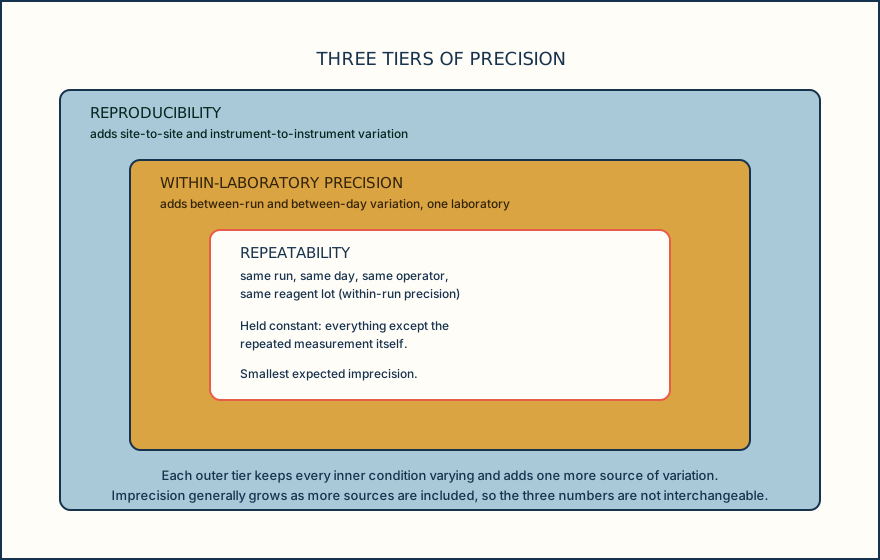
Precision is not one number; it depends on which conditions are held fixed. Repeatability (also called within-run precision) holds run, day, operator, and reagent lot constant and captures only the smallest, tightest source of scatter. Within-laboratory precision adds between-run and between-day variation while staying in one laboratory. Reproducibility adds site-to-site or instrument-to-instrument variation on top of that. Imprecision generally grows as more sources of variation are allowed to vary, so a repeatability SD and a reproducibility SD for the same method are not interchangeable numbers.
Bias is estimated by comparison, not by inspection of a single result. A short verification study uses repeated measurements at specified levels against assigned values to decide whether the laboratory can reproduce a manufacturer precision and bias claim before putting a method into service; its inputs are replicate results and assigned values, and its output is that verification decision. A patient-sample comparison uses many specimens across the interval and a regression method that handles error in both methods to estimate concentration-specific bias and agreement; its inputs are paired patient-sample results, and its outputs are bias and agreement across the interval. These are distinct designs, not interchangeable uses of CLSI EP15 and EP09.
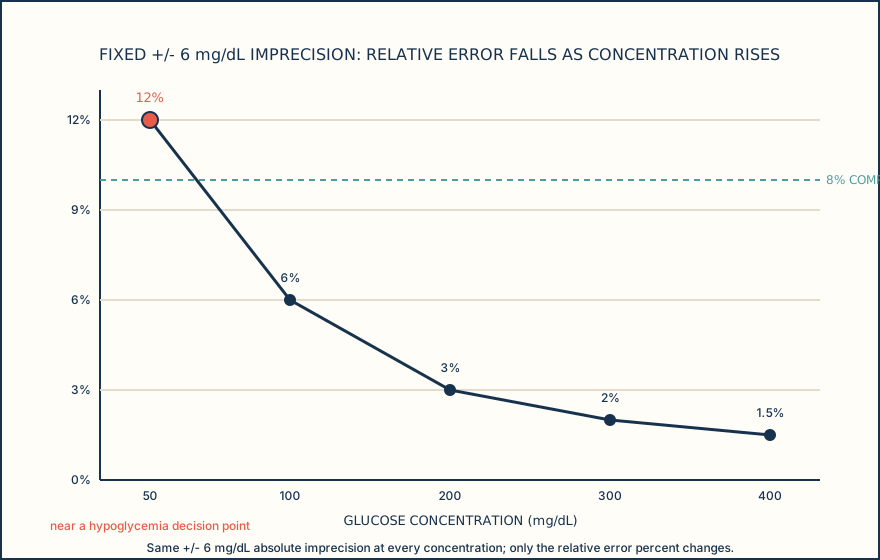
Absolute error is the result minus the reference, in the reported unit. Relative error is that same difference expressed as a percentage of the reference. The two diverge as concentration falls: a fixed absolute imprecision of a few mg/dL is a small relative error at a high glucose concentration and a much larger relative error near a hypoglycemia decision point. This is why allowable-difference criteria for glucose proficiency testing are written as a percentage or an absolute floor, whichever is greater, rather than a percentage alone.
Allowable performance specifications describe what a laboratory or an accreditation program has decided is an acceptable total observed difference; they are not a universal constant. One citable, worked example is the federal proficiency testing acceptable-performance criterion for glucose: the target value plus or minus 8 percent, or plus or minus 6 mg/dL, whichever is greater. Outside criteria published for specific proficiency-testing-graded analytes, a laboratory sets its own allowable total error or allowable bias limits from its verified or established performance specifications; there is no single universal number that applies to every analyte or every laboratory.
Know which precision tier a number represents and which allowable-difference criterion applies before deciding whether a result is close enough.
Illustrative drawing — this picture was drawn rather than captured.
Illustrative drawing — this picture was drawn rather than captured.
| Concentration (mg/dL) | 8% of target (mg/dL) | Absolute floor (mg/dL) | Allowable difference used (mg/dL) |
|---|---|---|---|
| 50 | 4.0 | 6 | 6 (floor is greater) |
| 100 | 8.0 | 6 | 8 (percent is greater) |
| 300 | 24.0 | 6 | 24 (percent is greater) |
| Concentration (mg/dL) | Absolute imprecision (mg/dL) | Relative error (%) |
|---|---|---|
| 50 | 6 | 12.0 |
| 100 | 6 | 6.0 |
| 200 | 6 | 3.0 |
| 300 | 6 | 2.0 |
| 400 | 6 | 1.5 |
Knowledge checks
Reading and checks are open. Sign in only to save.
Knowledge check 1
Knowledge check 2
Section status
Finish this section
Reading and checks are open. Sign in only to save.
The module finishes after every required section is marked done and every check in those sections is correct.