Required section · Section 5 of 6
A discordant immunoassay result: choosing the next step
A one-step sandwich immunoassay on Method B returns a hormone-type result well below what the clinical picture suggests. The specimen shows no hemolysis, icterus, or lipemia flag. The technologist has three plausible mechanisms in mind: a high-dose hook (prozone) effect, heterophile antibody interference, or a cross-reactant unrelated to either. Each has a different confirmatory step, and picking the wrong one wastes time without resolving the discordance.
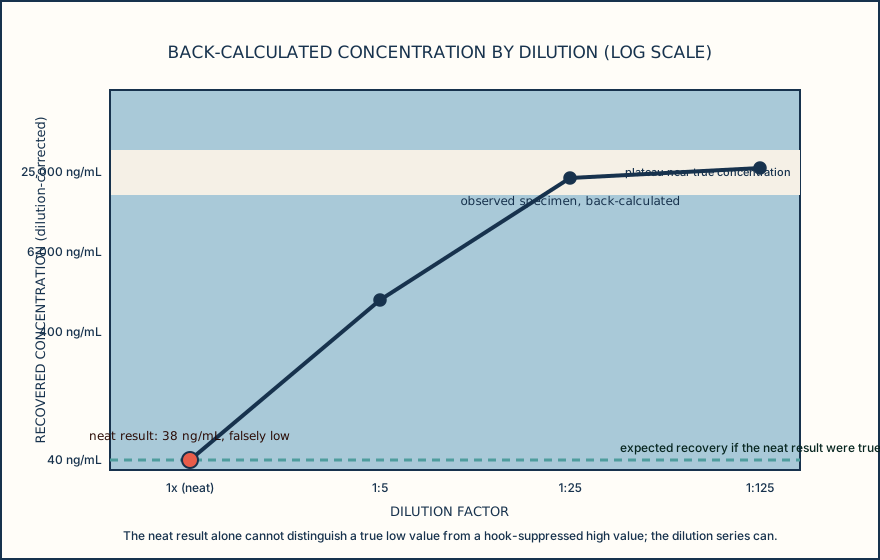
High-dose hook effect happens mainly in one-step sandwich immunoassays when analyte concentration is so high it saturates the capture and detection antibodies separately, preventing the sandwich complex from forming and driving the signal, and therefore the reported concentration, falsely low. The standard confirmatory step is serial dilution: a specimen affected by hook effect shows a disproportionate rise in recovered concentration as it is diluted, rather than the flat, proportional recovery an unaffected specimen would show.
In this case, the specimen is serially diluted at 1:5, 1:25, and 1:125. The recovered concentration rises far more than the dilution factor alone would predict, consistent with a hook effect rather than a proportionally diluting true low result. That pattern is the strongest available evidence pointing toward hook effect as the mechanism, though it does not by itself rule out every other cause.
Heterophile antibody interference behaves differently. It is caused by endogenous patient antibodies binding assay antibodies nonspecifically, and it can push a result falsely high or falsely low depending on the assay's architecture. The most useful confirmatory steps are testing on an alternate manufacturer's platform and reviewing whether serial dilution behaves in a nonlinear, nonparallel pattern rather than the specific rising pattern seen with hook effect. A heterophile-blocking reagent can also be tried, but a negative blocking result does not exclude interference, because blocking reagents do not neutralize every interfering antibody.
Biotin interference is a third, distinct mechanism, specific to assays using biotin-streptavidin or biotin-avidin capture chemistry. Excess free biotin, most often from supplement or high-dose therapeutic biotin intake, competes for binding sites, and the direction of bias depends on the assay's format: commonly falsely low in a sandwich assay and falsely high in a competitive assay. FDA guidance finalized in 2020 recommends manufacturers evaluate biotin interference up to 3,500 ng/mL and disclose the tolerance and bias direction for each assay. The confirmatory step here is checking the patient's biotin exposure history and the assay's current package insert, not a generic waiting period.
For this specimen, the serial dilution result is the most direct and immediately available evidence, and it points toward hook effect. Testing on an alternate platform would add corroborating evidence but at higher cost and turnaround time. Reviewing biotin exposure is inexpensive and worth doing in parallel, since Method B's chemistry could theoretically be biotin-dependent, but it does not explain a rising, hook-pattern dilution curve as directly as a hook effect does.
Illustrative drawing — this picture was drawn rather than captured.
Illustrative drawing — this picture was drawn rather than captured.
| Dilution | Back-calculated concentration (raw result x dilution factor) | Expected if neat result were true and unaffected |
|---|---|---|
| 1x (neat) | 38 ng/mL | 38 ng/mL |
| 1:5 | 2,000 ng/mL | 38 ng/mL |
| 1:25 | 24,000 ng/mL | 38 ng/mL |
| 1:125 | 26,000 ng/mL (plateau) | 38 ng/mL |
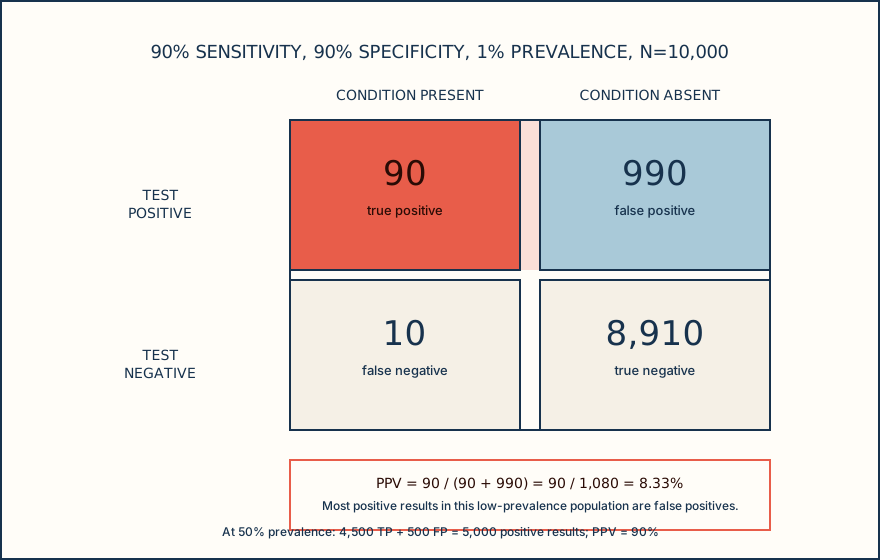
| Test result | Condition present | Condition absent | Total |
|---|---|---|---|
| 1% prevalence: Test positive | 90 (true positive) | 990 (false positive) | 1,080 |
| 1% prevalence: Test negative | 10 (false negative) | 8,910 (true negative) | 8,920 |
| 1% prevalence: Total | 100 | 9,900 | 10,000 |
| 50% prevalence: Test positive | 4,500 (true positive) | 500 (false positive) | 5,000 |
| 50% prevalence: Test negative | 500 (false negative) | 4,500 (true negative) | 5,000 |
| 50% prevalence: Total | 5,000 | 5,000 | 10,000 |
Ordering exercise
Sequence the investigation steps for this discordant immunoassay result in the order that gathers the strongest evidence at the lowest cost first.
1. Test on an alternate platform
Send the specimen to a different manufacturer's immunoassay platform to see whether the discordance is method-specific, at higher cost and turnaround time.
2. Document findings and notify the clinician
Record the investigation and its result, and communicate the interpretation and any limitation to the ordering clinician once the mechanism is reasonably characterized.
3. Review biotin exposure history
Check the chart and, if possible, ask about supplement or high-dose biotin use, since this requires no rerun and can be done immediately.
4. Run a serial dilution series
Dilute the specimen across several factors and compare recovered concentration to the proportional expectation to test for hook effect.
Knowledge checks
Reading and checks are open. Sign in only to save.
Knowledge check 1
Knowledge check 2
Section status
Finish this section
Reading and checks are open. Sign in only to save.
The module finishes after every required section is marked done and every check in those sections is correct.