Required section · Section 5 of 6
Learner decision: specimen B does not fit
Outpatient specimen B is from a 31-year-old on a stable levothyroxine prescription with a recent history of a hair, skin, and nail supplement, reported as feeling well with no hyperthyroid symptoms. The original-platform result: TSH 0.05 mIU/L (suppressed), FT4 0.9 ng/dL (mid-reference), total T3 110 ng/dL (mid-reference). TSH alone looks hyperthyroid. FT4 and T3 look ordinary. That is the discordance: a suppressed TSH with hormone measures that have not moved.
Classify this against the three drawn reference patterns first: it is not the concordant overt hyperthyroid pattern from specimen A, because FT4 and T3 are not elevated. It is not the primary hypothyroid pattern. It is not the central hypothyroid signature, because FT4 is not low. It does not cleanly fit any of the three, and that mismatch is itself the finding worth acting on.
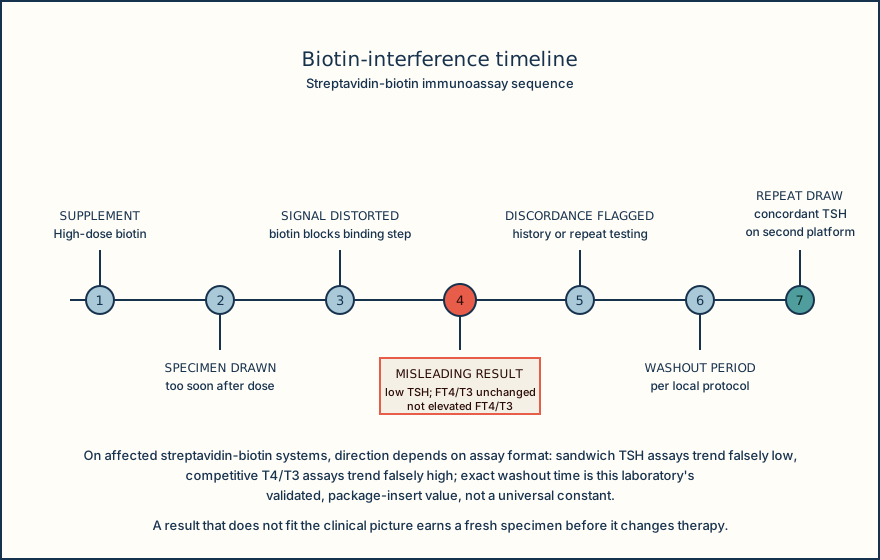
The recent high-dose biotin-type supplement history is the lead to follow. Biotin can interfere with streptavidin-biotin-based immunoassays: in sandwich-format assays, often used for TSH, it can cause a falsely low result; in competitive-format assays, often used for T4/T3, it can cause a falsely high result. Together this can mimic a hyperthyroid or an over-replaced levothyroxine pattern without any real change in the patient's thyroid status. The exact washout duration and dose threshold are assay-specific and must be confirmed against the current package insert for the assay in use; the mechanism and direction are established, and the exact number is a local, declared value.
The defensible next action is to confirm or exclude recent high-dose biotin exposure and rerun the affected analyte, either on the current specimen after excluding interference by protocol or on a fresh draw after an appropriate washout, per this laboratory's biotin-interference protocol. Repeating only TSH without addressing the interference question would not resolve the mechanism. Assuming overtreatment and stopping the medication, or sending for imaging, would act on an unconfirmed number and are not defensible from this evidence alone.
The alternate-platform result after washout is TSH 2.10 mIU/L, within the reference interval and consistent with the unchanged FT4 and T3. This demonstrates resolution of the discordance and supports biotin interference as the working explanation. It does not, by itself, prove the exact mechanism without further confirmatory studies such as PEG precipitation; that limit is stated directly rather than overclaimed.
A TSH that disagrees with its own FT4 and T3, in a patient with a plausible interference history, earns a repeat before it earns a headline.
Illustrative drawing — this picture was drawn rather than captured.
Illustrative drawing — this picture was drawn rather than captured.
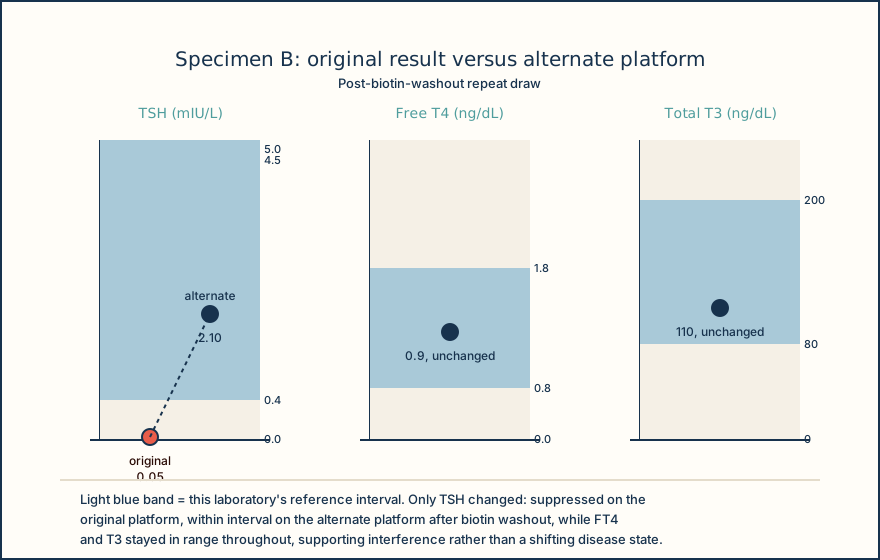
| Analyte | Reference interval | Original platform | Alternate platform, post-washout |
|---|---|---|---|
| TSH | 0.40-4.50 mIU/L | 0.05 mIU/L (suppressed) | 2.10 mIU/L (within interval) |
| Free T4 | 0.8-1.8 ng/dL | 0.9 ng/dL (mid-reference) | not repeated; unchanged clinically |
| Total T3 | 80-200 ng/dL | 110 ng/dL (mid-reference) | not repeated; unchanged clinically |
Ordering exercise
Put the steps of a macro-TSH or heterophile-antibody workup for an isolated, clinically discordant elevated TSH in the order this laboratory actually performs them.
1. Perform PEG precipitation with recovery calculation
Estimates the proportion of immunoreactive TSH that is macro-TSH bound to immunoglobulin rather than free, active hormone.
2. Collect a fresh specimen
Rule out a labeling, clotting, or specimen-integrity issue before assuming an analytical interference.
3. Escalate to a reference laboratory
Protein A/G or gel-filtration chromatography confirms macro-TSH when local studies remain inconclusive.
4. Perform serial dilution
Supportive but not definitive, because macro-TSH can dilute linearly and mimic a true elevated result.
5. Test on an alternate immunoassay platform
A result that normalizes on a different platform points toward a platform-specific interference rather than true patient physiology.
Knowledge checks
Reading and checks are open. Sign in only to save.
Knowledge check 1
Knowledge check 2
Knowledge check 3
Knowledge check 4
Knowledge check 5
Section status
Finish this section
Reading and checks are open. Sign in only to save.
The module finishes after every required section is marked done and every check in those sections is correct.