Required section · Section 2 of 6
The feedback loop that makes TSH useful
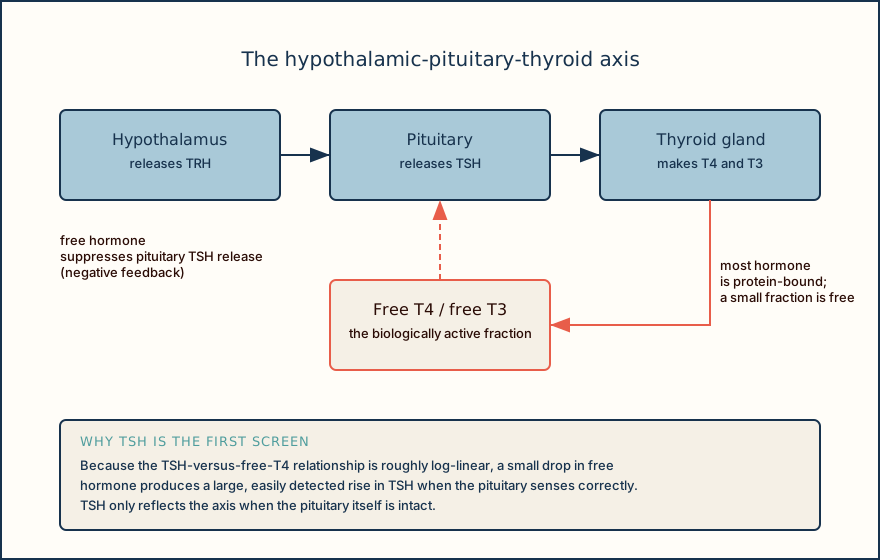
The hypothalamus releases thyrotropin-releasing hormone (TRH), which drives the pituitary to release TSH, which drives the thyroid gland to produce thyroxine (T4, the major product) and triiodothyronine (T3, in smaller amounts). Circulating T4 and T3 are mostly bound to carrier proteins, chiefly thyroxine-binding globulin (TBG), with a small unbound fraction that is biologically active and available to tissues. That free fraction feeds back to suppress TSH release, closing the loop.
Because the relationship between TSH and free T4 is roughly log-linear, a small real change in free hormone produces a comparatively large, easily measured change in TSH. That is the entire reason TSH is the standard first-line screening test when the hypothalamic-pituitary-thyroid (HPT) axis is intact: it amplifies small hormonal shifts into a signal the laboratory can detect early, before free T4 itself moves outside its own reference interval.
That amplification only works when the sensor is intact. Primary thyroid-gland disease breaks the loop at the gland: the pituitary still senses free hormone correctly and TSH moves appropriately, inversely, to whatever the gland is doing. Pituitary or hypothalamic disease breaks the loop at the sensor itself: TSH can no longer be trusted to reflect what the peripheral tissues are actually seeing, because the gauge is damaged, not the thing it measures.
This single loop, and the distinction between a broken gland and a broken sensor, underlies every pattern: each is a variation on where in this loop the signal has gone wrong, or on whether something outside the loop, a binding protein, an illness, or an assay artifact, is distorting what the laboratory reads.
Before naming a pattern, place the abnormal value on this loop and ask whether the gland or the sensor is the more likely site of the problem.
Illustrative drawing — this picture was drawn rather than captured.
How the laboratory professional works from one abnormal thyroid result to a defensible statement.
Classify the direction
Place the TSH and free T4 directions against the primary-versus-central framework: which pattern, if any, do they fit.
Check the context
Ask whether pregnancy, recent acute illness, or a binding-protein condition explains an apparent mismatch between total and free hormone results.
Rule out an assay event
When a result does not fit the clinical picture, or contradicts a very recent prior result, investigate interference before it changes management: repeat on a fresh specimen, compare platforms, consider biotin history, dilution, or PEG-precipitation studies.
Communicate the uncertainty
Report what the pattern supports and what it does not; an unresolved discordance is communicated, not silently resolved by picking the more convenient interpretation.
Knowledge checks
This section has no knowledge checks.
Section status
Finish this section
Reading and checks are open. Sign in only to save.
The module finishes after every required section is marked done and every check in those sections is correct.