Required section · Section 3 of 6
Where the numbers and the methods can mislead
The albumin-corrected calcium formula estimates what total calcium would be at a reference albumin concentration; it does not measure ionized calcium. Directly measured ionized calcium is preferred when the result will guide a decision, particularly in hypoalbuminemia, critical illness, major surgery, significant acid-base disturbance, renal failure, marked transfusion/citrate exposure, or apparent hypocalcemia, because the formula can perform poorly in these settings.
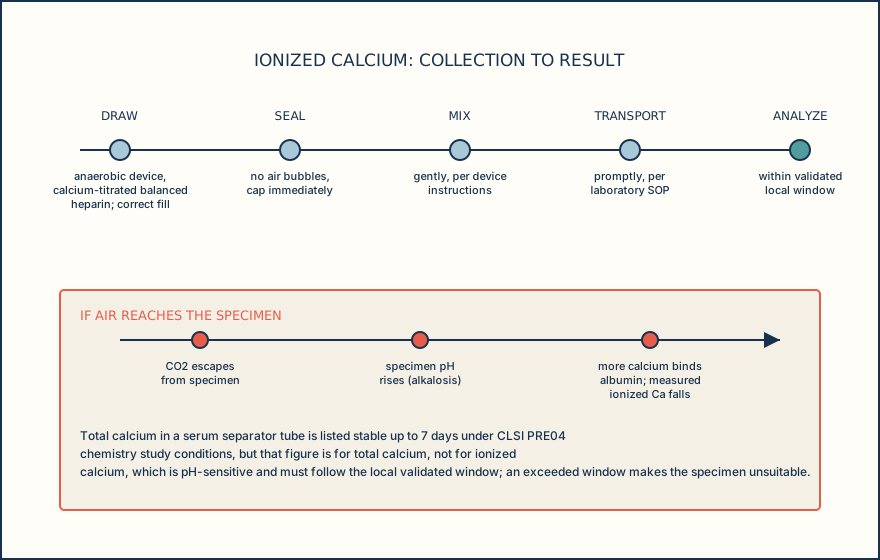
Ionized calcium is pH-dependent in a way total calcium is not. Acidosis increases the release of protein-bound calcium and raises ionized calcium; alkalosis increases albumin binding and lowers ionized calcium, without necessarily changing the total. Because of this, ionized calcium must be collected anaerobically, in a blood-gas syringe or a capillary device with calcium-titrated balanced lithium heparin, free of air bubbles, mixed gently, and analyzed within the local assay procedure’s validated window; if that window is exceeded, the specimen is unsuitable for this ionized-calcium result.
Air exposure lets CO2 escape, raises specimen pH, and shifts the measured ionized calcium result. Excess or non-balanced liquid heparin, or an underfilled draw device, changes the effective heparin concentration and can bias ionized calcium and other electrolytes, so the device and fill volume specified by the manufacturer and the laboratory's standard operating procedure must be followed exactly. For contrast, total calcium in a serum separator tube is listed stable up to 7 days under CLSI PRE04 chemistry study conditions, a figure that applies to total calcium only and is not a substitute for the laboratory's own validated stability data.
Vitamin D testing has two different jobs and two different markers. 25(OH)D has a half-life of roughly 2-3 weeks and reflects the body's vitamin D stores; it is the marker used to assess vitamin D status. 1,25-dihydroxyvitamin D (calcitriol) has a half-life of hours, is not a reliable indicator of vitamin D stores, and is not a routine screening test; its narrow role includes situations such as unexplained hypercalcemia with suppressed PTH or suspected extrarenal calcitriol production.
The Endocrine Society's 2024 guideline on vitamin D for the prevention of disease replaced its 2011 guideline for the general, healthy population and deliberately does not endorse a single universal 25(OH)D target or a single laboratory definition of sufficiency, insufficiency, or deficiency; it suggests against routine 25(OH)D testing in generally healthy people without an established indication, while explicitly not applying to people with conditions such as CKD, malabsorption, hypocalcemia, or suspected metabolic bone disease.
PTH immunoassays are not all measuring the same thing. A second-generation ('intact') assay detects full-length PTH(1-84) together with some large circulating fragments; a third-generation ('whole' or 'biointact') assay is more specific for full-length PTH(1-84) alone.
These generations are not interchangeable and should not be converted with a fixed multiplier, because PTH fragments accumulate as renal clearance falls, so intact-PTH results can run higher than whole/biointact results in the same patient, particularly in chronic kidney disease (CKD). Trending PTH in one patient over time should use the same assay generation, and where possible the same manufacturer platform, because absolute PTH values are not standardized across methods; the Roche Elecsys electrochemiluminescence immunoassay, used here as one example with an adult reference interval of about 15-65 pg/mL, is one such method, and Roche states each laboratory should verify transferability to its own population.
A discordant calcium/PTH pattern is a reason to ask what the specimen, the correction formula, and the assay generation can and cannot tell you, before it is a reason to ask what disease the patient has.
Illustrative drawing — this picture was drawn rather than captured.
| Condition | PTH | Calcium | Phosphate | Mechanism |
|---|---|---|---|---|
| Primary hyperparathyroidism | High | High | Low to low-normal | PTH not suppressed for the calcium level; renal phosphate wasting |
| Hypoparathyroidism | Low | Low | High | Loss of the PTH-driven renal phosphate excretion effect |
| Vitamin D deficiency | High (secondary) | Low-normal | Low-normal | Low calcitriol reduces intestinal absorption; PTH rises to compensate |
| CKD-associated secondary hyperparathyroidism | High (secondary) | Low-normal | High | Reduced GFR limits phosphate excretion and calcitriol production |
Ordering exercise
Put the ionized calcium specimen steps in the order that keeps the result accurate, from draw to analysis.
1. Mix gently
Mix per the device's instructions to distribute anticoagulant without introducing air or causing hemolysis.
2. Analyze within the validated local window
Analyze within the local assay procedure’s validated window; if it is exceeded, the specimen is unsuitable for this ionized-calcium result.
3. Draw anaerobically
Collect with the specified anaerobic device (blood-gas syringe or calcium-titrated balanced lithium-heparin capillary device) at the correct fill volume.
4. Transport promptly
Move the specimen to the analyzer promptly, per the laboratory's standard operating procedure.
5. Seal without air
Expel or avoid air bubbles and cap the device immediately so no air exchange occurs with the specimen.
Knowledge checks
Reading and checks are open. Sign in only to save.
Knowledge check 1
Knowledge check 2
Section status
Finish this section
Reading and checks are open. Sign in only to save.
The module finishes after every required section is marked done and every check in those sections is correct.