Required section · Section 2 of 6
What normally happens: calcium fractions and the feedback loop
Serum total calcium is not one uniform pool. Roughly 50% circulates as free, ionized calcium; roughly 40% is protein-bound, mostly to albumin; and roughly 10% is complexed to anions such as phosphate and citrate. Only the ionized fraction is physiologically active: it is the form muscle, nerve, and cardiac tissue respond to, and the form the parathyroid gland senses. A total calcium value adds all three fractions together and can move for reasons that have nothing to do with ionized calcium, most commonly a change in albumin.
The calcium-sensing receptor (CaSR) on parathyroid chief cells is the sensor in this system. When ionized calcium falls, CaSR activation decreases, releasing inhibition of PTH secretion so the parathyroid glands release more parathyroid hormone (PTH). PTH then acts directly on two targets: bone, where it increases osteoclastic resorption through osteoblast RANKL signaling and releases calcium and phosphate into circulation, and kidney, where it increases distal tubular calcium reabsorption and decreases proximal tubular phosphate reabsorption. Net effect of direct PTH action: calcium rises, phosphate falls.
PTH's third effect is indirect. PTH stimulates renal 1-alpha-hydroxylase, the enzyme that converts 25-hydroxyvitamin D [25(OH)D] into the active hormone 1,25-dihydroxyvitamin D, also called calcitriol. Calcitriol increases intestinal absorption of both calcium and phosphate. As calcium and calcitriol rise, they feed back on the parathyroid gland and suppress further PTH secretion, closing the loop. Magnesium sits underneath this whole system as a required cofactor for PTH secretion and for PTH receptor signaling; severe hypomagnesemia can blunt PTH release even when calcium is low.
Reading a calcium/PTH panel is reading this loop from the outside: PTH direction tells you how the parathyroid gland is responding, phosphate direction tells you whether the kidney is behaving the way PTH would predict, and vitamin D markers tell you whether the intestine has the raw material and the activated hormone to absorb calcium in the first place. The same reusable loop explains every pattern in the next section; nothing new gets introduced, only which node is broken.
Before naming a diagnosis, ask which step of this loop the numbers are consistent with, because PTH, calcium, phosphate, and vitamin D only make sense read together.
Illustrative drawing — this picture was drawn rather than captured.
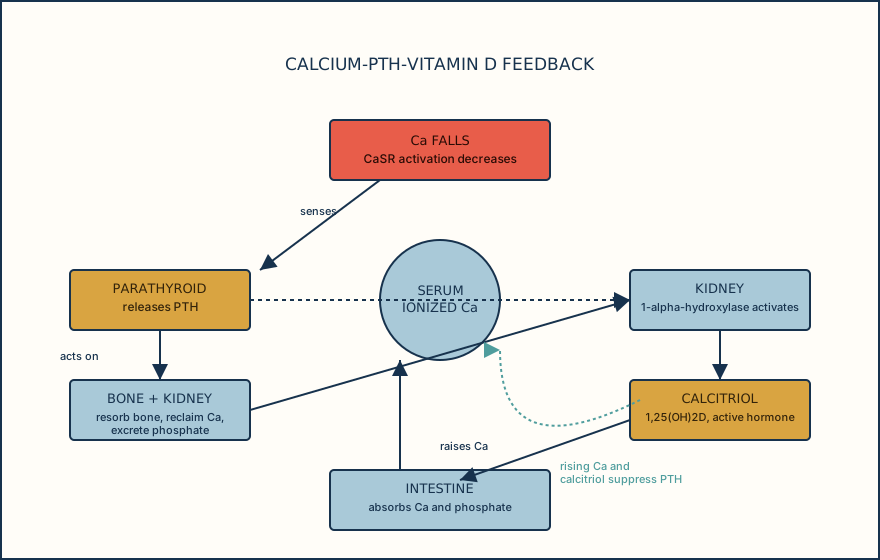
One turn of the calcium-PTH-vitamin D loop, starting from a fall in ionized calcium.
Ionized calcium falls
The calcium-sensing receptor (CaSR) on parathyroid chief cells detects the drop in free, ionized calcium, not total calcium.
Parathyroid releases PTH
Reduced CaSR activation releases inhibition of PTH secretion from the chief cells.
PTH acts directly on bone and kidney
Bone: osteoblast RANKL signaling increases osteoclastic resorption, releasing calcium and phosphate. Kidney: distal tubular calcium reabsorption rises and proximal tubular phosphate reabsorption falls.
PTH activates vitamin D
PTH stimulates renal 1-alpha-hydroxylase, converting 25-hydroxyvitamin D to the active hormone calcitriol, 1,25-dihydroxyvitamin D.
Calcitriol raises intestinal absorption
Calcitriol increases intestinal absorption of both calcium and phosphate, adding to the calcium supplied by bone and kidney.
Rising calcium and calcitriol suppress PTH
As ionized calcium and calcitriol rise, they feed back on the parathyroid gland and reduce further PTH secretion, closing the loop.
Knowledge checks
Reading and checks are open. Sign in only to save.
Knowledge check 1
Knowledge check 2
Section status
Finish this section
Reading and checks are open. Sign in only to save.
The module finishes after every required section is marked done and every check in those sections is correct.