Required section · Section 2 of 6
Particles carry cholesterol; the panel measures some of the cholesterol directly
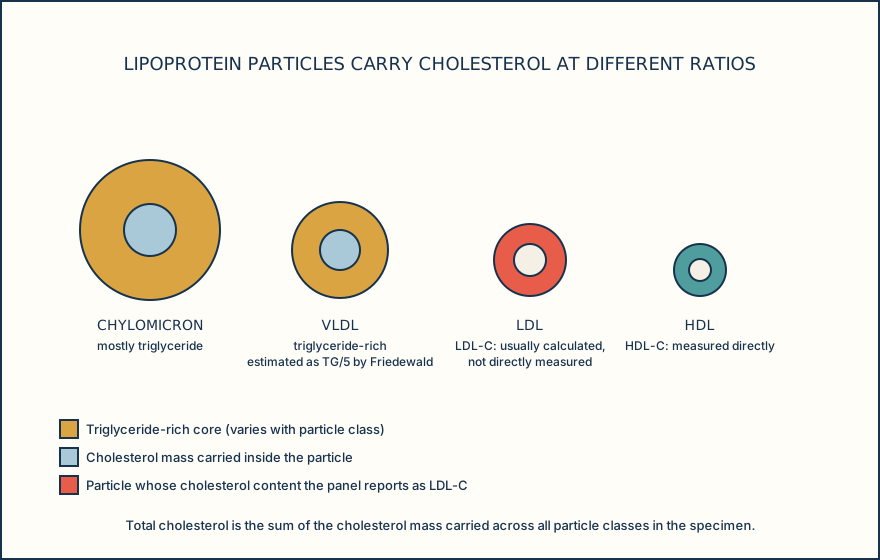
Cholesterol in blood does not circulate free. It travels packaged inside lipoprotein particles, alongside triglyceride, phospholipid, and protein. Different particle classes carry very different ratios of triglyceride to cholesterol. Chylomicrons and VLDL (very-low-density lipoprotein) are triglyceride-rich; LDL (low-density lipoprotein) and HDL (high-density lipoprotein) carry proportionally more cholesterol relative to triglyceride. Total cholesterol is the sum of the cholesterol mass carried across every particle class in the specimen, not a property of any one particle.
A standard lipid panel measures total cholesterol, HDL-C, and triglycerides directly, using enzymatic assays run on the chemistry analyzer. LDL-C, on most routine panels, is not measured directly at all. It is calculated from those three measured values by subtracting HDL-C and an estimated VLDL-cholesterol (VLDL-C) term from total cholesterol. The estimate for VLDL-C is where triglyceride concentration enters the calculation, and it is also where the calculation can go wrong.
LDL-C, a cholesterol mass, is a related but distinct measure from LDL particle number or apolipoprotein B (apoB), a particle-count surrogate. LDL particles do not all carry the same amount of cholesterol, so two specimens with the same LDL-C can carry different numbers of LDL particles, particularly with insulin resistance, diabetes, or hypertriglyceridemia. That distinction resurfaces later when apoB is discussed as a complementary measure, not a replacement for LDL-C.
When a lipid result looks unexpected, the first question is not what the number means clinically, but whether that number was measured on the analyzer or produced by a downstream calculation.
Illustrative drawing — this picture was drawn rather than captured.
From venipuncture to a released lipid panel: what the analyzer measures directly and what the laboratory information system calculates afterward.
Specimen collected
Serum is drawn by venipuncture, fasting or nonfasting per the ordering policy; either is acceptable for a baseline panel and ASCVD risk estimate in most adults not already on lipid-lowering therapy.
Three analytes measured directly
The chemistry analyzer runs enzymatic colorimetric reactions for total cholesterol and triglycerides, and a homogeneous enzymatic method for HDL-C, producing three independently measured results.
LDL-C and non-HDL-C calculated
The laboratory information system applies the laboratory's chosen equation (commonly Friedewald) to the three measured values to produce calculated LDL-C, and subtracts HDL-C from total cholesterol to produce non-HDL-C.
Calculation and consistency verified
Before release, the triglyceride result is checked against the equation's validity ceiling, and non-HDL-C is confirmed to be numerically at or above LDL-C, since non-HDL-C includes LDL-C plus VLDL and remnant cholesterol.
Result released
The panel is released with the calculation method identifiable to the ordering clinician; interpretation and any treatment implication belong to the clinician, not the laboratory.
Knowledge checks
Reading and checks are open. Sign in only to save.
Knowledge check 1
Section status
Finish this section
Reading and checks are open. Sign in only to save.
The module finishes after every required section is marked done and every check in those sections is correct.