Required section · Section 3 of 6
Equations, ceilings, and the measures that do not depend on triglycerides
The classic Friedewald equation is LDL-C = TC - HDL-C - (TG / 5), all in mg/dL. The TG/5 term estimates VLDL-C from triglycerides using a fixed ratio of 5. That fixed ratio is not constant across individuals or across triglyceride concentrations, so Friedewald-calculated LDL-C tends to underestimate the true value as triglycerides rise, particularly when LDL-C is already low, below roughly 100 mg/dL and especially below 70 mg/dL. Friedewald is not considered valid at TG 400 mg/dL or higher; above that ceiling, the equation should not be used to report a numeric LDL-C.
Two newer equations replace the fixed factor of 5 with something more flexible. Martin-Hopkins selects an adjustable factor from a table indexed by non-HDL-C and triglycerides; its original table covered TG under 400 mg/dL and was extended in 2021 to cover TG 400 to 799 mg/dL. Sampson-NIH is a multiple-regression estimate developed from a different patient population and is intended to be accurate to roughly TG 800 mg/dL. Neither equation is validated at unlimited triglyceride concentrations, and a large NHANES 2015-2018 comparison found the three equations classify most adults into the same guideline LDL-C category when TG is under 400 mg/dL, with individual-level differences that can still matter clinically near a decision point.
Non-HDL-C is calculated differently: total cholesterol minus HDL-C, with no triglyceride term at all. It captures the cholesterol carried by every apolipoprotein-B-containing particle, not only LDL, and it stays calculable and interpretable at triglyceride concentrations where a calculated LDL-C is no longer valid. That is why a laboratory continues to report non-HDL-C on a high-triglyceride specimen even when it suppresses the calculated LDL-C. Apolipoprotein B (apoB) is a different kind of measurement entirely: an immunoturbidimetric or immunonephelometric assay that measures the mass of apoB protein directly, used as a surrogate for the number of atherogenic particles because most apoB-containing particles carry one apoB molecule. It requires no triglyceride-based calculation and current multisociety guidance supports selective apoB measurement, particularly when triglycerides are elevated, roughly above 200 mg/dL, or in diabetes, established cardiovascular disease, or when LDL-C is already at goal.
Fasting status matters less than it once did. Either a fasting or nonfasting specimen is acceptable for a baseline panel and ASCVD risk estimate in most adults. The specific analytic trigger to repeat fasting is a nonfasting triglyceride result of 400 mg/dL or higher, which brings the specimen back to the same ceiling that governs the Friedewald calculation. A grossly lipemic (turbid) specimen reflecting elevated triglyceride-rich lipoproteins is expected biology at that concentration; CLSI's PRE04 standard states specimen suitability is measurand-specific, so a condition unacceptable for one analyte on the panel can remain acceptable for another. Lipemia can still interfere with other chemistry assays on the same tube through light scattering and matrix effects, and enzymatic triglyceride methods can show a high-dose interference (a falsely normal-appearing result) above an instrument-specific concentration documented in the manufacturer's method sheet, so extreme lipemia is a reason for extra scrutiny, not automatic rejection.
Reference and decision values for every one of these results are guideline- and risk-context dependent, not a simple population reference interval; current guidance frames cholesterol values against risk-based treatment goals that vary with a person's ASCVD risk category, not one universal cutoff. CAP's chemistry checklist requires clinicians have access to information about the LDL-C equation in use, because Friedewald, Martin-Hopkins, and Sampson-NIH can give different numeric results from the same three measured inputs. Under 42 CFR 493.1255, the laboratory verifies the reportable range of each measured analyte (TC, HDL-C, TG) at required intervals; calculated LDL-C, non-HDL-C, and VLDL-C have no independent instrument measuring range of their own, so the laboratory instead validates the calculation logic and its input boundaries.
Illustrative drawing — this picture was drawn rather than captured.
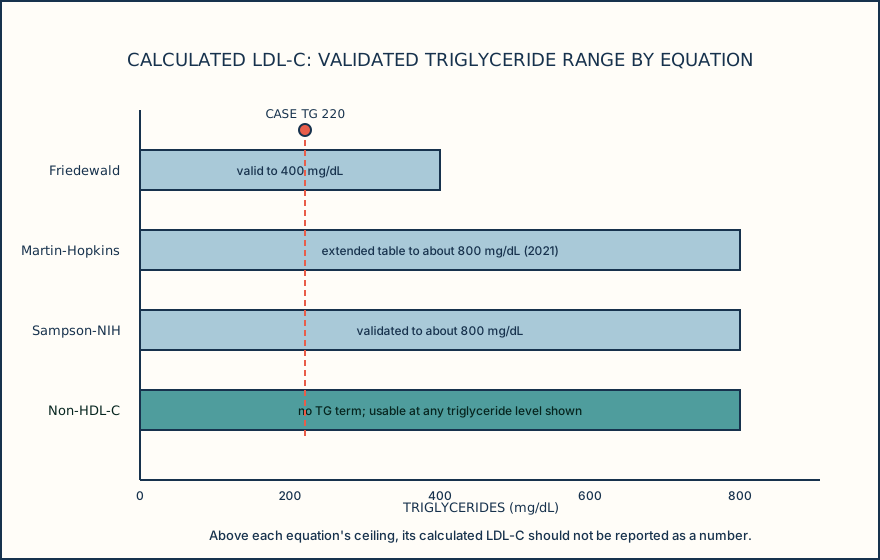
| Equation | Formula (mg/dL) | Validated TG range | Key limitation |
|---|---|---|---|
| Friedewald | TC - HDL-C - (TG/5) | Not valid at TG >= 400 | Fixed TG/5 factor underestimates LDL-C as TG rises and LDL-C falls |
| Martin-Hopkins | TC - HDL-C - (TG / adjustable factor) | Extended table to about TG 799 | Factor comes from a lookup table indexed by non-HDL-C and TG |
| Sampson-NIH | Regression formula using TC, HDL-C, TG, non-HDL-C | Validated to about TG 800 | Regression-derived; developed from a distinct patient population |
| Non-HDL-C | TC - HDL-C | No TG-based ceiling | Captures all apoB-containing particles, not LDL specifically |
Knowledge checks
Reading and checks are open. Sign in only to save.
Knowledge check 1
Knowledge check 2
Knowledge check 3
Knowledge check 4
Knowledge check 5
Section status
Finish this section
Reading and checks are open. Sign in only to save.
The module finishes after every required section is marked done and every check in those sections is correct.