Required section · Section 3 of 6
Timing, thresholds, and what can make a trend uninterpretable
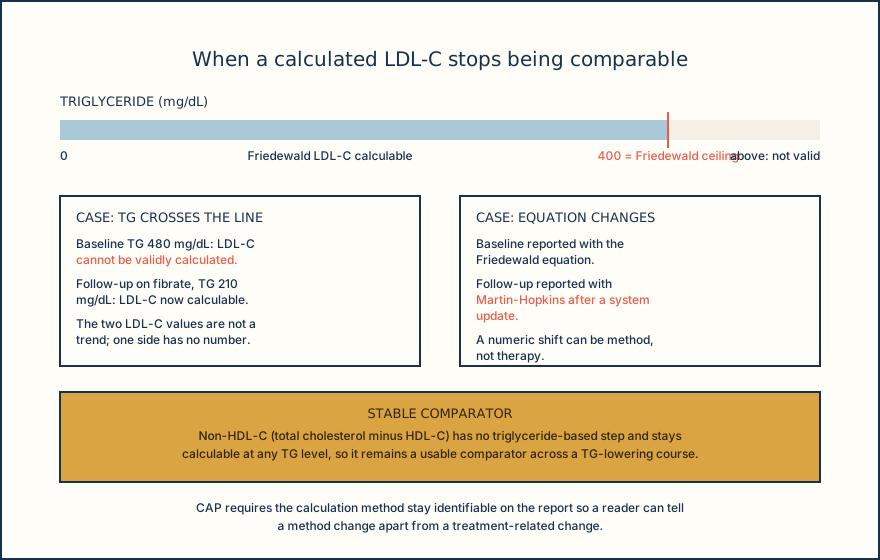
Either a fasting or nonfasting specimen is acceptable for baseline and most follow-up lipid testing. The one specimen-driven trigger to know is that a nonfasting triglyceride result at or above 400 mg/dL calls for a repeat fasting specimen, because a Friedewald-calculated LDL-C is not considered valid once triglycerides reach that level. This matters directly for lipid-lowering therapy: a triglyceride-lowering drug (fenofibrate, icosapent ethyl, or a PCSK9-directed add-on in a patient with elevated triglycerides) can move a patient's triglyceride value across that 400 mg/dL line between baseline and follow-up. When that happens, one of the two calculated LDL-C values may not exist or may not be comparable to the other, independent of any true change in LDL particle burden.
A second source of an apparent trend that is not a treatment effect is a change in the LDL-C calculation method itself. Friedewald, Martin-Hopkins, and Sampson-NIH equations can produce different numeric results from the identical specimen. Laboratory accreditation standards require that the equation used to produce a calculated result stay identifiable to the ordering clinician, precisely because an equation change between two time points can look like a treatment-related change when it is not. Non-HDL-C, calculated as total cholesterol minus HDL-C, has no triglyceride-based estimation step and stays calculable and interpretable at any triglyceride level, which makes it a more stable comparator than calculated LDL-C when a patient's triglycerides are changing across a treatment course.
Acute illness is a third confounder, and it is not a drug effect: acute coronary syndrome, infection, surgery, or significant physiologic stress transiently lowers total cholesterol and LDL-C and can alter triglycerides and HDL-C independent of any medication change. A treatment-response lipid panel drawn during acute illness is either deferred or interpreted with that confounder stated explicitly, because it is not comparable to a stable-state baseline or follow-up value.
Before reading a lipid trend as a drug effect, confirm the two draws sit inside the locally applicable comparison protocol, on the same reported equation, and outside a period of acute illness; if any of those is not true, say so rather than letting the number speak for itself.
Illustrative drawing — this picture was drawn rather than captured.
| Item | Value | Why it matters |
|---|---|---|
| Comparison timing | Case follow-up at week 6; apply the locally applicable protocol | Timing determines comparability under the applicable local protocol; it is not a universal release trigger. |
| Nonfasting TG repeat-fasting trigger | >=400 mg/dL | Confirms a reliable TG and LDL-C value before comparison |
| Friedewald LDL-C validity ceiling | TG <400 mg/dL | Above this, calculated LDL-C is not considered valid at that draw |
| High-intensity statin expected LDL-C reduction | Approximately >=50% from untreated baseline | Benchmark for judging whether a follow-up response is smaller than expected |
Knowledge checks
Reading and checks are open. Sign in only to save.
Knowledge check 1
Knowledge check 2
Section status
Finish this section
Reading and checks are open. Sign in only to save.
The module finishes after every required section is marked done and every check in those sections is correct.