Required section · Section 2 of 6
What normally happens: receptors, particles, and clearance
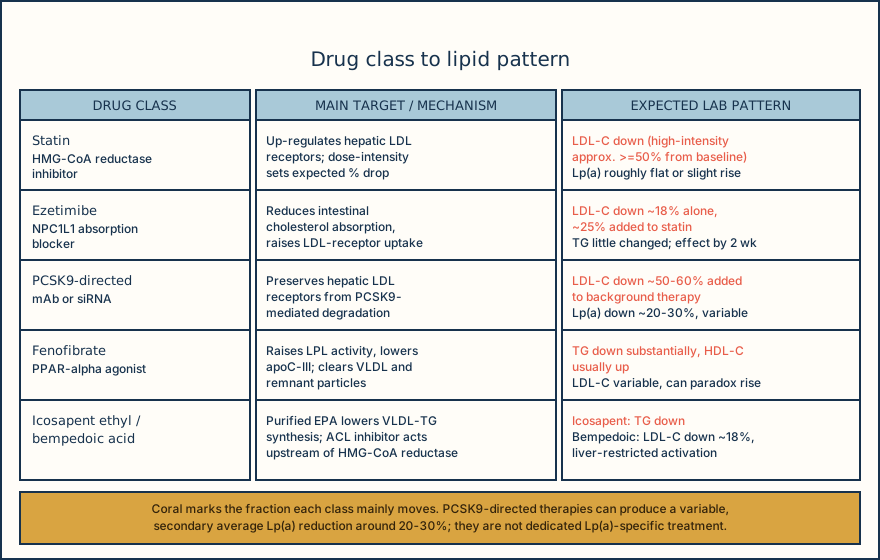
Most lipid-lowering drugs work by changing how fast the liver clears LDL particles from plasma or by changing how much triglyceride-rich lipoprotein the liver makes and releases. Statins inhibit HMG-CoA reductase, the rate-limiting enzyme in hepatic cholesterol synthesis. Lower hepatic cholesterol content signals the liver to put more LDL receptors on its cell surface, and those receptors pull more LDL particles out of circulation. Ezetimibe reaches the same LDL-receptor result by a different route: it blocks the NPC1L1 transporter that absorbs dietary and biliary cholesterol in the intestine, which lowers hepatic cholesterol stores and triggers the same receptor up-regulation, without touching synthesis directly.
PCSK9-directed therapies work on the receptor itself rather than on cholesterol supply. PCSK9 is a protein that normally tags LDL receptors for degradation after they deliver an LDL particle. Evolocumab and alirocumab are monoclonal antibodies that bind circulating PCSK9 and prevent that degradation, so more receptors recycle back to the cell surface. Inclisiran is a small interfering RNA that reduces how much PCSK9 the liver makes in the first place. Both routes leave more functioning LDL receptors available, which is why PCSK9-directed therapy produces some of the largest LDL-C reductions in routine use.
Fenofibrate and icosapent ethyl work on a different lipid fraction. Fenofibrate increases lipoprotein lipase activity and lowers apoC-III, which speeds clearance of triglyceride-rich VLDL and remnant particles; the expected result is a substantial triglyceride drop, usually with an HDL-C rise, and a variable LDL-C change. Icosapent ethyl, a purified EPA product, reduces hepatic VLDL-triglyceride synthesis and secretion through mechanisms the manufacturer's label describes as not fully established. Bempedoic acid inhibits ATP-citrate lyase, an enzyme upstream of HMG-CoA reductase in the same synthesis pathway statins act on, but the enzyme it targets is activated mainly in liver tissue rather than skeletal muscle.
The process map below lays out the shared receptor-clearance pathway that statins, ezetimibe, and PCSK9-directed therapy all converge on, because that shared endpoint is why their LDL-C effects are additive when combined. Knowing which pathway a drug acts on tells which lipid fraction should move and which fraction has no mechanistic reason to move.
Illustrative drawing — this picture was drawn rather than captured.
Three drug classes converge on the same hepatic LDL-receptor clearance step, which is why their LDL-C effects can add together.
Hepatic cholesterol supply changes
A statin blocks HMG-CoA reductase and lowers new synthesis; ezetimibe blocks NPC1L1 and lowers absorbed cholesterol reaching the liver. Either route lowers the liver's internal cholesterol pool.
LDL-receptor expression or survival rises
A lower hepatic cholesterol pool signals more LDL-receptor gene expression. Separately, a PCSK9-directed antibody or siRNA prevents existing receptors from being degraded, so more receptors are available regardless of the synthesis pathway.
Hepatic clearance of circulating LDL increases
More functional LDL receptors on the liver surface pull more LDL particles out of plasma. This is the shared endpoint; it is why combining a statin with ezetimibe or a PCSK9-directed agent produces a larger LDL-C reduction than either alone.
Measured LDL-C falls on the follow-up panel
The laboratory sees the downstream result, a lower calculated or measured LDL-C, without a direct assay of receptor number. The percentage change compared with the expected range for the drug class and dose is what the laboratory can evaluate.
Knowledge checks
Reading and checks are open. Sign in only to save.
Knowledge check 1
Knowledge check 2
Section status
Finish this section
Reading and checks are open. Sign in only to save.
The module finishes after every required section is marked done and every check in those sections is correct.