Required section · Section 2 of 6
What the timed sample represents
After a dose, concentration changes as drug distributes and clears. A peak is collected after distribution is complete, a trough immediately before the next dose, and a random level has an unspecified timing. A target derived for one sampling strategy cannot simply be applied to another.
With stable dosing, steady state is approached after about four to five half-lives. A level before steady state may look low or high for reasons that are pharmacokinetic rather than analytical. Renal and hepatic function, dialysis, pregnancy, age, and critical illness can change clearance or distribution.
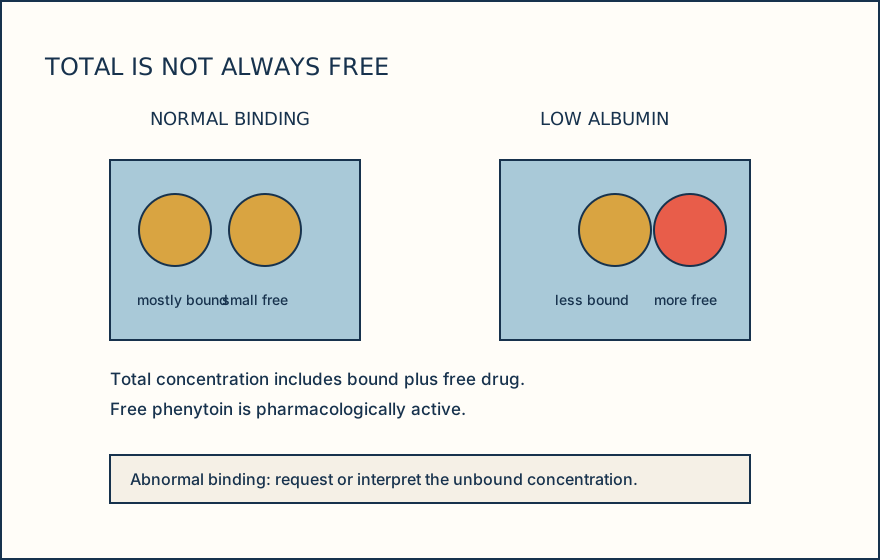
Total concentration includes protein-bound and free drug. For phenytoin, the free fraction is pharmacologically active, so low albumin or uremia can raise free drug without a proportional total change. A normal total value does not rule out a clinically important free concentration when binding is abnormal.
Name the sampling strategy and steady-state context before comparing a result with a target.
Illustrative drawing — this picture was drawn rather than captured.
Interpret a TDM concentration in its collection context.
Identify the question
Confirm drug, intended monitoring approach, and whether the result is peak, trough, random, or AUC input.
Reconstruct the timeline
Verify dose, route, infusion end or last dose, exact draw time, and specimen source.
Check context
Review steady state, clearance context, binding, and method limitations.
Release bounded result
Release or recollect/comment under local policy and communicate a local critical result when applicable.
Knowledge checks
Reading and checks are open. Sign in only to save.
Knowledge check 1
Section status
Finish this section
Reading and checks are open. Sign in only to save.
The module finishes after every required section is marked done and every check in those sections is correct.