Required section · Section 5 of 6
Learner decision: resolve an arsenic result
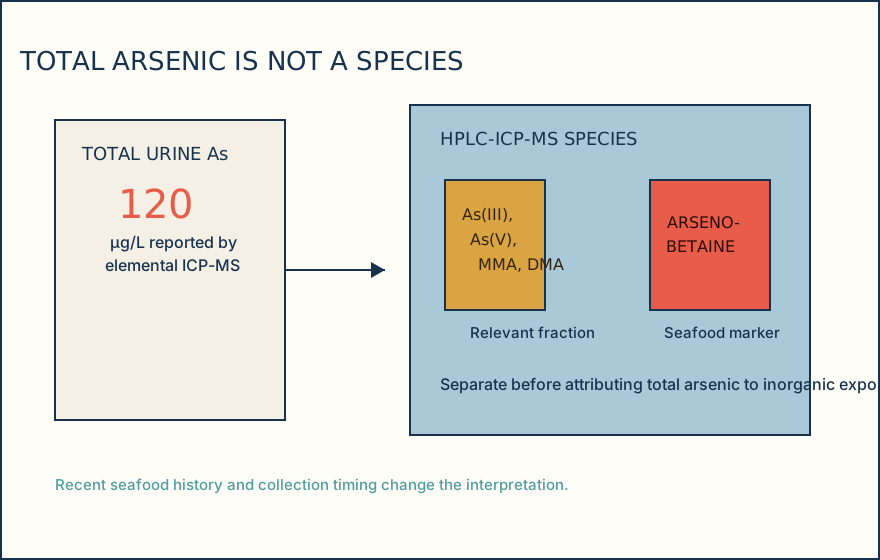
An outpatient spot urine total arsenic result is 120 µg/L by ICP-MS. The requisition says the person ate shellfish the evening before collection and asks whether the result proves inorganic arsenic exposure. The immediate laboratory decision is whether total arsenic answers that question.
Total ICP-MS arsenic does not distinguish arsenite, arsenate, methylated metabolites, arsenobetaine, or arsenocholine. Arsenobetaine from fish and shellfish can markedly increase total urine arsenic for roughly 48 hours and is considered essentially nontoxic relative to inorganic arsenic. A result consisting of arsenobetaine alone does not support an inorganic exposure conclusion.
The preferred bounded action is to document seafood history and pursue a collection after avoiding seafood for about 48 hours when feasible, with a speciated urine method if the toxicological question remains. Only a complete timed collection, with calculation of the total amount excreted over the interval, removes the hydration dependence seen in a spot concentration; timing a single voided sample without that calculation does not by itself yield an excretion result. If only a spot sample is used, report and interpret the concentration according to the laboratory's validated hydration-adjustment and interval policy.
Do not turn an elevated total urine arsenic result into an inorganic-exposure conclusion without species and collection context.
Illustrative drawing — this picture was drawn rather than captured.
Knowledge checks
Reading and checks are open. Sign in only to save.
Knowledge check 1
Section status
Finish this section
Reading and checks are open. Sign in only to save.
The module finishes after every required section is marked done and every check in those sections is correct.