Required section · Section 3 of 6
What Each Screening Test Actually Challenges
PT and aPTT are clot-based tests. Each measures the time to fibrin clot formation after a defined in-vitro activation of citrated plasma. Neither test recreates the cell-based model on a real cell surface; each is a reagent challenge run in a cuvette, timed by an analyzer's clot detector.
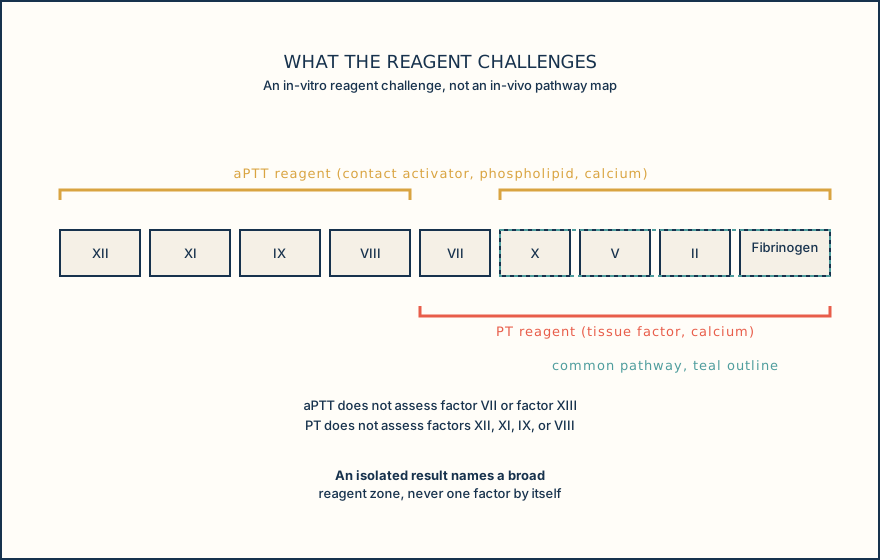
The PT reagent supplies tissue factor and calcium. It broadly challenges factor VII plus the common-pathway factors X, V, and II, and it depends on adequate fibrinogen to form a clot at all. The INR is a calculation intended to standardize PT results across reagent lots and instruments for vitamin K antagonist monitoring. It is not a universal expression of every anticoagulant's effect, and it should not be read that way outside that specific use.
The aPTT reagent supplies a contact activator, phospholipid, and calcium. It broadly challenges the contact factors XII and XI, plus IX and VIII, and shares the same common-pathway dependence on X, V, II, and fibrinogen. It does not assess factor VII, and it does not assess factor XIII.
Thrombin time (TT) adds thrombin directly to plasma, so it challenges fibrinogen-to-fibrin conversion and fibrin polymerization rather than any upstream pathway factor. It can be prolonged by low or dysfunctional fibrinogen or by thrombin inhibitors, including heparin and direct thrombin inhibitors, and how responsive it is depends on the specific TT reagent. Clauss fibrinogen is a separate functional clot-based assay that dilutes plasma, adds high thrombin, and reads a result off a calibration curve, reporting method-specific fibrinogen activity. An anti-Xa assay measures residual factor Xa chromogenically after adding a known amount, so less residual Xa means more inhibitor activity, and the calibration must match the specific drug or heparin question being asked.
None of these reagent behaviors are fixed facts of nature. Tissue-factor source, aPTT activator and phospholipid composition, the analyzer's clot-detection principle, and reagent responsiveness all change how PT and aPTT behave, and reference intervals are tied to that specific reagent-instrument combination.
Read a PT or aPTT result as a statement about a specific reagent system's response, then ask which broad factor group that system was built to challenge, before reaching for a factor name.
Illustrative drawing — this picture was drawn rather than captured.
| Test | Reagent components | Factors or process broadly challenged |
|---|---|---|
| PT / INR | Tissue factor, calcium | Factor VII plus common pathway: X, V, II, and fibrinogen |
| aPTT | Contact activator, phospholipid, calcium | Factors XII, XI, IX, VIII plus common pathway: X, V, II, and fibrinogen; not VII or XIII |
| Thrombin time (TT) | Thrombin added directly | Fibrinogen-to-fibrin conversion and fibrin polymerization; not upstream factors |
| Clauss fibrinogen | Diluted plasma, high thrombin, calibration curve | Method-specific functional fibrinogen activity |
| Anti-Xa, heparin-calibrated | Chromogenic substrate reacting with residual factor Xa | Compatible with anti-Xa activity; a heparin-calibrated signal does not identify heparin or exclude a factor Xa inhibitor |
Knowledge checks
Reading and checks are open. Sign in only to save.
Knowledge check 1
Knowledge check 2
Section status
Finish this section
Reading and checks are open. Sign in only to save.
The module finishes after every required section is marked done and every check in those sections is correct.