Required section · Section 3 of 6
Method details, reagent variability, and specimen pitfalls
Vitamin K antagonist monitoring uses PT reported as INR, which standardizes the PT system across reagents and instruments using a manufacturer-assigned international sensitivity index (ISI). INR standardization applies specifically to the PT system for VKA monitoring; it is not a general unit of anticoagulant effect and does not standardize a result for any other drug class. A manufacturer's ISI may need local verification or calibration because PT/INR performance depends on the specific PT system in use, not on the ISI value alone.
Continuous intravenous UFH may be monitored with a locally validated aPTT therapeutic range or with a heparin-calibrated anti-Xa procedure, chosen and validated locally. aPTT and anti-Xa can disagree during UFH monitoring for reasons unrelated to heparin dose: baseline aPTT prolongation, altered heparin responsiveness, acute-phase reactant changes, an underlying factor deficiency, a lupus anticoagulant, or a preanalytic error such as an under-filled or contaminated draw. Discordance is a prompt to investigate, not a reason to average the two results.
LMWH has a less predictable effect on aPTT than UFH does, so aPTT is not LMWH's routine monitoring method. Where LMWH anti-Xa monitoring is used, it is drug-, dose-, and timing-specific; current professional guidance advises against routine anti-Xa-guided dose adjustment of therapeutic LMWH in pregnancy, obesity, or severe renal dysfunction. An anti-Xa result ordered outside a clear indication still needs drug, dose, timing, and assay context before it means anything.
Direct oral anticoagulants (DOACs) are the hardest group to screen with PT and aPTT, because responsiveness varies with drug concentration and with the specific thromboplastin or aPTT reagent on the analyzer, so the same drug level can look different on two different reagent lots or platforms. A normal PT or aPTT alone cannot exclude clinically relevant DOAC activity. Apixaban can prolong PT, INR, and aPTT, but at therapeutic doses the changes are small, variable, and not useful for monitoring apixaban. Dabigatran can prolong aPTT, ecarin clotting time, dilute thrombin time (dTT), TT, and INR, but INR is relatively insensitive to dabigatran.
Standard TT is highly responsive to dabigatran: with the local reagent, a normal TT supports the absence of a clinically relevant dabigatran concentration, while a prolonged TT is a qualitative flag, not a quantitative result. Where a drug concentration in ng/mL is actually needed, dTT, ecarin-based assays, and chromogenic anti-factor IIa assays can be calibrated to report dabigatran, and a drug-calibrated chromogenic anti-Xa assay is the dedicated method for rivaroxaban, apixaban, or edoxaban concentration. A heparin-calibrated anti-Xa result and a DOAC-calibrated anti-Xa concentration are not interchangeable outputs, even though both are reported as anti-Xa.
Anticoagulants can affect the screen, mix, and confirm steps of lupus anticoagulant (LA) testing, so a mixing study does not reliably identify an inhibitor when a drug is present, and DOACs in particular can create false-positive or false-negative LA patterns. Heparin neutralizers and DOAC adsorbents are method-specific mitigation tools; they require local validation because removal can be incomplete or can itself alter clotting tests. None of this replaces documenting drug exposure before releasing an LA interpretation.
Illustrative drawing — this picture was drawn rather than captured.
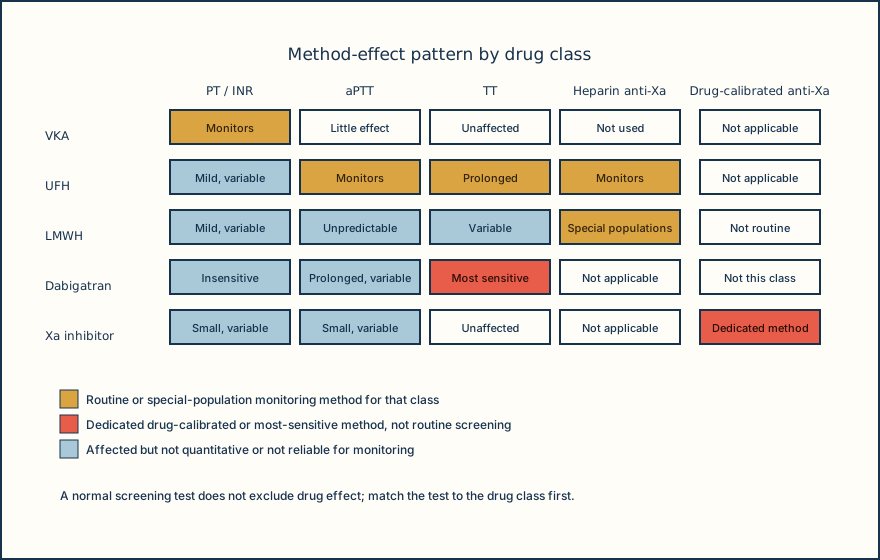
| Drug class | Preferred monitoring approach | Test not useful for monitoring this class |
|---|---|---|
| Vitamin K antagonist | PT reported as INR, standardized to the local PT/ISI system | aPTT, TT, and anti-Xa are not used to monitor VKA |
| Unfractionated heparin | Locally validated aPTT range or heparin-calibrated anti-Xa | PT/INR is not a UFH monitoring tool |
| Low-molecular-weight heparin | Anti-Xa only where indicated, drug- and timing-specific; not routine | aPTT is not routine due to unpredictable response |
| Dabigatran | dTT, ecarin-based, or chromogenic anti-IIa for concentration; TT to screen for absence | Standard INR is relatively insensitive to dabigatran |
| Factor Xa inhibitor | Drug-calibrated chromogenic anti-Xa for concentration | PT and aPTT changes are small, variable, and not useful for monitoring |
Knowledge checks
Reading and checks are open. Sign in only to save.
Knowledge check 1
Knowledge check 2
Knowledge check 3
Knowledge check 4
Section status
Finish this section
Reading and checks are open. Sign in only to save.
The module finishes after every required section is marked done and every check in those sections is correct.