Required section · Section 5 of 6
A second case: choose the right next step
A different patient is on apixaban per the medication list. The order is PT and aPTT only, drawn by routine peripheral venipuncture, no line involved. PT returns 13.4 s (10.0-13.0, mildly high), INR 1.05 (0.9-1.1, normal), aPTT 34 s (25-35, upper normal). The requesting team asks whether these results mean the apixaban level is subtherapeutic or absent.
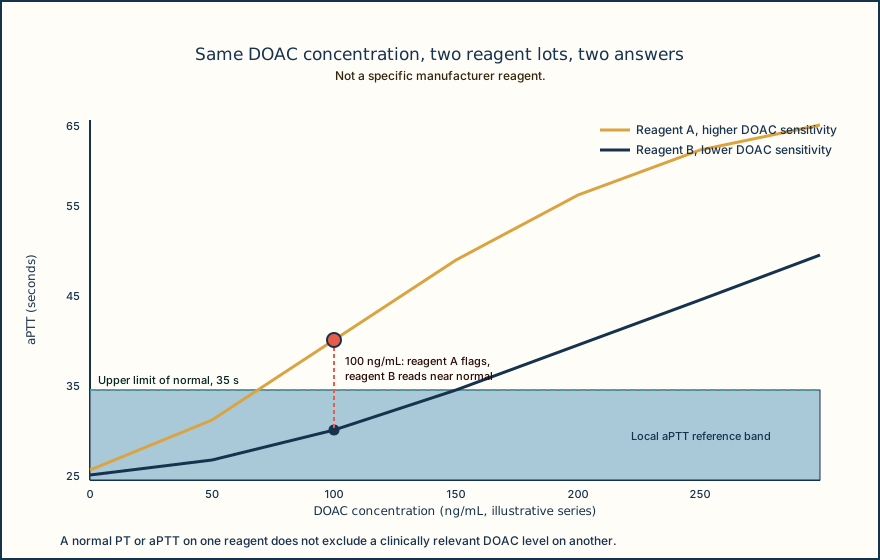
Apply the method-effect pattern. Apixaban is a factor Xa inhibitor. At therapeutic doses it can produce small, variable prolongation of PT, INR, and aPTT, but those changes are not reliable enough to use for monitoring apixaban, and a normal or near-normal PT/aPTT does not exclude a clinically relevant drug level. The reagent in use also has its own sensitivity, so the same drug concentration could look different on another instrument or reagent lot. See the reagent comparison chart for how two reagent lots can disagree on the same specimen.
The decision in front of the reader is which piece of information would actually resolve the clinical question, not which test to run reflexively. The two strongest candidates are the exact time of the last apixaban dose relative to the draw, which determines where in the drug's pharmacokinetic curve this specimen falls, and a drug-calibrated chromogenic anti-Xa assay calibrated specifically for apixaban, which is the dedicated method for reporting an apixaban concentration in ng/mL. A heparin-calibrated anti-Xa result would not answer this question, because a heparin-calibrated anti-Xa result and a DOAC-calibrated anti-Xa concentration are not interchangeable outputs.
Both cases share a structure: an unexpected or ambiguous coagulation result is not interpreted by staring harder at the number. It is interpreted by working back through mechanism, method sensitivity, and specimen or drug history in a fixed order, so the next step is investigation-driven rather than guess-driven. For a discordant result, review the pattern, check drug and collection history, match the mechanism, select the dedicated assay, and then decide whether to release or hold the interpretation.
Illustrative drawing — this picture was drawn rather than captured.
Ordering exercise
Put these steps in the order a laboratory scientist should follow when a coagulation result is unexpected or internally discordant, before releasing an interpretation.
1. Release the interpretation or hold for repeat collection
Report only when test, drug, and specimen history are consistent; otherwise document the concern and follow the local recollection policy.
2. Match the pattern to a plausible mechanism
Ask which anticoagulant class, or which preanalytic problem, would produce this specific combination of results.
3. Review which tests are abnormal and which are normal
Identify the full pattern across PT/INR, aPTT, TT, and anti-Xa rather than reacting to a single flagged value.
4. Select the drug-specific or confirmatory assay needed
Choose a dedicated method, such as a drug-calibrated anti-Xa assay or TT, when the screening tests cannot answer the question.
5. Check drug history and specimen collection details
Look for anticoagulant name, last-dose timing, and line, flush, or lock exposure that could explain the pattern.
Knowledge checks
Reading and checks are open. Sign in only to save.
Knowledge check 1
Knowledge check 2
Section status
Finish this section
Reading and checks are open. Sign in only to save.
The module finishes after every required section is marked done and every check in those sections is correct.