Required section · Section 4 of 6
Working the case: a specimen that cannot answer the question
Return to the request from the opening problem. The citrate tube is short filled and the same-draw CBC shows platelets 62 x10^9/L (reference range 150-400 x10^9/L), hemoglobin 8.1 g/dL (reference range 12.0-16.0 g/dL), and leukocytes 16.8 x10^9/L (reference range 4.0-11.0 x10^9/L). No platelet-function result is released from this draw.
The short fill is a rejection criterion on its own: it changes the ratio of citrate anticoagulant to blood, alters the calcium available for the reaction, and disqualifies the tube for light-transmission aggregometry, whole-blood impedance aggregometry, and cartridge P2Y12 testing regardless of the platelet count or the rest of the CBC. The low platelet count is a separate problem, an analytical signal limitation rather than a rejection criterion in itself: a count this low can independently reduce or destabilize the aggregation signal in light-transmission aggregometry and in whole-blood impedance aggregometry, so a blunted result from an otherwise valid specimen could reflect too few platelets rather than a drug effect. The low hemoglobin and elevated leukocyte count are interpretive confounders, not independent grounds for rejection: anemia and hematocrit materially affect whole-blood impedance aggregometry and other shear-dependent platelet tests, and a markedly elevated leukocyte count can likewise alter a whole-blood signal, so a properly collected specimen with these findings still needs that biological context weighed before a result is read as reflecting drug effect rather than the patient's hematologic state.
The correct first action is to follow the local specimen-rejection and recollection policy: reject the short-filled tube, document the reason and the medication and collection timing, and request a properly collected specimen before any platelet-function method is run. A normal platelet count or a normal PT/aPTT would not repair this specimen and would not answer the ADP-pathway question either.
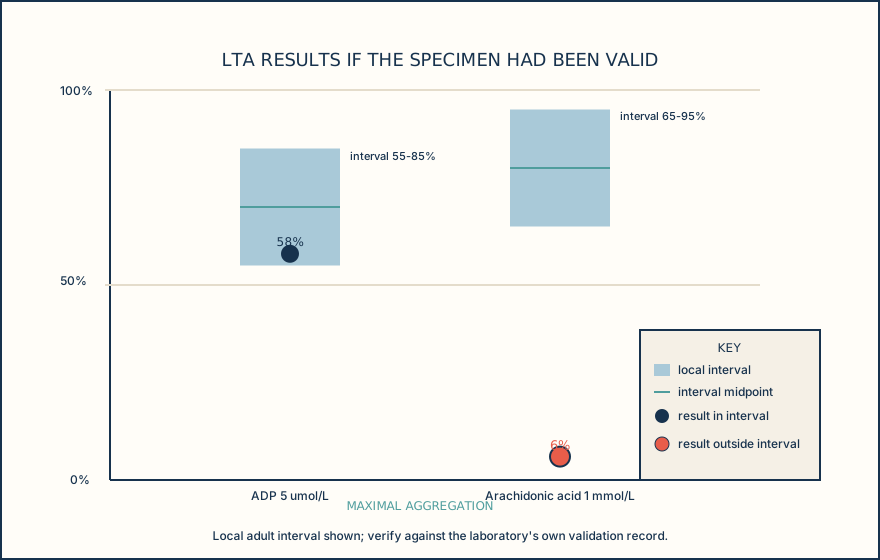
If a correctly collected specimen had been tested by a locally validated LTA procedure: ADP 5 umol/L gives maximal aggregation of 58%, within the laboratory's local adult interval of 55-85%; arachidonic acid 1 mmol/L gives maximal aggregation of 6%, below the local adult interval of 65-95%.
This pattern, preserved ADP response with reduced COX-1-pathway response, could be compatible with an aspirin effect and an intact P2Y12 pathway. It cannot, by itself, distinguish a missed clopidogrel dose from altered drug exposure, an interacting medication, inflammation, an inherited platelet-function defect, or ordinary analytical variation. It cannot direct a treatment change. It documents what the ADP and arachidonic-acid agonist responses looked like under the stated method and conditions, nothing more.
An aggregation result is only as valid as the specimen that produced it, and even a valid result answers a narrower question than a clinician might assume it does.
Illustrative drawing — this picture was drawn rather than captured.
| Analyte | Result | Reference range | Flag |
|---|---|---|---|
| Platelets | 62 x10^9/L | 150-400 x10^9/L | Low |
| Hemoglobin | 8.1 g/dL | 12.0-16.0 g/dL | Low |
| Leukocytes | 16.8 x10^9/L | 4.0-11.0 x10^9/L | High |
| Citrate tube fill | Short filled | Full draw to fill line | Reject |
| Agonist | Maximal aggregation | Educational local interval | Pathway assessed |
|---|---|---|---|
| ADP 5 umol/L | 58% | 55-85% | ADP/P2Y12 |
| Arachidonic acid 1 mmol/L | 6% | 65-95% | COX-1/thromboxane |
Knowledge checks
Reading and checks are open. Sign in only to save.
Knowledge check 1
Knowledge check 2
Section status
Finish this section
Reading and checks are open. Sign in only to save.
The module finishes after every required section is marked done and every check in those sections is correct.