Required section · Section 2 of 6
What a Factor Assay Is Actually Measuring
A one-stage factor assay is a clot-based test. Patient plasma is diluted and mixed with plasma that has been made deficient in exactly one factor, then an aPTT-type clotting reaction is triggered. The deficient substrate plasma supplies every other coagulation factor at normal levels, so the factor under study becomes the limiting variable in how fast the mixture clots. The clot time is read against a calibration curve built from serial dilutions of a reference plasma with a known factor activity, and the patient's result is reported as a percent or IU/dL activity by interpolation on that curve.
Because the whole system depends on the deficient plasma, the reagent, the calibrator, the instrument, and the assay conditions, a factor assay result is method-dependent. Two laboratories running the same specimen on different platforms with different deficient plasma lots can report different numbers for the same patient. That is normal and expected, not evidence of error, but it means a result should always be read with its own method in mind rather than compared against a number remembered from somewhere else.
The 1:1 mixing study you already ran is a screening step that sits upstream of the factor assay decision. When patient plasma is mixed 1:1 with normal plasma, a simple factor deficiency is diluted toward normal and the clot time shortens toward the reference range, a corrected pattern. When an inhibitor is present, it keeps neutralizing factor activity even in the mixed sample, so correction is absent or only partial. Neither a corrected nor an uncorrected mix by itself proves deficiency or inhibition; the pattern narrows the next test, and some inhibitors only show themselves after incubation, which is why both an immediate and a 2-hour, 37 C mix are compared.
A factor assay result is only meaningful next to its own calibration curve and its own deficient-plasma system, and the mixing study is a routing test, not a final answer.
Illustrative drawing — this picture was drawn rather than captured.
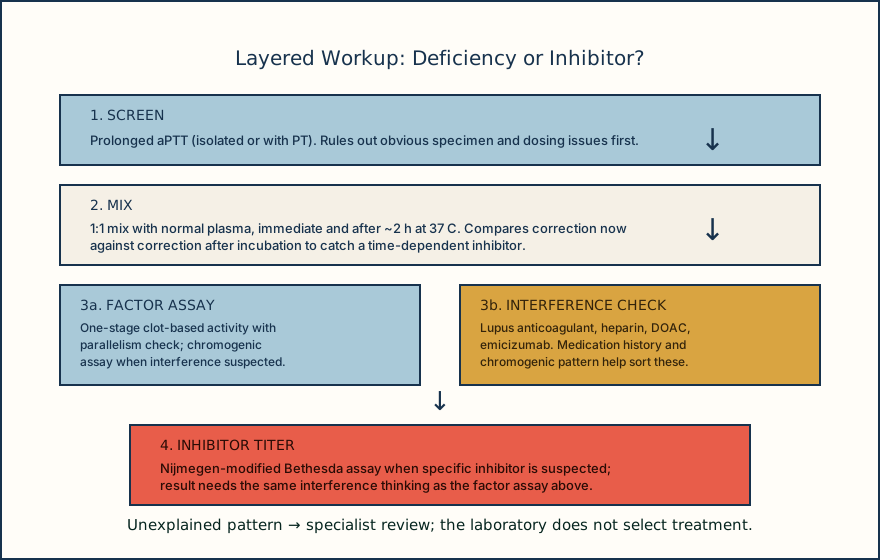
From a prolonged aPTT to a routed mixing study.
Screening aPTT flags the problem
An isolated prolonged aPTT with a normal PT points toward the intrinsic pathway, including FVIII, FIX, FXI, FXII, or an inhibitor of one of those factors.
Run the immediate 1:1 mix
Patient plasma is mixed 1:1 with normal pooled plasma and the aPTT is repeated right away. Correction toward the reference interval favors a simple deficiency.
Compare against the incubated mix
The same mix is held roughly 2 hours at 37 C and retested. Worsening after incubation favors a time-dependent inhibitor rather than a static deficiency.
Route to factor assay and inhibitor studies
The correction pattern, together with medication history, decides whether the next step emphasizes a factor assay, an interference check, an inhibitor titer, or several of these together.
Knowledge checks
Reading and checks are open. Sign in only to save.
Knowledge check 1
Knowledge check 2
Section status
Finish this section
Reading and checks are open. Sign in only to save.
The module finishes after every required section is marked done and every check in those sections is correct.