Required section · Section 3 of 6
Parallelism, Chromogenic Methods, and Interference
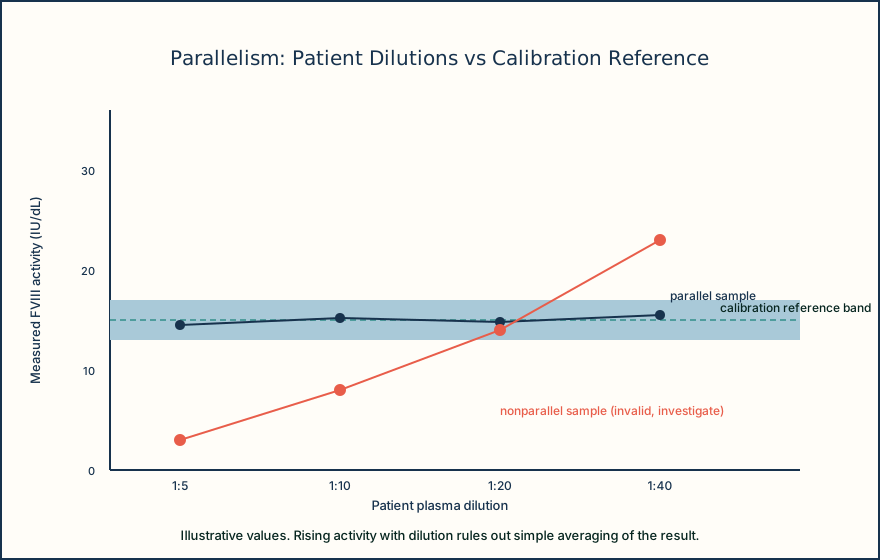
Before a factor activity is interpreted, the patient's serial dilutions should track parallel to the calibration curve. A parallel result means the patient's dilution curve has the same shape as the reference curve, just offset by the activity level, which is the assumption the one-stage assay depends on. A nonparallel result, where activity rises or falls in a way that does not track the calibrator, can signal an inhibitor or an activated sample rather than a stable factor level. A nonparallel result should trigger investigation and repeat testing at a different dilution, not averaging across dilutions to produce a single number.
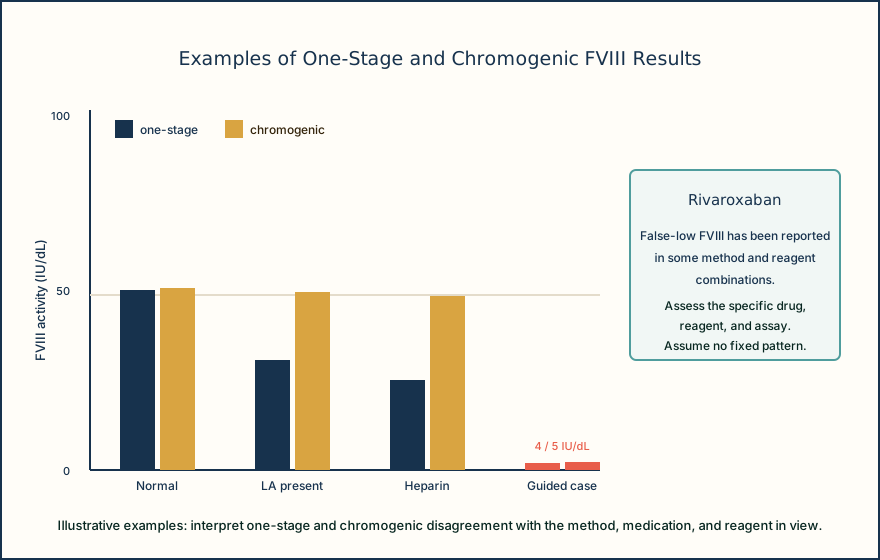
A chromogenic FVIII (or FIX) assay works differently. Instead of timing a clot, it measures factor-dependent generation of activated factor X (FXa), detected by cleavage of a chromogenic substrate and read photometrically against a standard curve. Because it does not depend on the same phospholipid-dependent clotting reaction as the one-stage assay, a chromogenic FVIII result can help resolve a low one-stage FVIII result when lupus anticoagulant (LA) is suspected, since chromogenic assays are usually insensitive to that interference. LA can also lower apparent intrinsic factor activities on clot-based assays generally, and it can coexist with a true FVIII problem, so a low one-stage result with LA present is not automatically explained away.
Several other interferences deserve a name check at this stage. Recent heparin can materially depress a one-stage FVIII result while leaving a chromogenic FVIII result largely unaffected, based on a comparison study of methods. DOACs can cause false factor activity results in clot-based assays, with the direction and size of the effect depending on the specific drug, reagent, and assay design; rivaroxaban in particular has produced false-low FVIII and FIX activities in a multicenter assessment. Emicizumab, a bispecific antibody therapy, shortens aPTT-based FVIII assays and clot-based inhibitor studies, so a bovine-reagent chromogenic FVIII method is required for FVIII inhibitor measurement when a patient is on emicizumab.
FVIII inhibitors themselves are frequently time- and temperature-dependent, which is why the immediate and roughly 2-hour, 37 C incubated mix results are compared rather than relying on either alone. Multiple factor deficiencies, prolonging both PT and aPTT together, point toward a different differential: reduced hepatic synthesis or vitamin K deficiency rather than a single specific inhibitor. A broad multi-factor deficiency pattern does not, by itself, support a single-factor inhibitor conclusion.
Before trusting a low FVIII result, check parallelism, check the medication history, and consider whether a chromogenic assay would separate a true deficiency from an assay artifact.
Illustrative drawing — this picture was drawn rather than captured.
Illustrative drawing — this picture was drawn rather than captured.
| Interference | Effect on one-stage FVIII | Effect on chromogenic FVIII | Why it matters here |
|---|---|---|---|
| Lupus anticoagulant | Can be falsely low | Usually not affected | Can coexist with true low FVIII; does not exclude an inhibitor by itself |
| Recent heparin | Can be falsely low | Not affected in the cited comparison | Medication history should be checked before trusting a low one-stage result |
| Rivaroxaban (DOAC) | Falsely low in multicenter data | Effect depends on drug, reagent, assay | Timing of last dose belongs in the workup |
| Emicizumab | Falsely shortens clot-based results | Bovine-reagent chromogenic required for inhibitor testing | Standard clot-based inhibitor testing is not valid during therapy |
Knowledge checks
Reading and checks are open. Sign in only to save.
Knowledge check 1
Knowledge check 2
Section status
Finish this section
Reading and checks are open. Sign in only to save.
The module finishes after every required section is marked done and every check in those sections is correct.