Required section · Section 4 of 6
Working the Case: Low FVIII, Two Methods, One Titer
Return to the case. The isolated prolonged aPTT (68.4 s) with a normal PT (11.8 s) already pointed at the intrinsic pathway. The mixing study showed partial correction immediately (39.1 s) and worse correction after 2-hour, 37 C incubation (61.7 s), a pattern that favors a time-dependent inhibitor over a static single-factor deficiency, though the mixing study alone does not establish or exclude that conclusion.
The one-stage FVIII activity comes back at 4 IU/dL, and the chromogenic FVIII activity comes back at 5 IU/dL, both far below the local adult interval of 50-150 IU/dL. Because both a clot-based method and a substrate-cleavage method agree on a very low result, lupus-anticoagulant-only depression of a one-stage number is less likely here, though it is not fully excluded by two low numbers alone. FIX and FXI are not shown as depressed in this case, which keeps the picture focused on FVIII rather than a broad multi-factor pattern.
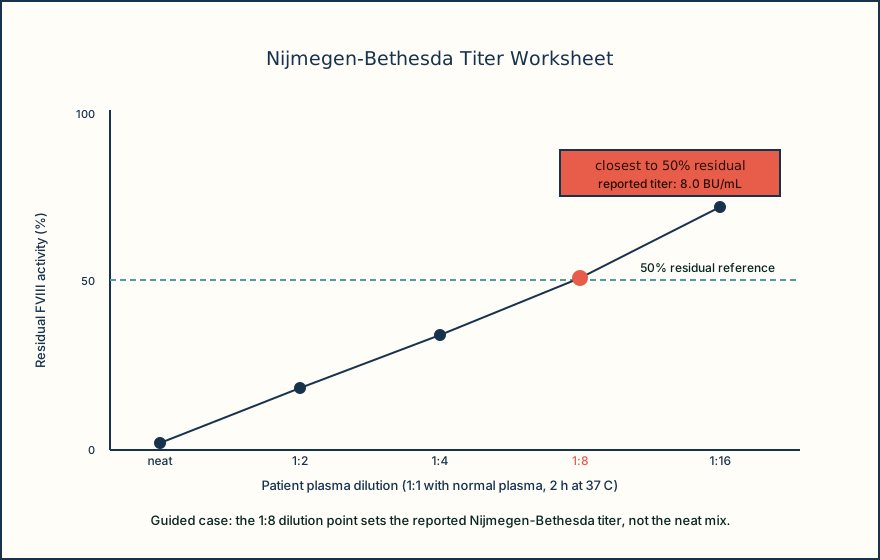
A Nijmegen-modified Bethesda titer is run next. A Bethesda unit (BU) is defined as the amount of inhibitor that neutralizes 50% of FVIII activity in normal plasma after 2 hours at 37 C. Because acquired FVIII inhibitors often show nonlinear, type 2 kinetics, the assay runs a series of patient plasma dilutions mixed 1:1 with normal plasma, and the dilution whose residual FVIII activity lands closest to 50% is the one used to calculate the reported titer, not the neat (undiluted) mix. In this case the 1:8 patient dilution produces residual FVIII activity closest to 50%, and that dilution point is used to report a titer of 8.0 BU/mL, a detected result.
The Nijmegen modification improves specificity at low titers compared to the classic Bethesda method, but it does not eliminate lupus anticoagulant interference on its own; a low-positive Bethesda result can still reflect LA rather than a true FVIII-specific inhibitor. Validated preanalytical heat treatment can remove residual FVIII activity before inhibitor testing in some protocols, but a heat-treatment step by itself does not prove a result is a specific inhibitor rather than an artifact. The titer estimates functional inhibition under the stated incubation conditions; it does not measure bleeding severity or predict how the patient will bleed.
Putting the pieces together, this case shows an unexplained isolated prolonged aPTT, low FVIII by two independent methods, a worsening mixing pattern on incubation, and a detected Nijmegen-Bethesda titer. That combination supports an acquired FVIII inhibitor pattern (consistent with acquired hemophilia A), but low FVIII has other differentials, and mixing studies are too poorly standardized to establish or exclude that diagnosis on their own. The medication history recorded no heparin, DOAC, or emicizumab, which removes some but not all of the interference explanations discussed earlier.
Report the titer from the dilution closest to 50% residual activity, not the neat mix, and treat a detected titer as one piece of an unexplained pattern that still needs full workup and specialist review.
Illustrative drawing — this picture was drawn rather than captured.
| Test | Result | Local interval or context | Flag |
|---|---|---|---|
| PT | 11.8 s | 10.5-13.5 s | None |
| aPTT | 68.4 s | 25.0-35.0 s | High |
| Immediate 1:1 mix aPTT | 39.1 s | Local mixing interpretation required | Partial correction |
| 2 h, 37 C 1:1 mix aPTT | 61.7 s | Local mixing interpretation required | Persistent prolongation |
| FVIII one-stage activity | 4 IU/dL | Local adult interval 50-150 IU/dL | Low |
| FVIII chromogenic activity | 5 IU/dL | Local adult interval 50-150 IU/dL | Low |
| Nijmegen-modified Bethesda result | 8.0 BU/mL | Reported in BU/mL; local verification applies | Detected |
| Patient plasma dilution | Residual FVIII activity (%) | Closest to 50% residual | Contribution to reported titer |
|---|---|---|---|
| Neat (1:1 mix, undiluted patient) | 8 | No | Too far from 50%; not used |
| 1:2 | 18 | No | Too far from 50%; not used |
| 1:4 | 33 | No | Closer, still not selected |
| 1:8 | 51 | Yes | Selected point; reported titer 8.0 BU/mL |
| 1:16 | 71 | No | Past the 50% point; not used |
Knowledge checks
Reading and checks are open. Sign in only to save.
Knowledge check 1
Knowledge check 2
Section status
Finish this section
Reading and checks are open. Sign in only to save.
The module finishes after every required section is marked done and every check in those sections is correct.