Required section · Section 3 of 6
Variables that change the answer
Specimen quality drives everything downstream. An underfilled citrate tube can lengthen calcium-dependent clotting assays because the blood-to-citrate ratio is wrong, and a line draw can be confounded by heparin or another anticoagulant, so collection history is a high-yield discriminator before any interpretation begins. The laboratory applies its own validated handling, centrifugation, storage, and stability limits rather than a universal time rule, so refer to local procedure for the exact figures.
Case 2, bleeding history with normal PT and aPTT: normal screens do not exclude von Willebrand disease (VWD) or a qualitative platelet disorder. Initial VWD testing is VWF antigen, platelet-dependent VWF activity, and factor VIII activity, read together with the bleeding history. VWF is an acute-phase reactant, so stress, acute bleeding, trauma, pregnancy, and inflammation can raise it and complicate a baseline assessment. Platelet aggregometry is separate specialized testing with its own specimen, agonist, control, and interpretation requirements; it is not interchangeable with the VWD-specific assay set.
Case 5, an inhibitor workup with a nonparallel factor assay: one-stage intrinsic factor assays are clot-based and can be distorted by lupus anticoagulant (LA), a factor inhibitor, or an anticoagulant. Nonparallel dilution behavior raises concern for analytical interference or an inhibitor; it is not proof of a specific one. Inspect the dilution curve and, where the laboratory has one validated, run a chromogenic factor VIII assay on the same specimen; otherwise use another validated method. The chromogenic assay measures factor VIII activity through a different chemistry and is usually insensitive to LA, but it is not immune to every interference, and a true factor VIII inhibitor lowers activity by both methods. Agreement supports that the low activity is reproducible across methods but does not name its cause. Disagreement points to assay-specific interference and calls for a targeted interference workup before either number is released with a definitive interpretation.
Case 6, an LA workup during anticoagulation: direct oral anticoagulants (DOACs) can cause false-positive or false-negative LA findings in phospholipid-dependent clotting assays. If clinically safe, LA testing is best obtained without anticoagulant interference, and any drug interruption is a prescriber decision, not a laboratory instruction. When testing cannot be deferred, the report and any communication must state the anticoagulant exposure and the residual limitation it creates. LA evaluation uses phospholipid-dependent screen, mix, and confirm principles across at least two assay systems, commonly a dilute Russell viper venom time (dRVVT) and an LA-sensitive aPTT system, under the laboratory's procedure.
A normal screen, a nonparallel dilution, or an anticoagulated LA panel each carries a specific caveat, and stating that caveat is part of a complete result, not an afterthought.
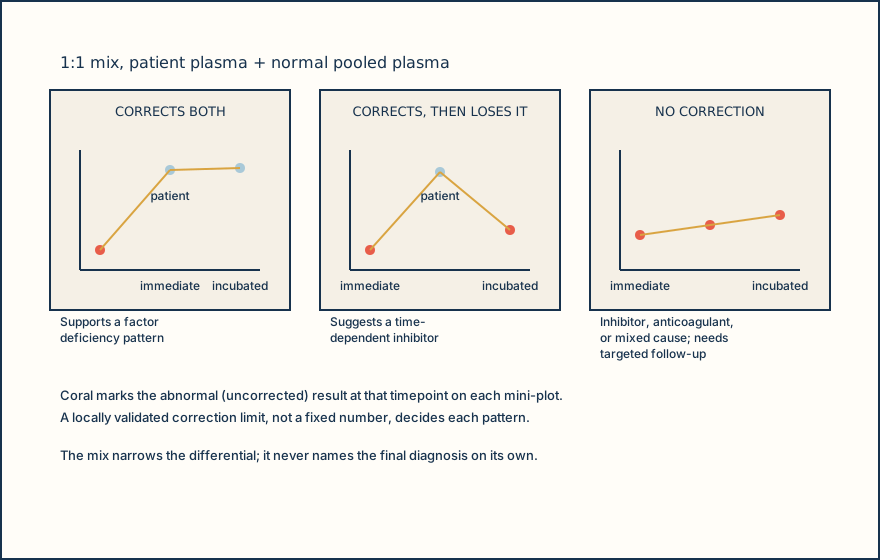
Illustrative drawing — this picture was drawn rather than captured.
| Test | Interval | Unit |
|---|---|---|
| PT | 10.0-13.0 | s |
| aPTT | 25-35 | s |
| Fibrinogen | 200-400 | mg/dL |
| D-dimer | less than 0.50 | mg/L FEU |
| Platelets | 150-400 | x10^9/L |
| Factor VIII activity | 50-150 | IU/dL |
| VWF antigen | 50-200 | IU/dL |
| VWF activity | 50-200 | IU/dL |
Knowledge checks
Reading and checks are open. Sign in only to save.
Knowledge check 1
Knowledge check 2
Section status
Finish this section
Reading and checks are open. Sign in only to save.
The module finishes after every required section is marked done and every check in those sections is correct.