Required section · Section 4 of 6
One result, worked end to end
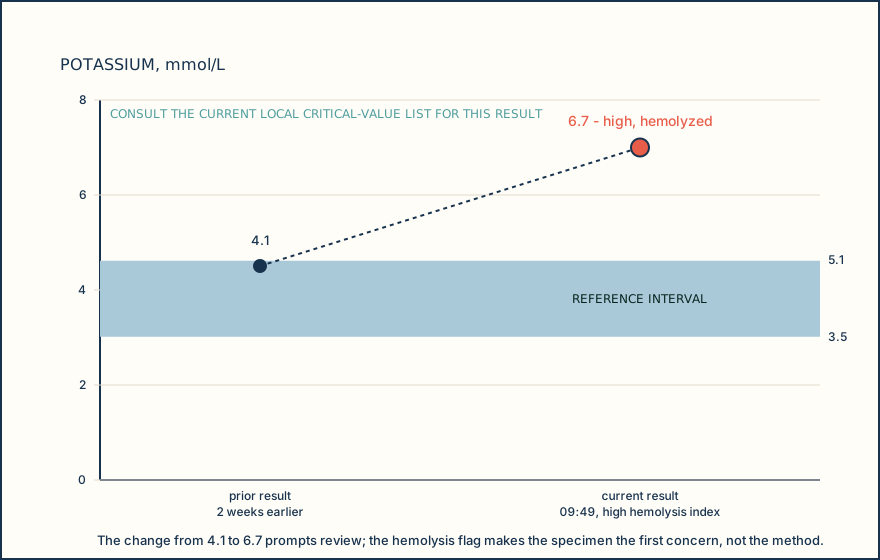
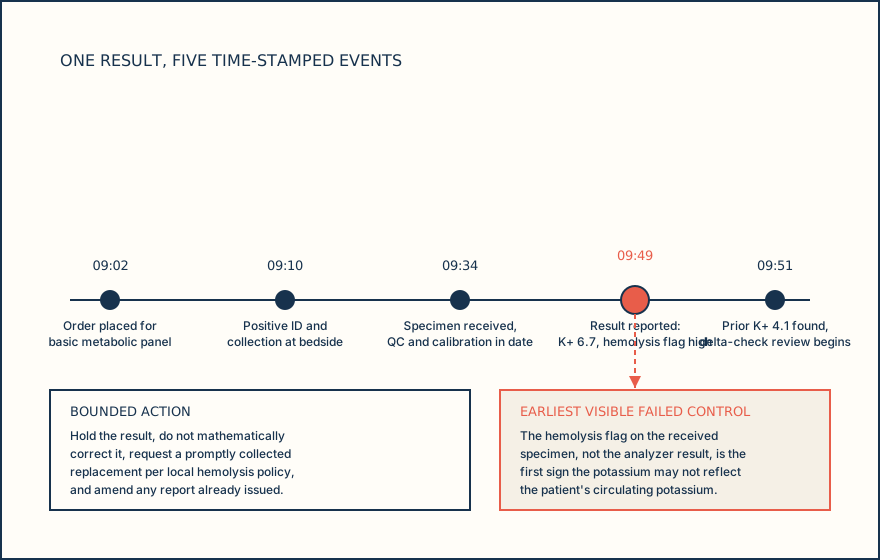
An adult emergency-department patient has an order for a basic metabolic panel entered at 09:02. The collector positively identifies the patient and labels a serum separator tube at the bedside at 09:10. The tube reaches the laboratory and is logged at receipt at 09:34. On the routine chemistry analyzer, quality control is acceptable and the current reagent and calibrator status is in date. The analyzer reports at 09:49 with a potassium of 6.7 mmol/L against a local adult reference interval of 3.5 to 5.1 mmol/L, flagged high, and a high hemolysis index flagged as an interferent. Sodium, chloride, carbon dioxide, and creatinine are all within their reference intervals.
At 09:51, the technologist reviewing the result sees a prior potassium of 4.1 mmol/L drawn two weeks earlier. Under local delta-check rules this triggers a review prompt; it is not by itself proof that today's result is wrong or that the patient's potassium truly changed. What is already visible without any further testing is the high hemolysis index alongside the high potassium. That combination was first detected at receipt and confirmed again in the analyzer's result; the receipt record shows when the hemolysis was first visible, not when or where it actually occurred. Being visible this early in the record, rather than at the analyzer, which performed within its verified specifications, makes the specimen the earliest visible failed control in this case: a specimen that may not represent the patient's circulating potassium.
The method measured potassium accurately in the specimen that reached the analyzer. What the method cannot do is tell the reviewer whether that specimen's potassium matches the patient's circulating potassium, because hemolysis can add potassium that was never in the bloodstream. Separating what was measured from what the result may mean is the whole of the reasoning here: 6.7 mmol/L is a true measurement of an unreliable specimen, not necessarily a true measurement of the patient.
The bounded action follows from that separation. Do not release a mathematically corrected potassium; no accepted correction factor exists for this case. Hold the result, inspect the specimen and the collection and transport record for a preventable cause of hemolysis, and follow local hemolysis and urgent-result policy. If local policy requires recollection, request a promptly collected replacement specimen and document the disposition of the original. If the initially measured value meets the laboratory's own critical-value criteria, communicate the result and the specimen limitation through the approved path and document the recipient, the time, and any required read-back or acknowledgment. When a replacement result is released, any previously issued report is corrected through the amended-report process, with both versions retained (42cfr-493-1291). This case does not direct a specific patient treatment (lippi-2019; ditoro-2022; 42cfr-493-1291).
Illustrative drawing — this picture was drawn rather than captured.
Illustrative drawing — this picture was drawn rather than captured.
| Result | Value | Reference interval | Flag or context |
|---|---|---|---|
| Sodium | 139 mmol/L | 135-145 mmol/L | none |
| Potassium | 6.7 mmol/L | 3.5-5.1 mmol/L | high; consult current local critical-value list |
| Chloride | 103 mmol/L | 98-107 mmol/L | none |
| Carbon dioxide | 24 mmol/L | 22-29 mmol/L | none |
| Creatinine | 0.9 mg/dL | 0.7-1.3 mg/dL | none |
| Hemolysis index | high flag | local assay-specific limit not shown | interferent flag |
Knowledge checks
This section has no knowledge checks.
Section status
Finish this section
Reading and checks are open. Sign in only to save.
The module finishes after every required section is marked done and every check in those sections is correct.