Required section · Section 2 of 6
Three phases, one connected path
The total testing process is conventionally split into three phases: preexamination, examination, and postexamination. Preexamination covers everything from the clinical question and the order through collection, transport, receipt, and specimen preparation. Examination covers the analytic work itself: verified method performance, calibration, quality control, and the analysis. Postexamination covers everything after a number exists: result review, transmission, reference intervals and interpretive comments, critical value communication, acknowledgment, and any corrected report. CLIA regulation organizes laboratory requirements along this same shape, from the test request through the test report (42cfr-493-1241; 42cfr-493-1291).
These phase labels exist to locate controls and handoffs, not to assign blame. A specimen that is hemolyzed in preexamination and an analyzer that autoverifies without a valid interference check in examination are both laboratory quality failures, whether the event happened at a nursing unit, in a courier bag, or at the bench. The Clinical and Laboratory Standards Institute frames quality management as linked processes, assessment, records, and improvement across the whole laboratory service, deliberately not tied to a single physical location (clsi-qms01-ed5). A phase label tells you where to look for the control that should have caught a problem; it does not tell you who to blame.
Positive patient and specimen identification is the clearest example of a control that spans every phase rather than living in one place. CLSI's PRE01 standard describes identification as a process that runs through ordering, registration, collection, labeling, handling, examination, and reporting, not a single check performed once at the bedside (clsi-pre01-ed1). A wristband scan at collection does not protect a result that is mislabeled at receipt or misrouted at reporting. The process map below shows the three phases as connected stages, each with its own steps and its own acceptability decision, so a technologist can see the whole path rather than only the piece in front of them.
When a result looks wrong, start by asking which phase and which handoff it passed through, not by assuming the analyzer is the first place to look.
Illustrative drawing — this picture was drawn rather than captured.
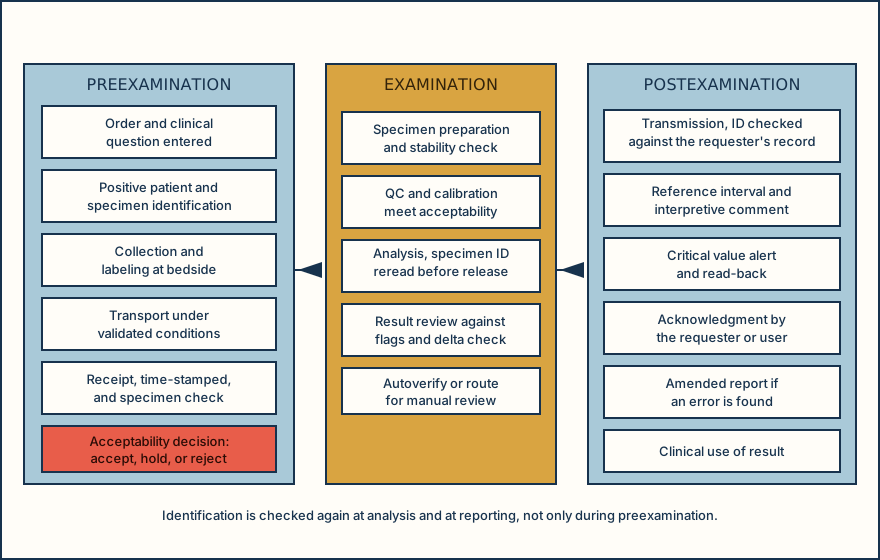
The total testing process as three connected phases with steps and acceptability decisions at relevant stages.
Order and clinical question
An authorized requester submits a written or electronic request naming the patient, the test, and information needed for accurate testing (42cfr-493-1241).
Identification and collection
The collector positively identifies the patient, collects the specimen, and labels it at the patient's side before leaving.
Transport and receipt
The specimen moves under validated conditions and its receipt date and time are documented, making receipt a traceable handoff (42cfr-493-1242).
Preparation and analysis
The specimen is checked for acceptability, then analyzed on a method with verified or established performance specifications (42cfr-493-1253).
Result verification
Control results meet acceptability criteria and the result is checked against reference intervals, delta rules, and autoverification logic before release (42cfr-493-1256).
Reporting, acknowledgment, and use
The report reaches the requester with identification, units, and interpretive context; critical results require direct alerting, and any error requires a prompt corrected report (42cfr-493-1291).
Knowledge checks
Reading and checks are open. Sign in only to save.
Knowledge check 1
Knowledge check 2
Section status
Finish this section
Reading and checks are open. Sign in only to save.
The module finishes after every required section is marked done and every check in those sections is correct.