Required section · Section 3 of 6
Reading the rules: warning, rejection, and the error they point to
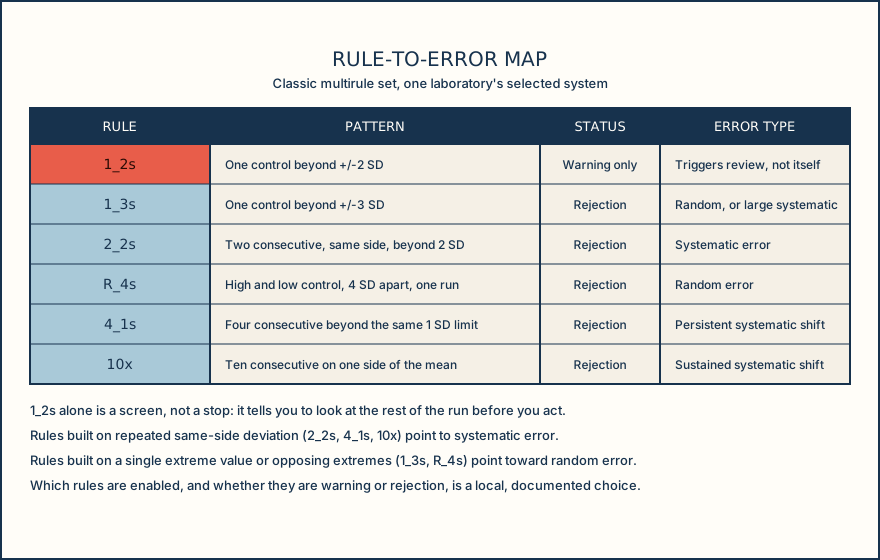
The classic multirule procedure described by Westgard, Barry, Hunt, and Groth uses a single 1_2s result, one control beyond +/-2 SD, as a warning. On its own, a 1_2s violation does not reject the run; it is a trigger to look at the rest of the QC pattern for that run and recent runs. Whether 1_2s is even enabled as a formal warning step, and what happens next, is a local, documented choice, not a universal requirement.
In the same classic procedure, 1_3s, 2_2s, R_4s, 4_1s, and 10x are rejection rules when a laboratory includes them in its selected system. A 1_3s violation, a single result beyond +/-3 SD, and R_4s, an opposing high-low spread of at least 4 SD within one run, are both primarily sensitive to random error: a single wild point or a swing between two extremes. A 2_2s violation, two consecutive same-side results beyond 2 SD, a 4_1s violation, four consecutive results beyond the same 1 SD limit, and a 10x violation, ten consecutive results on one side of the mean, are all built on a repeated same-side pattern and are primarily sensitive to systematic error, a shift or drift rather than a single outlier.
Whether a rule applies within one run or across a sequence of runs is a local decision that must be declared. In the guided case here, R_4s is evaluated only within a run, while 2_2s, 4_1s, and 10x are carried across sequential QC observations. CLSI C24 requires the laboratory to define run boundaries and the sequence convention for rules like these, because the same rule name can mean a different check depending on how a run is bounded locally.
Adding rules to a QC procedure generally improves detection of smaller systematic shifts compared with 1_3s alone, but every added rule also raises the chance of a false rejection, a control flagged as unacceptable when the system is actually working. This tradeoff is why laboratories select a rule set for a given method and quality goal rather than running every possible rule on every result. A rule pattern also only suggests an error class; it does not identify the cause. The investigation still has to look at the actual measuring system, reagents, calibration, and QC history, not just the rule name.
Not every control level has to behave identically, because error and method performance can be concentration dependent; a shift visible in a high-level control may not show at a low level, or the reverse. CLSI C24 also does not prescribe one QC strategy for every device or technology, and a risk-based plan, following an approach like CLSI EP23, weighs the measuring system, laboratory environment, clinical use of the result, manufacturer information, and applicable regulation. Frequency and schedule, including patient volume and time between QC events, are part of that same risk assessment. CMS describes an Individualized Quality Control Plan (IQCP) as one alternate QC option under 42 CFR 493.1250, built from a risk assessment, a quality-control plan, and ongoing quality assessment; it is not automatic permission to run fewer controls, and absent an approved alternative a laboratory follows the manufacturer's stated control number and frequency.
Illustrative drawing — this picture was drawn rather than captured.
Knowledge checks
Reading and checks are open. Sign in only to save.
Knowledge check 1
Knowledge check 2
Knowledge check 3
Knowledge check 4
Section status
Finish this section
Reading and checks are open. Sign in only to save.
The module finishes after every required section is marked done and every check in those sections is correct.