Required section · Section 3 of 6
Matching each performance characteristic to a study
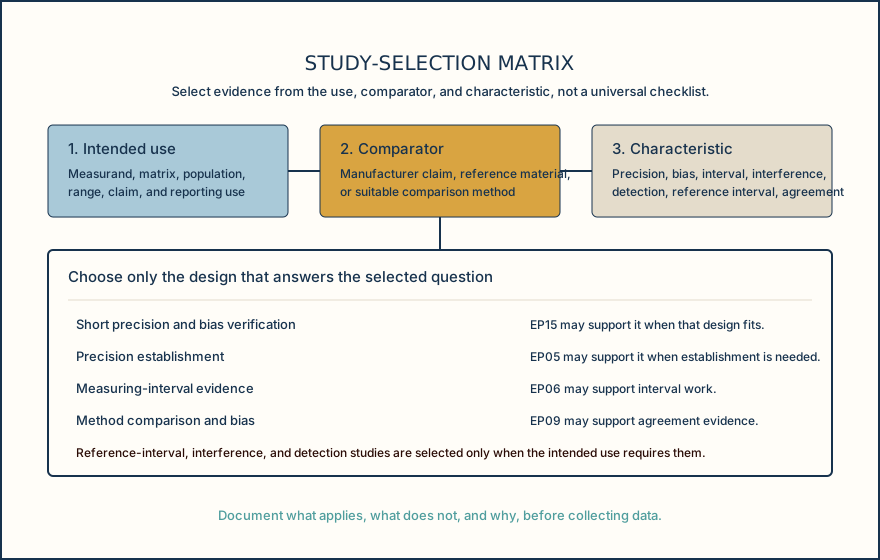
Select a study from three questions: the intended use, the comparator available, and the performance characteristic under review. First classify the method as verification or validation; then document which characteristics apply and why.
For quantitative methods, precision and bias may need evidence; measuring interval, detection capability, interference, reference interval, and comparison evidence are selected only when the intended use and claimed performance make them relevant. A comparison is not automatically required for every modified or noncleared method.
Use the design name only after that selection. EP15 can support a short precision-and-bias verification; EP05 supports broader precision establishment; EP06 addresses measuring-interval work; EP09 addresses comparison and bias against a suitable comparator. These names do not replace the decision about what evidence is needed.
For qualitative or semiquantitative methods, select cutoff-focused precision and agreement evidence appropriate to the intended use rather than applying quantitative CV language.
Write the characteristic, comparator, and acceptance criterion before collecting data, including why a characteristic does not apply.
Illustrative drawing — this picture was drawn rather than captured.
| Scenario | Method status | Pathway | Key studies owed |
|---|---|---|---|
| A | FDA-cleared method, used exactly per package insert | Verification | Precision, bias, reportable-range spot check, reference interval fit |
| B | FDA-cleared method with a laboratory-changed dilution step | Validation | Precision, bias, reportable range, specificity/interference, reference interval, all established locally |
| C | Laboratory-developed qualitative assay, no FDA clearance | Validation | Precision near cutoff (C5/C50/C95), PPA/NPA/OPA against a comparator, interference, stability |
Knowledge checks
Reading and checks are open. Sign in only to save.
Knowledge check 1
Knowledge check 2
Section status
Finish this section
Reading and checks are open. Sign in only to save.
The module finishes after every required section is marked done and every check in those sections is correct.