Required section · Section 5 of 6
Deciding what a plan still owes
A colleague brings a draft verification plan for a second, unrelated FDA-cleared assay. The draft states the precision design, the bias criterion, and the reference interval check. It says nothing about the reportable range: no linearity spot check, no statement of what interval the laboratory intends to report, and no acceptance criterion for that check. The instrument's package insert claims a measuring interval of 2 to 800 ng/mL, but the draft plan is silent on whether that full interval will be verified or whether the laboratory intends to report a narrower range.
This is the same gap the opening problem named: a plan that is not obviously wrong, but is not complete enough to be judged. The learner has to decide what to do with this draft before it goes to the director, using the same classification and study-selection reasoning worked through above, and has to be able to say specifically what evidence is missing, not just that something feels incomplete.
The decision also has to account for what happens after go-live. A validation or verification is not a one-time event; a later change to reagent lot, instrument, software version, specimen type, or procedure can retrigger some or all of the same study work, and the laboratory needs a readiness sequence, not just a study result, before any method starts reporting patient results.
An incomplete study plan is a specific, nameable gap, not a vague concern, and naming the exact missing characteristic and its criterion is what turns a review comment into something the plan's author can act on.
Illustrative drawing — this picture was drawn rather than captured.
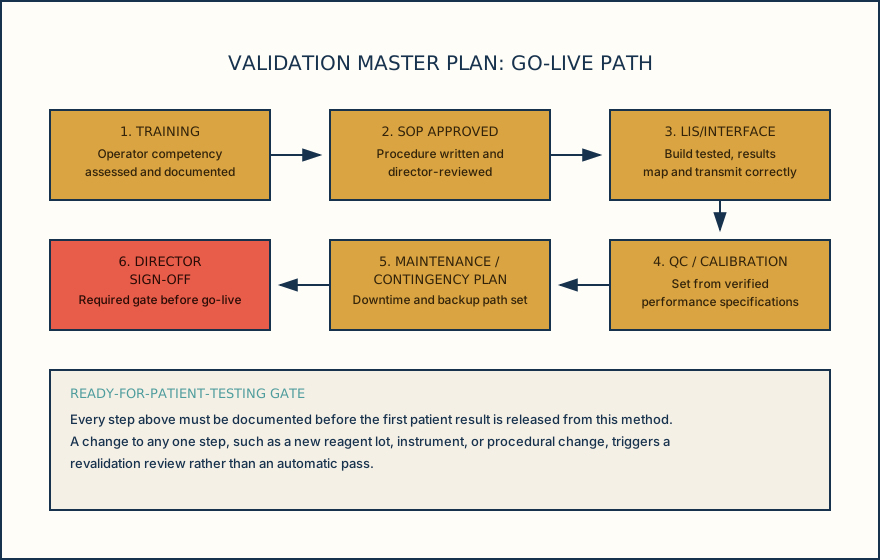
Ordering exercise
Put these go-live readiness activities in the order they need to close, ending with the step that has to come last before the method reports a patient result.
1. Obtain director sign-off
The laboratory director reviews the completed study and readiness activities and approves the method for patient testing.
2. Document a maintenance and contingency plan
A downtime and backup testing path is written down before the method is relied on for patient care.
3. Set QC and calibration procedures
QC ranges and calibration schedules are set from the performance specifications verified or established in the study.
4. Build and verify the LIS interface
Results map correctly from the analyzer to the laboratory information system and transmit as expected.
5. Approve the SOP
The written procedure reflects how the method is actually run and is reviewed and approved.
6. Train and assess operator competency
Staff who will run the method are trained and their competency is documented.
Knowledge checks
Reading and checks are open. Sign in only to save.
Knowledge check 1
Knowledge check 2
Section status
Finish this section
Reading and checks are open. Sign in only to save.
The module finishes after every required section is marked done and every check in those sections is correct.