Required section · Section 5 of 6
A failed high-end point after post-maintenance
A different method on the same analyzer family undergoes calibration verification after a post-maintenance trigger, following major preventive maintenance. Levels 1 through 4 pass. Level 5, near the AMR ceiling, does not: assigned value 705 mg/dL, observed mean 810 mg/dL, a +15% difference that exceeds the laboratory's documented ±8%/±6 mg/dL limit at that concentration. CAP requires the laboratory to define and follow acceptability criteria for calibration verification; a level that misses the defined limit calls for evaluation, investigation, and documented resolution under that criteria, not for discarding it and moving on.
The procedure and laboratory decide the go-live response: restrict the reportable range pending investigation, recalibrate and repeat the verification, delay go-live, or use another approved route. Four passing levels do not override the failed high point.
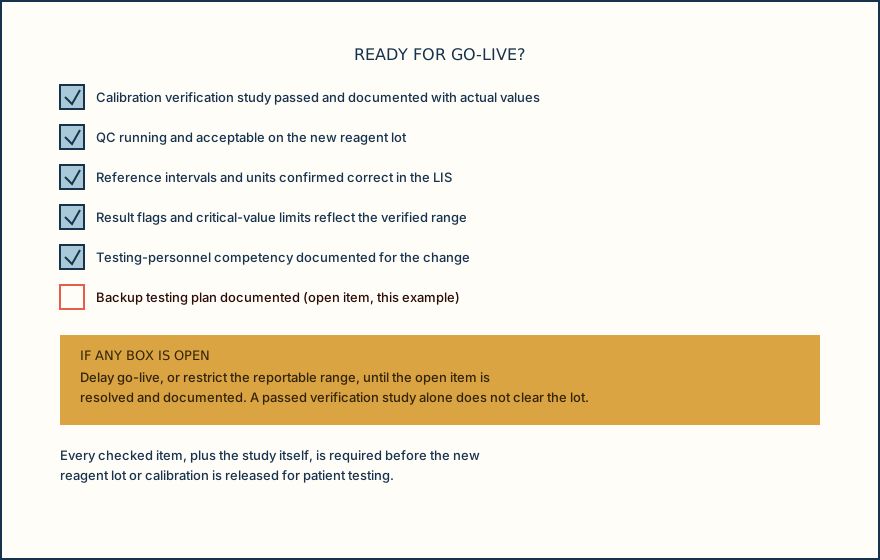
Whichever path is chosen, the record has to show the actual measurements, the target values, and the calculations obtained, not a statement that the study was performed. CMS survey guidance is explicit that this kind of general assertion does not substitute for the numbers. The go-live checklist below lists what has to be true, beyond the study itself, before any lot or calibration change reaches patient testing: QC acceptable, reference intervals and units configured correctly in the LIS, critical-value and flag limits matched to the verified range, personnel competency documented, and a backup testing plan in place.
A single failed high-end point is a reason to restrict the range or investigate, not a reason to average it away against four passing levels.
Illustrative drawing — this picture was drawn rather than captured.
Ordering exercise
The level 5 point failed after post-maintenance. Put the response into the defensible order, from first action to releasing the lot.
1. Update the LIS
Configure reference intervals, units, result flags, and critical-value limits in the laboratory information system to match the verified range.
2. Release the lot for patient testing
Only after every prior step is complete and documented does the new reagent lot or calibration go live for patient results.
3. Investigate the failing point
Review the level 5 result for a specimen, dilution, calculation, or instrument cause before deciding what to do about the range.
4. Confirm QC and competency
Confirm QC is running and acceptable on the new range, and confirm testing-personnel competency and a backup testing plan are documented.
5. Restrict the range or recalibrate
Based on the investigation, either restrict the reportable range below the failing level or recalibrate the method.
6. Repeat calibration verification
Re-run the affected levels to confirm the restricted range or the recalibrated method now meets the acceptance limit.
Knowledge checks
Reading and checks are open. Sign in only to save.
Knowledge check 1
Section status
Finish this section
Reading and checks are open. Sign in only to save.
The module finishes after every required section is marked done and every check in those sections is correct.