Required section · Section 4 of 6
Working the case: from Five Whys to a stated system cause
Start with the specific statement CAP and CLSI QMS11 both expect: on 2026-06-03 at 09:40, one hemolyzed plasma potassium result of 7.6 mmol/L was released from the core lab chemistry bench without hemolysis-index (H-index) review; the ordering unit called at 10:15; a repeat drawn at 10:30 reported 4.4 mmol/L, not hemolyzed, at 10:52. That is a process, a scope, a time window, and evidence, not 'a tech missed a flag.' CMS interpretive guidance directs the laboratory, once a flag-review failure like this surfaces, to check patient results from the affected run and since the last confirmed acceptable check, not only the one result that prompted the callback, before testing resumes on that pathway.
The correction happened fast: supervisor notified at 10:20, LIS report amended with a corrected-report comment at 10:55, ordering clinician given the corrected value at 10:58. That closes the immediate patient-safety gap. The investigation asks a separate question: why was this technologist, on this shift, able to release a flagged result at all, and why did nothing else catch it first.
Five Whys traced it back one layer at a time. The flag was not reviewed because the technologist released the result without checking it. The flag was not checked because the LIS work list the technologist actually used never showed it, the H-index flag lived only inside the instrument's own software.
The LIS rule did not hold flagged potassium results because that rule was built at go-live, before the analyzer's method added an H-index-driven potassium hold, and the rule was never updated afterward. The rule was not updated because change control had no defined trigger for routing analyzer interface or flagging changes to the LIS rule-build team.
And change control had no such trigger because its scope had only ever covered reagent and calibration changes, not interface or flagging logic. That last statement is the system cause: a scope gap in change control, not a lapse in one technologist's attention.
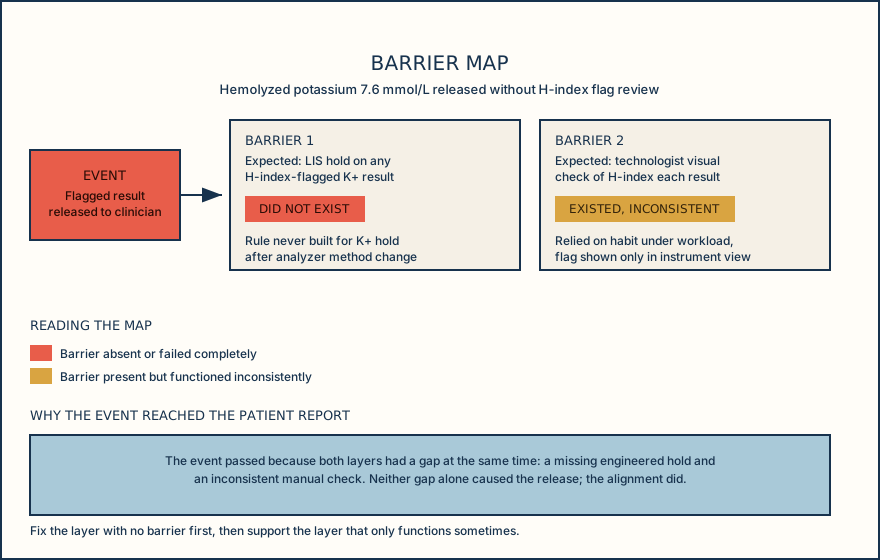
A barrier analysis on the same event asks a narrower question and gets a sharper answer. Two defenses should have caught this before release: an LIS hold on any H-index-flagged potassium result, and a technologist's visual check of the flag on every chemistry result. The first did not exist. The second existed but functioned inconsistently under workload, because the flag was easy to miss inside a busy run. Reason's Swiss-cheese framing fits this exactly: the event reached the patient report because both layers had a gap open at the same time, not because either gap alone was fatal.
Mapped against the nine contributing categories, this event touches interface (the flag's location), policy (change-control scope), training (reliance on habit over a system check), and communication (the method change never reaching the LIS team). It does not implicate staffing levels, equipment failure, or the analyzer's own performance; the H-index measurement itself worked exactly as designed. A barrier analysis and a Five Whys chain on the same event should agree on the system cause even though they ask the question differently; if they point to different root causes, one of the two was probably stopped too early.
Illustrative drawing — this picture was drawn rather than captured.
Ordering exercise
Arrange these five investigation findings in the order the Five Whys chain actually surfaced them, from the proximate act at the bench to the system cause.
1. Change-control scope gap
Change control covered reagent and calibration changes only, never extended to interface and flagging logic; the system cause.
2. Flag absent from the work list
The LIS autoverification rule did not hold flagged potassium results; the flag displayed only in the instrument's own software.
3. Flag not reviewed
The technologist released the result without reviewing the H-index flag.
4. No change-control trigger
Change control had no defined trigger to route analyzer interface or flagging changes to the LIS rule-build team.
5. LIS rule never updated
The rule was built before the analyzer method added an H-index-driven potassium hold and was never revised afterward.
Knowledge checks
Reading and checks are open. Sign in only to save.
Knowledge check 1
Section status
Finish this section
Reading and checks are open. Sign in only to save.
The module finishes after every required section is marked done and every check in those sections is correct.