Required section · Section 5 of 6
Critiquing the CAPA and defining a bounded effectiveness check
Three corrective-action drafts came out of the event review. The first: 'Retrain the technologist on hemolysis-index review procedure.' The second: 'Add a note to the shift huddle reminding staff to check the H-index before releasing chemistry results.' The third: 'Build an LIS rule that holds any potassium result exceeding the validated H-index action limit for mandatory review before release.' All three are plausible-sounding. Only the third changes what happens the next time a technologist is busy, distracted, or new to the bench, because it does not depend on that person remembering anything in the moment.
The first two sit at the bottom of the action hierarchy: educate and administrative reminder. They are not wrong to include, but a corrective action that stops there leaves the same system gap, an unenforced flag, in place for the next hire, the next busy shift, the next method change nobody thinks to route to the LIS team. CAP expects the laboratory to record the corrective action taken and evaluate whether it worked, and CMS interpretive guidance expects the laboratory to consider patient look-back, provider notification, or retesting when applicable; a training memo alone does not meet that bar for an event with this cause.
The corrective action selected here is the engineering control as the primary corrective action: build the LIS hold on H-index-flagged potassium (and, by extension, other hemolysis-sensitive analytes) results. It pairs that with a standardizing action, extending change control to require LIS rule review whenever an analyzer method or flagging parameter changes, so the same gap does not reopen after the next method update. Education follows, briefing staff on the new workflow once the hard stop exists, not as a substitute for it. A monthly audit of flagged results released without a hold adds a detect layer, feeding a CLSI QMS12-style quality indicator into ongoing monitoring rather than a one-time check.
A quality indicator, per CLSI QMS12, is a defined observation or data point showing how well a process performs, distinct from the goal or the alert threshold attached to it. QMS12 recommends defining a numerator, denominator, data source, frequency, owner, target, and action trigger for each indicator, starting with a small set of high-risk indicators and reviewing trends rather than single data points, because an acceptable overall rate can still hide a localized problem.
A leading indicator, such as the percentage of corrective actions completed on time, can signal performance before recurrence would show up; a lagging indicator, such as a recurrence rate measured over a quarter, describes an outcome after the fact. This case uses both: on-time completion of the LIS build is a leading signal, and the monthly count of flagged results released without a hold is the lagging measure used to assess the action during the planned follow-up period.
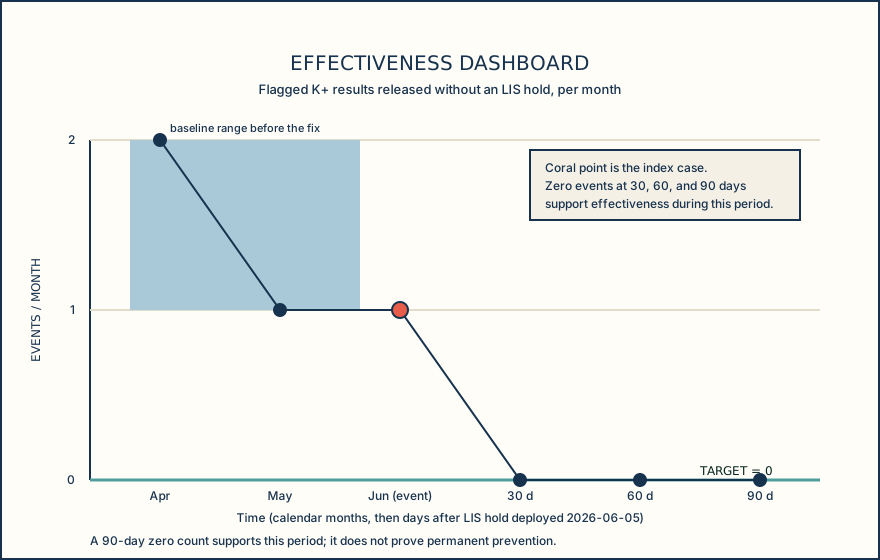
For this event: measure equals the number of H-index-flagged potassium results released without an LIS hold, per month; target equals zero; monitoring period equals 90 days beginning the week the LIS rule deploys; owner is the chemistry supervisor; review is documented in the laboratory's analytic-systems quality-assessment record at 30, 60, and 90 days. Any recurrence found before the 90-day mark escalates to a repeat corrective action rather than closing the record on schedule. A zero count across this case's 90-day period supports effectiveness during that period.
Illustrative drawing — this picture was drawn rather than captured.
| Drafted action | Hierarchy level | Verdict |
|---|---|---|
| Retrain the technologist on H-index review procedure | Educate | Acceptable as a supporting step; unsupported as the primary action |
| Add a huddle reminder to check H-index before release | Administrative reminder | Acceptable as a supporting step; unsupported as the primary action |
| Build an LIS hold on any flagged potassium result before release | Engineer | Preferred: does not depend on a person remembering under workload |
| Period | Flagged results released without a hold | Target | Status |
|---|---|---|---|
| Apr (baseline) | 2 | 0 | Above target |
| May (baseline) | 1 | 0 | Above target |
| Jun (index event) | 1 | 0 | Above target |
| 30 days post-fix | 0 | 0 | At target |
| 60 days post-fix | 0 | 0 | At target |
| 90 days post-fix | 0 | 0 | At target; supports effectiveness during this 90-day period |
Knowledge checks
Reading and checks are open. Sign in only to save.
Knowledge check 1
Knowledge check 2
Section status
Finish this section
Reading and checks are open. Sign in only to save.
The module finishes after every required section is marked done and every check in those sections is correct.