Required section · Section 3 of 6
Choosing a tool, then choosing an action that does not depend on memory
Not every nonconforming event needs the same depth of investigation. CAP and CLSI QMS11 both direct the laboratory to scale the scope and depth of investigation to possible patient impact and contributing factors, and to use a formal root-cause analysis (RCA) when it is warranted, such as for a sentinel event, rather than for every minor event. The Agency for Healthcare Research and Quality (AHRQ) now favors the phrase 'event investigation and contributing-factor analysis' over describing an event as having a single isolated root cause, which fits a proportionate, multi-cause view better than a hunt for one answer.
Five Whys is the fastest tool: starting from a specifically stated problem, ask why repeatedly until you reach a fact-based, actionable contributing factor. AHRQ is explicit that five is not a fixed count, and that an answer must be a fact you can verify, not an assumption or a guess about someone's intent. A fishbone (Ishikawa) diagram earns its place when several plausible causes interact at once; it organizes candidates along branches, task, tools, environment, staffing, training, communication, interface, policy, and leadership, so a team does not fixate on the first plausible cause it finds. Barrier analysis asks a narrower question: which defenses should have prevented the event, did each one exist, and did it actually function, then prioritizes gaps by a likelihood-by-severity score before an action plan is built.
Failure Modes and Effects Analysis (FMEA) is different in direction: instead of starting from an event that already happened, it starts from a process before anything goes wrong. CLSI EP23 (2nd edition, 2023) describes the workflow: define the intended use of the test, map the testing process, identify plausible failure modes, estimate risk from severity, occurrence, and detectability, decide whether the residual risk is acceptable, and select controls. A common scoring approach multiplies severity, occurrence, and detectability, each typically scored 1 to 10, into a risk priority number (RPN). That numeric scale is common practice, not a fixed requirement in EP23; a laboratory sets its own scoring definitions as local policy.
A low RPN can still hide a single failure mode with unacceptably high severity, a specimen swap or a critical-value miss, so severity-based escalation should never be replaced by RPN ranking alone; a laboratory that only chases the highest RPN number can miss the failure mode that is rare but catastrophic.
Once a cause is identified, the National Institute for Occupational Safety and Health (NIOSH) hierarchy of controls ranks responses from most to least reliable: elimination, substitution, engineering controls, administrative controls, and personal protective equipment, because the higher levels reduce how much the outcome depends on one person remembering to do the right thing at the right moment. Mapped to a laboratory quality context, that becomes eliminate the hazardous step, engineer a hard stop or automation, standardize the process administratively, and educate staff, with detect, ongoing monitoring, added as a laboratory-specific complement.
A control chosen from higher on the hierarchy is not automatically risk-free. NIOSH guidance notes that a combination of controls is usually needed, and that a new control should be evaluated to confirm it does not introduce a different hazard, an over-tight hard stop that blocks a legitimate urgent result is the kind of unintended consequence a laboratory should check for before it goes live, not after. Reach for Five Whys or a fishbone when an event has already happened, reach for FMEA when you are redesigning a process before it fails, and do not let a training memo stand in for an engineered fix.
Illustrative drawing — this picture was drawn rather than captured.
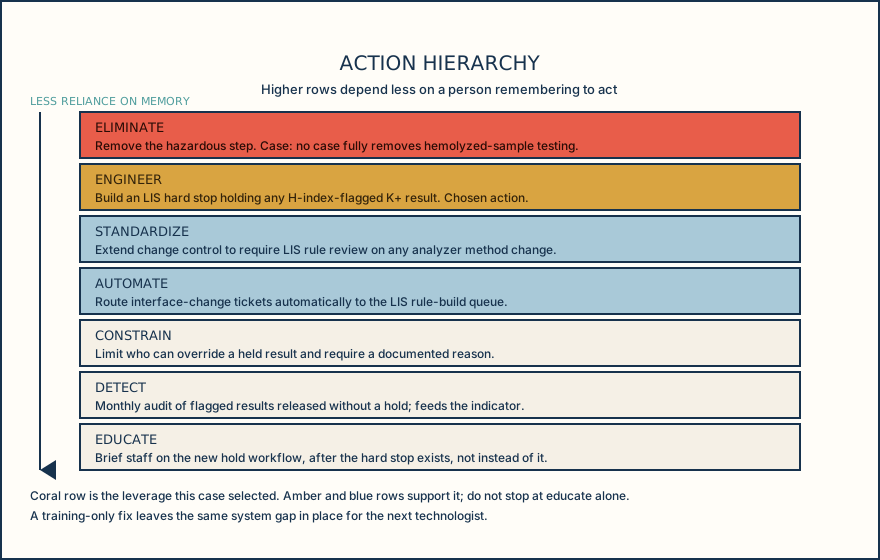
| Level | What it means | Action considered for this case |
|---|---|---|
| Eliminate | Remove the hazardous step entirely | Not applicable; hemolyzed-sample testing cannot be removed from chemistry workflow |
| Engineer | Build a hard stop that does not depend on a person noticing | LIS rule holding any H-index-flagged potassium result for mandatory review |
| Standardize | Change the procedure administratively for everyone | Extend change control to require LIS rule review on every analyzer method change |
| Educate | Train staff on the correct workflow | Brief staff on the new hold, after the hard stop exists, not as the primary fix |
Knowledge checks
Reading and checks are open. Sign in only to save.
Knowledge check 1
Knowledge check 2
Knowledge check 3
Section status
Finish this section
Reading and checks are open. Sign in only to save.
The module finishes after every required section is marked done and every check in those sections is correct.