Required section · Section 3 of 6
The six procedures, who assesses, and how often
CLIA requires moderate- and high-complexity laboratories to demonstrate and document personnel competency for all testing personnel (TP) performing nonwaived testing. Waived-only laboratories are not required to do this under CLIA, though CMS calls documented competency good practice there too. Competency assessment for nonwaived testing has six required procedures, and all six apply to every test a person performs, even when several tests run on one platform: direct observation of routine test performance including specimen handling; monitoring of recording and reporting of results; review of intermediate or worksheet results, QC records, PT results, and preventive-maintenance records; direct observation of instrument maintenance and function checks; assessment using previously analyzed specimens, internal blind samples, or external PT material; and assessment of problem-solving skills.
One exception: Provider-Performed Microscopy (PPM) competency assessment uses only five of the six procedures, dropping direct observation of instrument maintenance and function checks. For PPM testing personnel, who are physicians, dentists, or midlevel practitioners, the laboratory director evaluates competency and may delegate individual procedures in writing to other qualified PPM testing personnel.
For the new-analyzer tracer, first determine whether the person is in the first year of patient testing or later, then apply the current required cadence. Before the person reports patient results on the new system, obtain system-specific competency under the current procedure. A record for a prior instrument does not establish competency on the new system.
Who may perform the assessment depends on complexity. For high-complexity testing, the technical supervisor performs and documents competency, and may delegate in writing to a qualified general supervisor. For moderate-complexity testing, the technical consultant performs and documents it, or someone meeting technical-consultant qualifications. A person who does not meet the regulatory qualifications for that role cannot perform or be delegated a competency assessment, no matter how experienced they are at the bench. Competency assessment is not a CLIA requirement for non-testing personnel such as phlebotomy-only or accessioning staff, though the laboratory director still has to ensure they are monitored for competent performance of their assigned tasks.
If the record is missing, investigate the record and the actual testing history. Record absence is not itself proof that patient testing occurred before competency; state the actual condition found.
Illustrative drawing — this picture was drawn rather than captured.
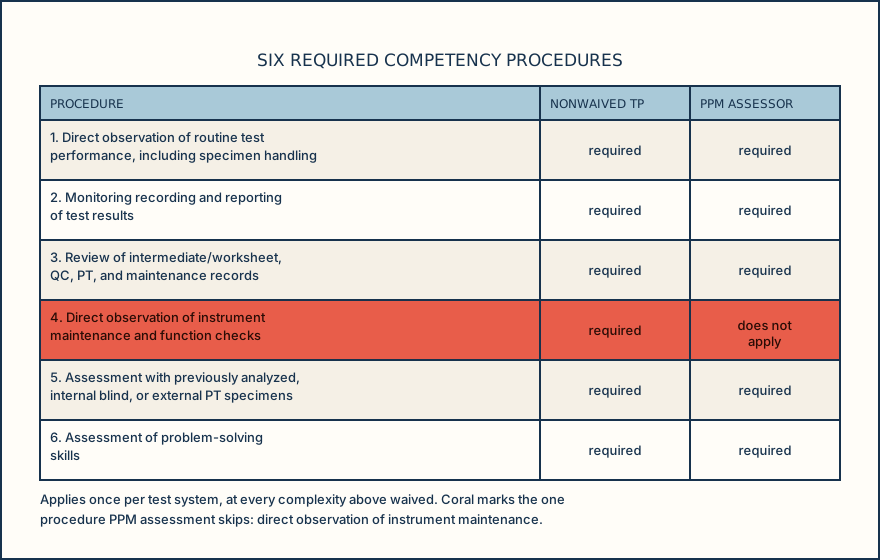
| # | Procedure | Applies to PPM assessment? |
|---|---|---|
| 1 | Direct observation of routine test performance, including specimen handling | Yes |
| 2 | Monitoring recording and reporting of results | Yes |
| 3 | Review of intermediate, QC, PT, and maintenance records | Yes |
| 4 | Direct observation of instrument maintenance and function checks | No |
| 5 | Assessment with previously analyzed, internal blind, or external PT specimens | Yes |
| 6 | Assessment of problem-solving skills | Yes |
| Complexity | Assessor | Delegation |
|---|---|---|
| Waived only | No CLIA requirement | Not applicable; documented good practice |
| PPM | Laboratory director | May delegate individual procedures in writing |
| Moderate | Technical consultant | Or a person meeting technical-consultant qualifications |
| High | Technical supervisor | May delegate in writing to a qualified general supervisor |
Knowledge checks
Reading and checks are open. Sign in only to save.
Knowledge check 1
Knowledge check 2
Section status
Finish this section
Reading and checks are open. Sign in only to save.
The module finishes after every required section is marked done and every check in those sections is correct.