Required section · Section 3 of 6
Immediate response by hazard type
Needlestick or sharps injury: wash the site immediately with soap and running water; do not squeeze the wound and do not apply bleach or another caustic disinfectant. Report the exposure immediately so the employer can arrange a confidential medical evaluation, because testing and any indicated post-exposure prophylaxis are time-sensitive and should not be delayed. The employer documents the route of exposure and circumstances, identifies and, where feasible and legally permitted, tests the source individual, offers baseline testing to the exposed employee, and provides the examining clinician's written opinion to the employee within 15 days of the completed evaluation. If the employee consents to blood collection but declines HIV testing at that time, the sample is preserved for at least 90 days so testing can still occur if requested.
Chemical eye or skin exposure: flush immediately and continuously with water for at least 15 minutes, including holding the eyelids open and moving the eyes to flush under the lids, per current NIOSH/CDC first-aid guidance and ANSI Z358.1. Remove contact lenses only if doing so does not delay the start of flushing.
ANSI/ISEA Z358.1-2014 (reaffirmed 2020) specifies a plumbed eyewash flow of at least 0.4 gallons per minute and an emergency shower flow of at least 20 gallons per minute, both sustained for 15 minutes without the user holding a valve open; OSHA's enforceable requirement, 29 CFR 1910.151(c), requires suitable drenching or flushing facilities where a worker's eyes or body may be exposed to injurious corrosive materials.
A personal eyewash bottle is not a substitute for a compliant 15-minute station; it can bridge the gap until the worker reaches full-flow equipment. Remove contaminated clothing while flushing continues, without spreading the chemical onto unaffected skin.
Cryogenic injury (for example, liquid nitrogen contact): move away from the source and remove contaminated clothing unless it is frozen to the skin, in which case thaw it first with lukewarm water rather than pulling it off. Get emergency medical evaluation even if the area looks minor, because the depth of a cryogenic injury is not obvious at first look. If refreezing is possible, do not rewarm the area in the field; cover it loosely with a clean, dry dressing, keep the person warm, and go for emergency care, because refreezing causes additional tissue damage. Do not rub, massage, or apply direct heat, ice, or ointment, and avoid breaking any blisters.
Fire: the commonly taught sequence is RACE, Rescue anyone in immediate danger if it is safe to do so, sound the Alarm and call 911, Confine the fire by closing doors and fume-hood sashes, and Extinguish only a small, contained fire with the correct extinguisher and a clear escape route, or otherwise Evacuate. Extinguisher operation is commonly taught as PASS: Pull the pin, Aim at the base of the fire, Squeeze the handle, Sweep side to side.
Never fight a fire that is spreading, producing heavy smoke, involves unknown chemicals, blocks the only exit, or is larger than small and contained; evacuate, close the door behind you, and do not re-enter until told it is safe. RACE and PASS are widely used institutional conventions, not a codified OSHA or CLSI requirement; follow the site fire-safety plan for the controlling procedure.
Biological spill or aerosol event: give immediate first aid, decontaminate the surface or biosafety cabinet using an agent-appropriate disinfectant, and report promptly to occupational health so cleansing and any indicated post-exposure care are not delayed, consistent with the bloodborne pathogens standard and BMBL guidance.
For a spill confined to a biosafety cabinet work surface, BMBL describes covering the spill with absorbent material, applying disinfectant from the outside edge toward the center, allowing the labeled contact time (BMBL cites 20-30 minutes as typical, subject to the product label), then wiping toward the center and discarding into biohazard waste, without shutting the cabinet off during the process. The disinfectant, its concentration, and its contact time are set by the laboratory's own spill-control plan and the product label, not by one fixed number that applies everywhere.
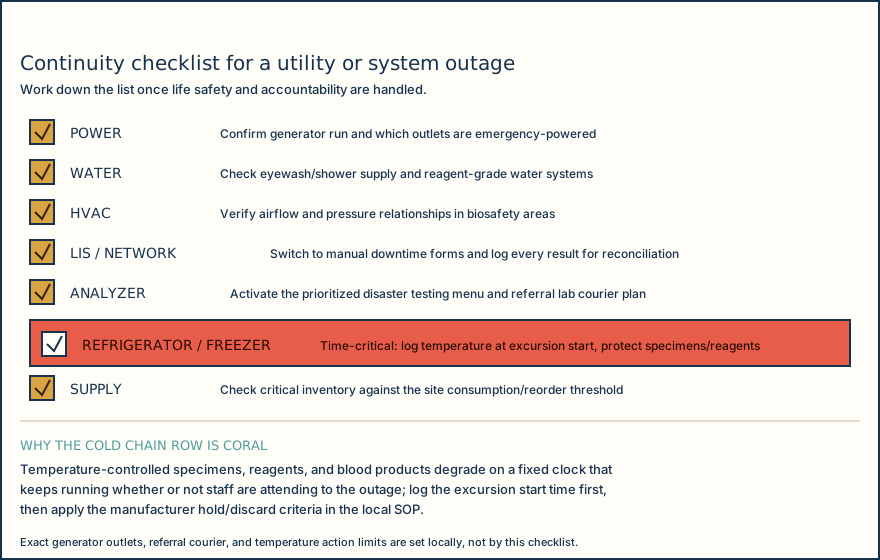
Utility and system failures, power, water, HVAC, LIS/network, analyzer, and refrigerator/freezer interruptions, do not require first aid, but they start the same notification habit: report the failure, then work the continuity checklist in the order safety allows. Match the hazard to its first-aid action before anything else, because the wrong first move (squeezing a puncture, rubbing a frostbite injury, rewarming a refreezing-risk area, or fighting a fire that is already spreading) can add harm that the correct sequence would have avoided.
Illustrative drawing — this picture was drawn rather than captured.
| Equipment | Minimum flow | Minimum duration | Key point |
|---|---|---|---|
| Plumbed eyewash station | 0.4 gallons per minute | 15 minutes continuous | Hold eyelids open and move eyes to flush under the lids |
| Emergency shower | 20 gallons per minute | 15 minutes continuous | Remove contaminated clothing while flushing continues |
| Personal eyewash bottle | Not rated to Z358.1 | Bridge only | Use only until the worker reaches a full-flow station or care |
| System | Immediate concern | Continuity action |
|---|---|---|
| Power | Analyzers and refrigeration lose power | Confirm generator run time and which outlets are emergency-powered |
| Water | Eyewash/shower and reagent water affected | Verify backup supply and post alternate first-aid locations |
| HVAC | Airflow and pressure relationships change | Check biosafety-relevant spaces first |
| LIS/network | Results cannot post electronically | Switch to manual downtime forms and log every result for reconciliation |
| Analyzer | Testing capacity drops | Activate the site's prioritized disaster testing menu and referral courier plan |
| Refrigerator/freezer | Cold chain at risk | Log excursion start time and apply manufacturer hold/discard criteria |
Knowledge checks
Reading and checks are open. Sign in only to save.
Knowledge check 1
Knowledge check 2
Section status
Finish this section
Reading and checks are open. Sign in only to save.
The module finishes after every required section is marked done and every check in those sections is correct.