Required section · Section 2 of 6
One sequence, every hazard
Laboratories face biological, chemical, cryogenic, thermal, mechanical, utility, weather, and security hazards. First protect people: escape danger, give urgent decontamination or first aid when delay worsens harm, isolate if safe, then notify, account for staff, and communicate through the incident structure. The exact first-action bundle changes with the hazard.
OSHA's emergency action plan standard, 29 CFR 1910.38, sets the floor for what a site plan must cover: procedures for reporting an emergency, evacuation procedures including exit-route assignments, procedures for staff who must operate critical equipment before leaving, procedures to account for everyone after evacuation, procedures for staff with rescue or medical duties, and named contacts who can explain the plan. An effective plan also names who has the authority to order evacuation versus shelter-in-place, the primary and alternate routes, the assembly or reunification point, how staff with disabilities or limited English proficiency are assisted, and the accountability method used afterward.
Above the immediate response sits a command structure. The Incident Command System (ICS), used under FEMA's National Incident Management System (NIMS), organizes a response under an Incident Commander with Command Staff (safety, public information, liaison) and General Staff sections for Operations, Planning, Logistics, and Finance/Administration, scaled to the size of the event. Hospitals use a hospital-specific adaptation, HICS. The Incident Commander is the only HICS position always activated; other positions activate only as needed. Routine laboratory operations are commonly represented within the Operations Section's Medical Care Branch under a Clinical Support Services Unit, and a laboratory director or similarly qualified person may separately serve as a Medical-Technical Specialist advising command on testing strategy and biosafety.
CLSI GP36, Planning for Laboratory Operations During a Disaster, is the laboratory-specific all-hazards planning guideline behind this structure. It covers preexamination, examination, and postexamination continuity: essential functions, a prioritized disaster testing menu, staffing contingencies, alternate or referral testing arrangements, utility and equipment failure contingencies, supply contingency stock, and recovery and after-action review. GP36 is meant to be adapted into a site-specific plan, not used as a substitute for one, and it explicitly does not provide procedures for specific diagnostic assays or the analytical aspects of biothreat testing.
The 42 CFR 493.1101 CLIA facilities standard requires a laboratory to be constructed, arranged, and maintained with adequate space, ventilation, and utilities for all testing phases, to minimize contamination, and to have safety procedures established, accessible, and followed against physical, chemical, biochemical, electrical, and biohazardous hazards. CAP accreditation expectations layer on top of that: laboratory-director review and approval of safety policies and procedures, a locally defined emergency-preparedness and response role covering initiation, management, and recovery, a written, workable evacuation plan, safe handling of blood and other potentially infectious spills, and a chemical hygiene plan with a designated responsible person.
Before memorizing any single hazard's steps, know the five-part shape and know who at your site has the authority to call evacuation versus shelter-in-place, because that call is not the bench worker's to make alone.
Illustrative drawing — this picture was drawn rather than captured.
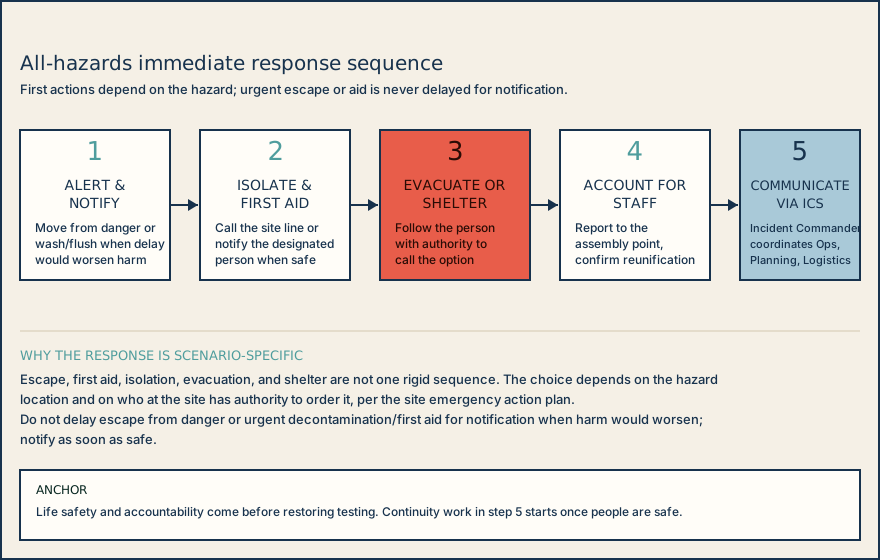
All-hazards decision map; urgent escape and first aid/decontamination are not delayed for notification.
Escape danger or give urgent aid
When delay worsens harm, move away from immediate danger or start urgent first aid/decontamination before notification.
Notify as soon as safe
Once immediate danger is addressed or urgent aid is underway, sound the alarm, call the site line, or notify the designated person.
Isolate, evacuate, or shelter as the hazard requires
Use the scenario-specific safe action and the site emergency plan; do not force every event into one rigid order.
Account for staff
Report to the assembly point or shelter location so accountability and reunification can confirm everyone is safe.
Communicate through incident command
Route ongoing information through the Incident Commander and, in a hospital, the Operations Section so decisions about testing and recovery are coordinated, not improvised.
Knowledge checks
Reading and checks are open. Sign in only to save.
Knowledge check 1
Section status
Finish this section
Reading and checks are open. Sign in only to save.
The module finishes after every required section is marked done and every check in those sections is correct.