Required section · Section 5 of 6
Run the drill: choose the bundle, not just the poster answer
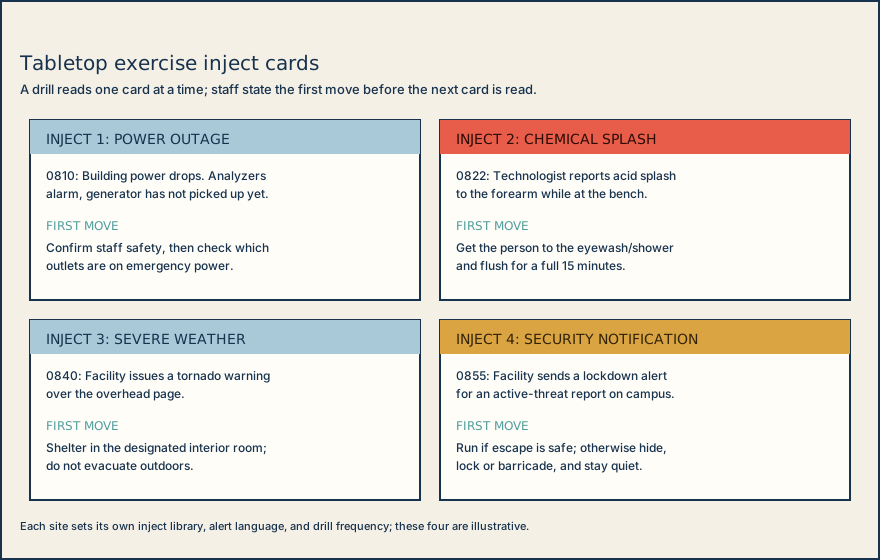
A tabletop exercise reads one inject card at a time and asks staff to state the first move before the next card is read. This is how a laboratory practices the all-hazards sequence without waiting for a real event, and it is how readiness expectations, drill records, and after-action documentation get built ahead of time instead of invented during a crisis.
The decision in front of a learner is rarely a single fact; it is a bundle. For a chemical splash, the bundle is get to the eyewash/shower, flush for the full duration, remove contaminated clothing without spreading the chemical, and report it, not any one of those alone.
For an active-threat notification, CISA and DHS describe Run, Hide, Fight as a set of options assessed in the moment, not a fixed sequence: run or evacuate if it can be done safely, hide or shelter in a location out of view and lock or barricade if escape is not safe, and fight only as an absolute last resort when life is in imminent danger and escape or hiding are not possible.
When law enforcement arrives, remain calm, follow instructions, put down items in hand, keep hands visible, avoid sudden movements or approaching officers, and continue evacuating as directed.
Choosing PPE alone is not a complete answer to any of these scenarios. A hierarchy-of-controls bundle for a laboratory emergency combines eliminating or isolating the hazard, engineering controls already in place (eyewash stations, biosafety cabinets, fume hoods, sharps containers), administrative steps (notification, documentation, the emergency action plan), and PPE as the last layer, not the only one. A learner who selects PPE by itself as the complete response has skipped the controls that actually stop the hazard.
Once immediate response and downtime activation are underway, the laboratory also owes the disaster testing menu a decision: which tests continue, which are suspended, and at what staffing or utility threshold, per the site's GP36-based continuity plan. That menu, along with referral-lab arrangements and manual documentation procedures, is local policy layered on the federal and consensus-standard framework above, not a fixed answer that can be supplied generically.
A correct emergency response is a small bundle of actions in the right order, not one memorized fact, and the exercise habit of naming the whole bundle out loud during a drill is what makes the real event faster.
Illustrative drawing — this picture was drawn rather than captured.
Knowledge checks
Reading and checks are open. Sign in only to save.
Knowledge check 1
Knowledge check 2
Section status
Finish this section
Reading and checks are open. Sign in only to save.
The module finishes after every required section is marked done and every check in those sections is correct.