Required section · Section 3 of 6
Building the package layer by layer
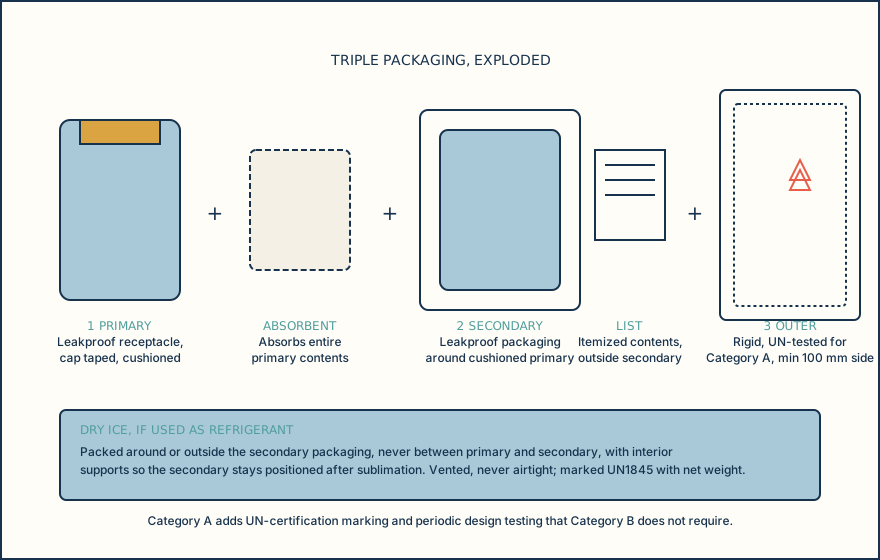
Both Category A and Category B ship in a triple packaging system: a leakproof (or, for solids, siftproof) primary receptacle, a leakproof or siftproof secondary packaging, and a rigid outer packaging. Multiple fragile primary receptacles placed inside one secondary packaging must be individually wrapped or separated so they cannot contact one another; this applies to Category A, Category B, and exempt-specimen packaging alike. For liquid material, absorbent sufficient to absorb the entire contents of all primary receptacles goes between the primary and secondary layers, and an itemized contents list goes between the secondary and outer layers.
Category A packaging carries requirements Category B does not. The outer packaging must meet UN performance-test standards under 49 CFR 178.609 and carry UN-specification certification marking under 178.503(f), with periodic design-qualification testing behind that certification; its smallest external dimension must be at least 100 mm. The primary receptacle or secondary packaging must withstand, without leakage, an internal pressure differential of at least 95 kPa (14 psi) and temperatures from -40C to +55C. Category B packaging is also triple packaging, but it does not require UN-specification certification marking or the periodic design testing 178.601 imposes on Category A packaging.
Category B carries its own quantity ceiling for air shipment: each primary receptacle is limited to 1 L for liquid material, and the outer package to 4 L total, excluding refrigerant; the primary or secondary layer must still withstand a 95 kPa pressure differential. Solid Category B specimens use siftproof primary and secondary packaging instead of leakproof. Every completed Category B package must pass a 1.2 m (3.9 ft) drop test in any orientation without leakage from the primary receptacle, and at least one outer-package surface must measure 100 mm by 100 mm or larger.
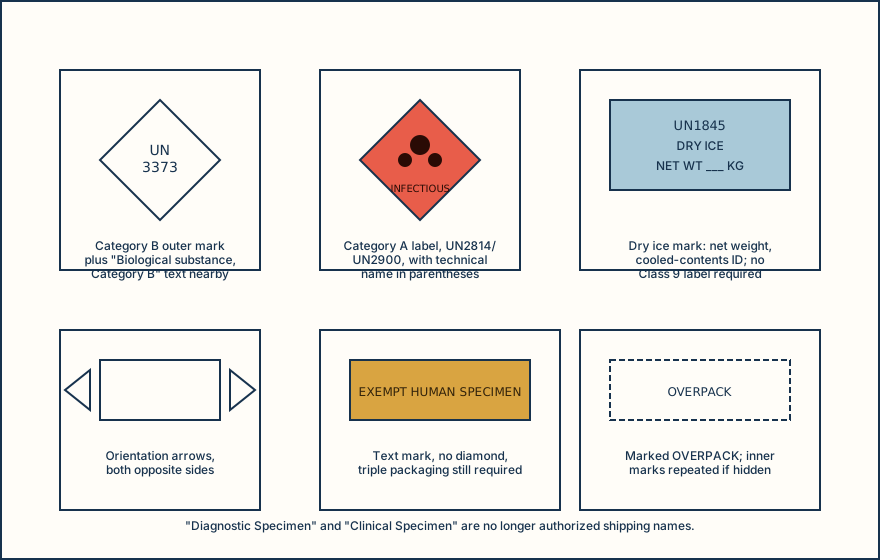
Dry ice refrigerant is packed around or outside the secondary packaging, never between the primary and secondary layers, with interior supports so the secondary packaging stays positioned as the dry ice sublimates. The package must vent carbon dioxide gas; an airtight sealed container is never permitted because pressure buildup can rupture the box. For air shipment of more than 2.5 kg of dry ice per package, the box shows the net mass of dry ice, "UN1845," and an identification of the material being refrigerated. At 2.5 kg or less, a small-quantity exception applies: the package must still vent, and must be marked "Dry ice" or "Carbon dioxide, solid," identify the cooled contents, and state the net weight, without requiring the UN1845 marking under that specific exception.
The Category B outer package bears the UN3373 diamond mark, contrasting background, border at least 2 mm wide, diamond sides at least 50 mm, characters at least 6 mm high, with "Biological substance, Category B" marked adjacent to it. "Diagnostic Specimen" and "Clinical Specimen" are no longer authorized proper shipping names on any package. The name and telephone number of a person knowledgeable about the material and able to act in an emergency must appear on the package or on an accompanying document such as the air waybill. An overpack containing one or more fully marked packages must itself be marked "OVERPACK" and reproduce the required inner markings on its exterior if they are not otherwise visible.
Illustrative drawing — this picture was drawn rather than captured.
Illustrative drawing — this picture was drawn rather than captured.
| Requirement | Category A (UN2814/UN2900) | Category B (UN3373) |
|---|---|---|
| Outer packaging certification | UN-specification tested (178.609), periodic design testing under 178.601 | No UN certification marking or periodic design testing required |
| Pressure/temperature test | Primary or secondary withstands 95 kPa and -40C to +55C | Primary or secondary withstands 95 kPa (aircraft, liquid) |
| Air quantity limit | No specific liquid ceiling in this packaging system | 1 L per primary receptacle, 4 L per outer package (liquid, air) |
| Drop test | Governed by 178.609 performance testing | 1.2 m (3.9 ft) drop, any orientation, no leakage |
| Minimum outer dimension | At least 100 mm smallest external dimension | At least one surface 100 mm x 100 mm or larger |
| Air documentation | Shipper's declaration and DG documentation required | No shipper's declaration required for a compliant shipment |
Knowledge checks
Reading and checks are open. Sign in only to save.
Knowledge check 1
Knowledge check 2
Section status
Finish this section
Reading and checks are open. Sign in only to save.
The module finishes after every required section is marked done and every check in those sections is correct.